
Particulate Matter (PM₁ – PM₂.₅ – PM₁₀)
Can be measured with:
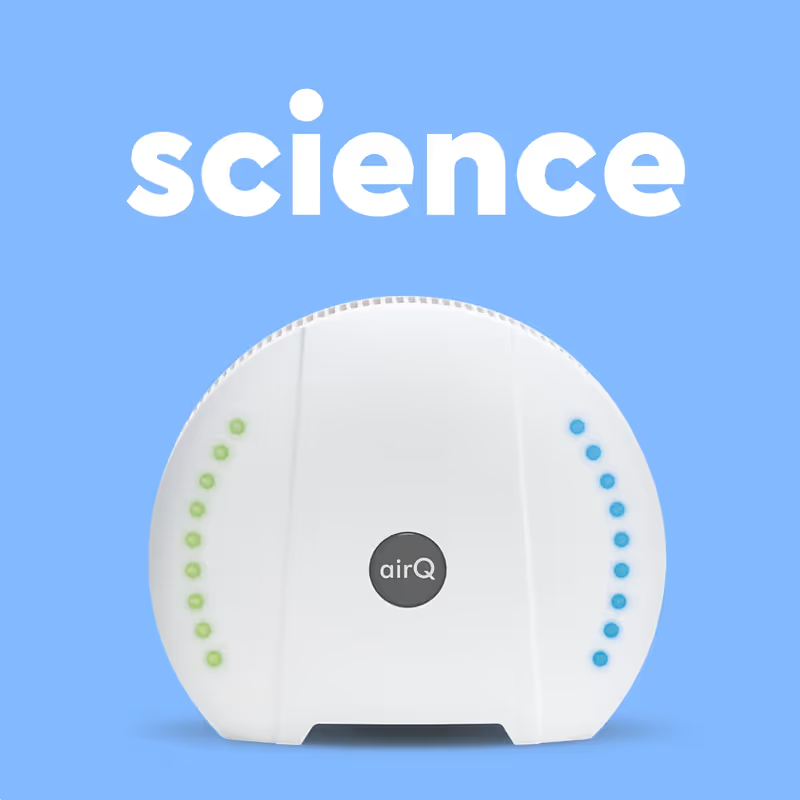
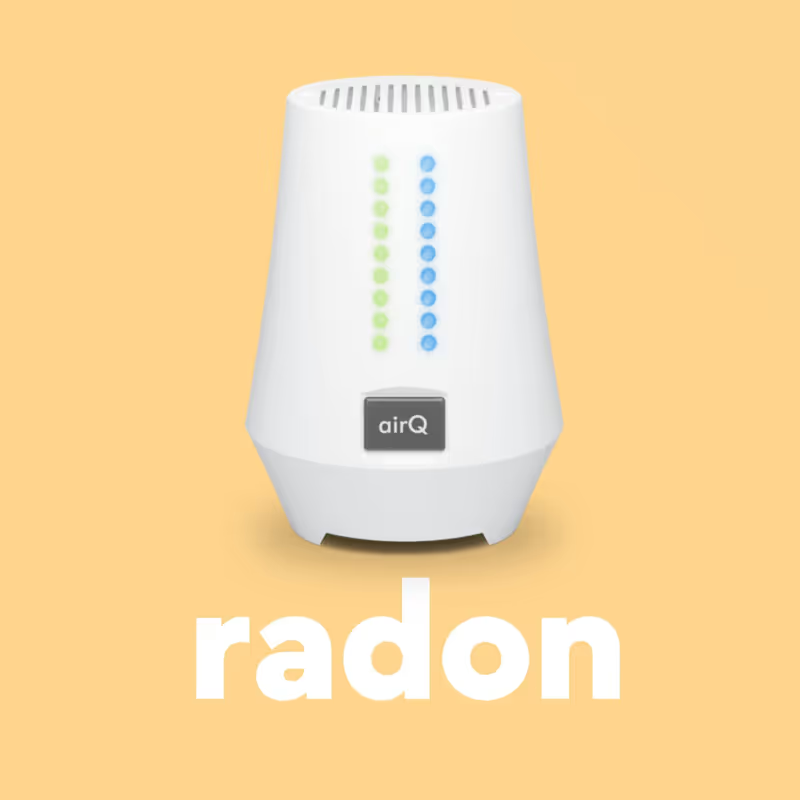
✓ measurable with air‑Q basic, air‑Q pro, air‑Q science and air‑Q radon science.
air-Qs with a sensor for Particulate Matter
Description:
The term "dust" describes a complex physico-chemical mixture of airborne, liquid or solid particles. These are also referred to as PM (particulate matter) and, in German, generally as particles.
Particles with a very small diameter that can reach as far as the bronchi are referred to as "particulate matter" or even ultrafine particulate matter. There are very large differences in composition between different types of particulate matter. Particulate matter can contain both organic and inorganic material.
Different particle sizes, which can be measured by the air-Q air analyzer for example, are referred to as PM₁₀, PM₂.₅ or PM₁.
Particulate matter has a high absorption potential for gaseous trace substances. As a result, pollutants with comparatively high boiling points (e.g. pesticides and plasticizers) accumulate very easily on particulate matter and increase the health risk from breathing air contaminated with particulate matter.
Limit values for PM₁, PM₂.₅ and PM₁₀:
Since the harmfulness of particulate matter depends on the size of the particles, various limit values have also been established. In general: the smaller the particulate matter particles, the deeper they can penetrate into the lungs and bloodstream. This increases their danger to humans.
For particulate matter PM₁₀ (whose particles are smaller than 10 µm), the German Federal Environment Agency (UBA) sets a daily limit value of 50 μg/m³ and an annual average value of 40 μg/m³ for outdoor air. The daily limit value may only be exceeded on 35 days per year.
Particulate matter with smaller particles can penetrate even deeper into the respiratory tract. That is why, since 2015, the annual limit value of 25 μg/m³ set by the World Health Organization (WHO) for particulate matter PM₂.₅ (particles with a diameter under 2.5 μm) in outdoor air has also been applied as an assessment value indoors.
So far there are no standardized measurement methods for even smaller particulate matter particles of the PM₁ category, so there is still no statutory limit value for these especially dangerous particles – dangerous because they reach the alveoli 100% of the time. Particles this small are also referred to as ultrafine particulate matter.
| Designation | PM 1 | PM 2.5 | PM 10 |
| UBA daily limit value | - | 25 µg/m³ | - |
| UBA daily limit value | - | - | 50 µg/m³ |
| UBA annual limit value | - | 25 µg/m³ | 40 µg/m³ |
Effects of excessive concentration:
Precisely assessing the health effects of particulate matter is difficult due to its inconsistent composition. However, particulate matter is generally assumed to be harmful to health. Unlike other pollutants, there are no real limit values for particulate matter concentration below which no health effects would be expected – even the smallest amount is considered harmful.
Regardless of the type of particulate matter, the particles irritate the respiratory tract and can cause inflammatory changes there. Depending on composition, pollutants bound in particulate matter can trigger allergic reactions or, as with coal dust for example, destroy the alveoli.
In particular, smaller particles can also reach the bloodstream via the alveoli and thus have a lasting impact on the cardiovascular system. Certain substances can also increase the risk of heart attack (e.g. sulfur-containing particulate matter) or be carcinogenic (e.g. asbestos).
In addition, irritation of the mucous membranes of the eyes, nose and throat can occur. Damage to the central nervous system also cannot be ruled out.
Formation of particulate matter:
Natural emissions (e.g. from soil erosion, oceans, volcanoes, forest and brush fires) as well as biogenic particles (e.g. viruses, fungal and bacterial spores, pollen, house dust mite excretions) are considered particularly common sources of particulate matter. However, human-caused air pollution is without doubt the main cause of particulate matter.
In outdoor air, particulate matter originates mainly from emissions from industrial plants, power plants and road traffic. Livestock farming likewise generates a considerable amount of ammonia, which forms particulate matter in the atmosphere after chemical reactions. Wood-burning in residential areas contributes to particulate matter pollution on cold days.
Through open windows and via shoes and clothing, these pollutants can also get into indoor spaces and thus into indoor air, impairing air quality. Candles, tobacco smoke, open fireplaces as well as cooking and frying also contribute to particulate matter pollution.
In addition, allergens from pets and chemicals from carpets and furniture can cling to particulate matter particles. Particulate matter particles can also enter indoor air through vacuuming and via office equipment such as printers, copiers and computers.
Sensor used:
Particulate matter is measured by means of optical scattering. An infrared LED and a detector are separated by a wall and never "see" each other directly. Only when a particulate matter particle passes through the LED's light does the detector see a flash. The sensor counts these flashes, and depending on how bright they are, it is determined whether it is a large particle (bright, PM₁₀) or a very small particle (dim, PM₁).
The advantage of the sensor used is its particularly good measurement accuracy compared to very expensive particle counters. The disadvantage of the measuring principle is cross-sensitivity to water vapor or fog. These fine water droplets also flash at very high relative humidity (> 90%) and are counted as particulate matter.
Measuring PM₁, PM₂.₅ and PM₁₀:
To get to the bottom of the causes of dangerously high particulate matter concentrations in indoor air, an indoor air measuring device such as the air-Q, which can measure different sizes of particulate matter (PM₁, PM₂.₅ and PM₁₀), is helpful. The air analyzer can be ordered in the online shop.
More measured values / sensors