Assess Virus and Mold Risk with the air-Q Air Quality Indices
With the air-Q air analyzer, all relevant substances in the air we breathe are continuously analyzed and assessed using our own specially developed air quality indices. Official limit values from the WHO, local environmental authorities, and the latest scientific studies are all incorporated. This let us develop the air-Q Health and Performance Index, the Virus-Free Index, and the Mold-Free Index, all continuously output by the air-Q.

The air-Q Air Quality Indices for Health, Performance, Mold and Viruses

air-Q Health Index Based on Current Official Limit Values
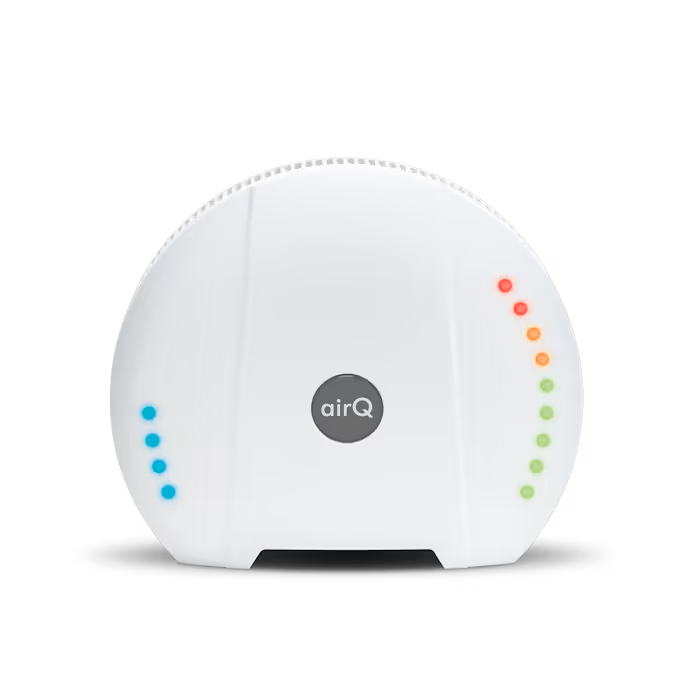
The air-Q assesses the impact of pollutants on physical health based on limit values from the WHO and the German Federal Environment Agency, and calculates the air-Q Health Index™. The air-Q Health Index is a core component of every air-Q and is calculated individually and live based on the sensors integrated in each model — so more sensors go into the index calculation for the air-Q Pro than for the air-Q Light. The air-Q Health Index is preset as a green LED theme on every air-Q. Keep an eye on your health at all times!

air-Q Performance Index Uses Insights from Current Studies
The air-Q Performance Index™ uses current research findings and studies that assess the impact of air quality on physical and mental performance. Key factors influencing the Performance Index include carbon dioxide, particulate matter, but also air temperature and humidity. From these, the air-Q calculates a continuous index that sums all influencing factors and outputs a cumulative Performance Index value. The air-Q Performance Index is preset as a blue LED theme on every air-Q. Keep track of air quality's impact on your physical and mental performance at all times!

air-Q Virus-Free Index
The air-Q Virus-Free Index was specially developed to assess a potential viral load. Carbon dioxide is used as the main indicator of possible aerosol exposure, and thus potential viral load. A high index means low risk from viruses; a low index means increased potential risk from viruses. The Virus-Free Index can be activated in the air-Q app and is output as a single sensor value. This means all display options are available for the Virus-Free Index too: LED themes on the air-Q, acoustic notifications, push/email messages, Smart Widgets, and more.

air-Q Mold-Free Index
The air-Q Mold-Free Index was developed to assess a potential mold risk. The trends of humidity and temperature over a certain period are used as indicators of possible mold burden. A high Mold-Free Index means low risk of mold developing; a low Mold-Free Index value means increased potential mold risk. The Mold-Free Index can be activated in the air-Q app and is output as a single sensor value. All display options are also available for the Mold-Free Index: LED themes on the air-Q, acoustic notifications, push/email messages, Smart Widgets, and more. Besides the continuously calculated air-Q Mold-Free Index, there is also the free Mold Risk Calculator to try out.
Incorporating Official Recommendations and Limit Values
The air-Q gives tips based on official limit values and recommendations. Guidelines from the Federal Environment Agency and the WHO are used and continuously applied for calculating the air-Q Health Index.


air-Q Health Index™ for Air Quality
Air quality directly affects our health. In the short term, dust and dry air can promote colds. Nitrogen oxides / nitrogen dioxide and ozone can also cause respiratory irritation and weaken the respiratory tract’s defense mechanisms, even with brief exposure.
In the long term, particulate matter, nitrogen oxides, sulfur oxides, ozone, formaldehyde and certain organic compounds (VOC gases) are of health concern and should therefore be continuously monitored — ideally around the clock — or avoided where possible.
The air-Q air analyzer accounts for all hazards posed by these substances and calculates the air-Q Health Index™ based on official limit values, regulatory recommendations (e.g. from the Federal Environment Agency or the WHO), and scientific studies. The air-Q Health Index is calculated from the "worst" reading among all measured values at a given point in time. For example, if elevated particulate matter leads to a 20% deduction and a high nitrogen dioxide value causes a 30% health deduction, the Health Index is calculated as follows: 100% – 30% (nitrogen dioxide value) = 70%. You can see exactly which value is driving your index score in the air-Q app.
The air-Q Health Advisor finally makes a highly specific analysis of causes possible using artificial intelligence. air-Q’s system gives individual tips for improving air quality that also benefit the user’s health.
Learn more here on our website about the significant influence of polluted air, air pollutants, and air quality on our health, our lives, and our wellbeing.
The air-Q Health Index in Live Operation
The air-Q Health Index is preset as a green LED theme and shows the impact of air quality on your health live.
air-Q Performance Index™ for Air Quality
Besides health, air quality also affects wellbeing and performance. After a very short time, the concentration of carbon dioxide in an enclosed room can reach a level that measurably and demonstrably impacts a person’s ability to concentrate. After one to two hours in a typical office, carbon dioxide levels are often measured that increase error rates and limit complex thinking ability.
There’s also concrete evidence of a direct relationship between particulate matter concentrations on one hand and performance on the other. Temperature and humidity also have a lasting effect on thinking ability. And a lack of oxygen also negatively affects an individual’s health and performance. Poor indoor air can quickly lead to productivity losses of 30% to 50%. This matters not only in the office, but also when working from home or generally at home — because mistakes happen due to reduced performance, leading to additional stress and possibly dissatisfaction and irritability.
The air-Q air analyzer, a device for measuring the quality of the air we breathe and indoor air, captures all factors that affect wellbeing and performance, and calculates the air-Q Performance Index™ for the air we breathe, taking scientific studies and research into account.
The air-Q Performance Index calculation is based on a cumulative method grounded in current performance studies that have analyzed performance losses from specific stresses on the air we breathe. For example, if a high carbon dioxide level in the air leads to a 20% performance deduction and a high temperature causes a 10% deduction, the Performance Index is calculated as follows: 100% – 20% (CO₂ deduction) – 10% (temperature deduction) = 70%
The air-Q Performance Index in Live Operation
The air-Q Performance Index is preset as a blue LED theme and shows the impact of air quality on your performance live.