Light / Illuminance (lx)
Can be measured with:
✓ als Zusatzsensor verwendbar mit air-Q Science
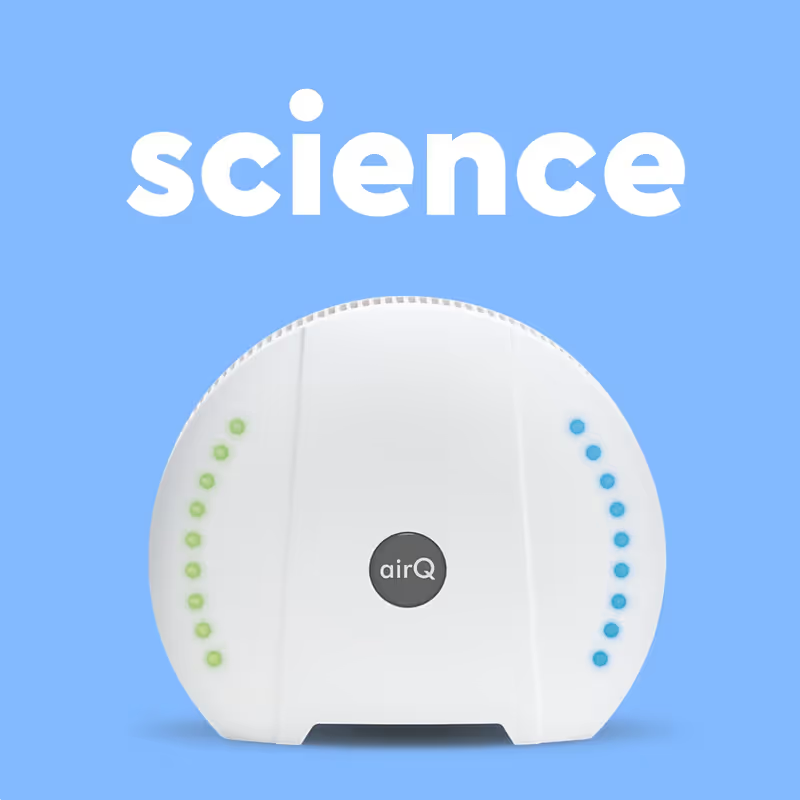
air-Qs with a sensor for Light / Illuminance
Description of light / illumination:
Light allows people to perceive their surroundings with their eyes. However, too much or too little light distorts our sensory impression. This applies to both daylight and artificial lighting. Above all, the intensity and wavelength of the light are decisive for its tolerability.
Various regulations govern how bright artificial light sources should be and at which wavelengths they should emit. For example, the safety lighting of escape routes must have an intensity of at least 1 lux.
For comparison: That is roughly the same amount of light still emitted by a candle at a distance of about 1 meter. Typical living-room lighting, by contrast, is around 100-300 lx, and that of a modern operating room is 160,000 lx.
The human eye perceives radiation in the wavelength range of approximately 380 – 780 nanometers (nm). It works most easily in daylight with wavelengths around 555 nm. The brightness range in which it can perceive contrast lies between 10−4 cd/m2 and 104 cd/m².
These values result in the optimal illuminance for workplaces: on average, it should be at least 500 lx.
Limit values for lighting:
In Germany, recommendations apply to workplaces regarding the type and direction of light and the associated protection of the eyes against fatigue.
In its publication "Technical Rules for Workplaces", the Federal Institute for Occupational Safety and Health (BAuA) presented the following minimum values in May 2023 with regard to "lighting and visual contact":
| Activity area / room use | Minimum illuminance E (lx) |
| Fine work, e.g. grinding of decorations, color inspection, assembly work | 1000 lx |
| Writing, reading, data processing | 500 lx |
| Archives | 200 lx |
| Break rooms, waiting rooms, changing rooms | 200 lx |
Effects of too much or too little light:
Unfavorable lighting conditions can lead to concentration problems, headaches and eye strain, and even faulty perception and reaction. In poorly lit environments, people often also adopt an unfavorable posture in order to minimize visual deficits as much as possible. In the long term, this can lead to strain injuries and damage, and thus to higher rates of sick leave.
To protect against the short- and long-term effects of inadequate lighting, it is recommended to monitor the correct light intensity.
Formation of light
Light is produced by the conversion of chemical energy during combustion or fusion processes, or by the discharge of electrical energy. It can also be released through the conversion of electrical energy. Both processes occur in nature (fire, lightning, the sun) as well as being generated by humans (incandescent bulbs, LEDs).
Sensor used:
The light sensor measures light intensity by detecting the brightness of incoming light and converting it into a digital signal. It only takes into account the light spectrum visible to the human eye and ignores infrared and ultraviolet radiation.
Measuring light:
Measure light as well as pollutants in the indoor air of your office or home in real time - with the air-Q air analyzer, which can be ordered here .
More measured values / sensors