
Ozone (O₃)
Can be measured with:
✓ messbar mit air‑Q pro sowie air‑Q science
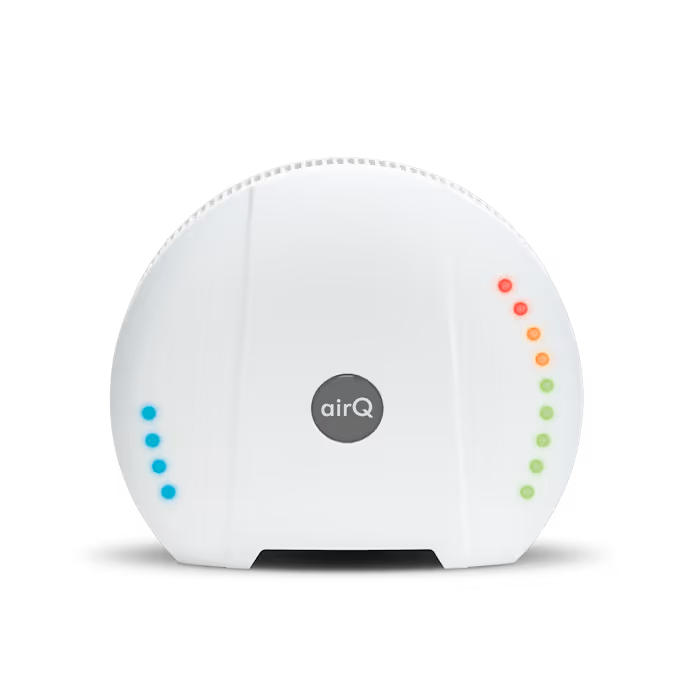
air-Qs with a sensor for Ozone


Description:
Ozone (O₃) is a colorless to slightly blue gas with a pungent, sharp to chlorine-like odor. The odor threshold for human perception of the gas is 40 µg/m³.
It is one of the most important trace gases in the atmosphere and, at an altitude of 20 to 30 kilometers, forms the natural ozone layer, which protects against the sun's harmful ultraviolet radiation.
Ozone is an unstable molecule that decays into dimeric oxygen within a short time. In addition, O₃ is highly reactive (oxidizing) and toxic to humans. It is combustion-supporting and can form ignitable and explosive mixtures. Ozone is heavier than air.
Limit Values for Ozone:
Because of its tendency to decay within a short time under normal conditions, the concentration of ozone in the air should be close to zero and therefore not measurable.
The EU has established various 1-hour values for O₃, which describe the concentration whose effect unfolds within one hour. An information threshold of 90 ppb (parts per billion), or 180 µg/m³, was set. If this is exceeded, the public must be notified. In addition, an alert threshold of 120 ppb (240 µg/m³) was set, upon reaching which an ozone warning must be issued.
According to the Federal Environment Agency, the daily maximum 8-hour value of 120 µg/m³ (60 ppb) may be exceeded on no more than 25 days per calendar year. In the long term, however, this value should not be exceeded on any day at all.
The former limit value (MAK value) of 100 ppb (200 µg/m³) was replaced by the workplace exposure limit (AGW). Since no AGW has yet been established for ozone, the previous MAK value serves as a non-binding guideline. International workplace limit values are even lower, at just 60 ppb (120 µg/m³).
| Designation | Ozone limit values |
| Federal Environment Agency (UBA) maximum 8h value | 120 µg/m³ |
| Federal Environment Agency (UBA) information threshold (1h average value) | 180 µg/m³ |
| Federal Environment Agency (UBA) alarm threshold (1h average value) | 240 µg/m³ |
Effects of Excessive Concentration:
Ozone is absorbed through breathing as well as through the eyes. Due to its strongly oxidizing properties, exposure to O₃ can cause irritation and even lasting damage to the eyes and mucous membranes. Symptoms include hoarseness, coughing, headaches and nausea, as well as nosebleeds and bronchitis.
Because ozone impairs lung function, high concentrations can lead to the formation of pulmonary edema (fluid accumulation in the lungs). Pre-damaged or sensitive individuals, such as those suffering from asthma or chronic bronchitis, are especially susceptible to the harmful effects of ozone. There is also reasonable suspicion that O₃ is carcinogenic to humans.
Performance is also affected by a high O₃ content in the air, as it can cause fatigue and difficulty concentrating.
Formation:
Ozone, among other substances, is formed during lightning discharges in a thunderstorm. It is also formed through the process of photodissociation, in which oxygen molecules in the stratosphere are split into two individual atoms — radicals — under high-energy solar radiation, which then react with an O₂ molecule to form O₃.
The formation of ozone near the ground is the result of a complex reaction between oxygen, nitrogen oxides (NOx), and volatile organic compounds (VOC) under intense sunlight.
The precursor pollutants of this reaction come mainly from human-caused sources such as combustion plants and over-fertilized soils (nitrogen oxides). Volatile organic compounds are produced through the use of solvents (including paints, varnishes, and adhesives) and through fuel combustion. Natural sources of the precursor pollutants include emissions from deciduous and coniferous trees.
Indoors, ozone can be generated by electrical devices such as printers. High voltage and UV radiation are responsible for this.
Sensor Used:
Ozone is measured using an electrochemical sensor. O₃ molecules that "dock" onto the surface of the sensor cause a small current within it. The advantage of our sensor is the manufacturer's individual sensitivity calibration and its especially long service life.
The ozone sensor we use has cross-sensitivities to hydrogen sulfide (H₂S) and nitrogen dioxide (NO₂). It therefore also reacts to NO₂ and shows a reading even when no O₃ is present. It reacts negatively to H₂S. When H₂S increases, the measured O₃ value decreases.
Measuring Ozone:
The air-Q is a versatile air quality measuring device that also functions as an ozone meter and can measure precise ozone values.
Many details about the technology can be found here. You can order the air-Q air analyzer in our online store.
More measured values / sensors