
Volatile Organic Compounds (VOC)
Can be measured with:
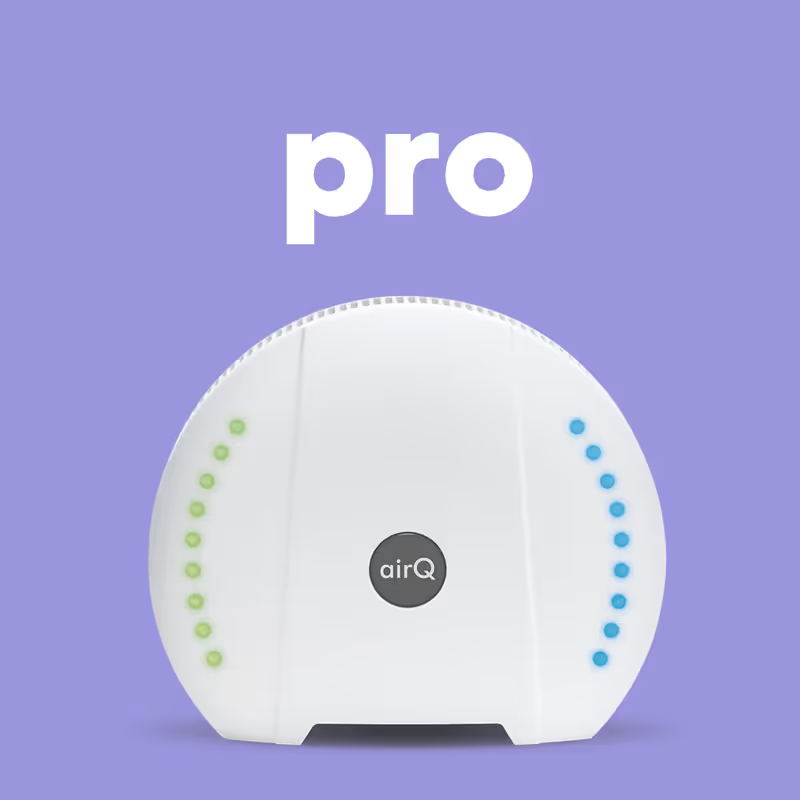
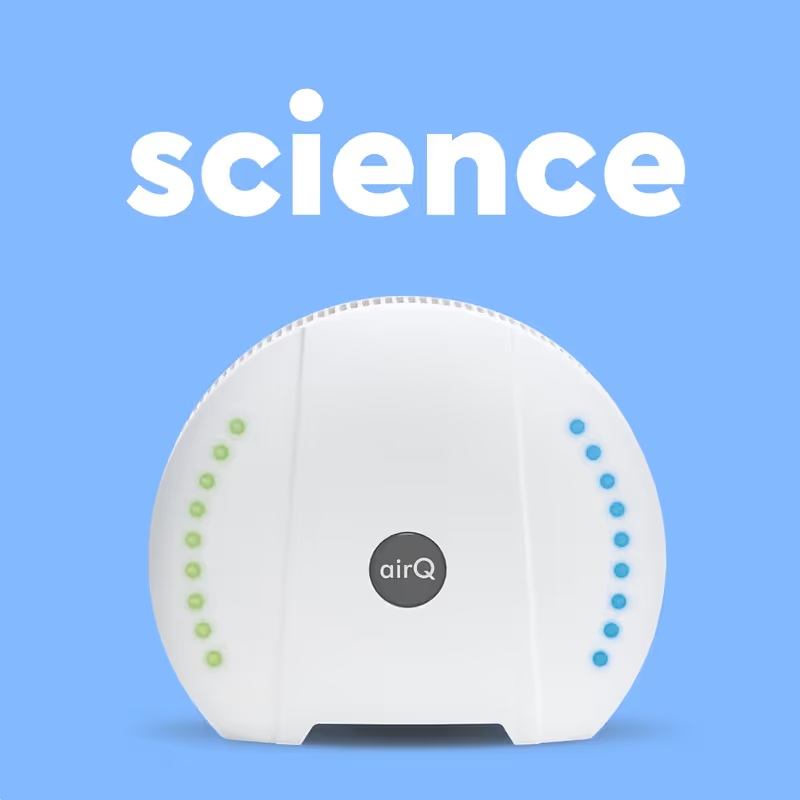
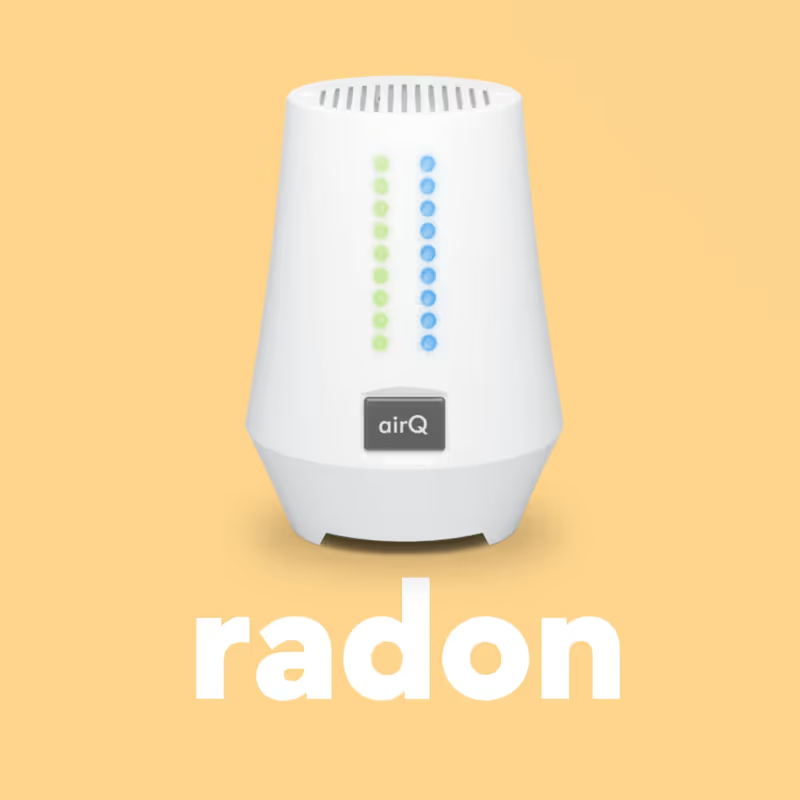
✓ messbar mit air‑Q light, air‑Q basic, air‑Q pro, air‑Q science, air‑Q radon und air‑Q radon science.
air-Qs with a sensor for Volatile Organic Compounds
Description:
The abbreviation VOCs (Volatile Organic Compounds) refers to the group of carbon-containing substances that evaporate at low temperature or already occur in gaseous form at room temperature. These "volatile organic compounds" are further divided into two subgroups. VVOCs (Very Volatile Organic Compounds) describe highly volatile substances that are often strongly odorous. Less volatile organic compounds are referred to as SVOCs (Semivolatile Organic Compounds).
TVOCs (Total Volatile Organic Compounds), i.e. the totality of these substances, have a boiling range between 50 °C and 250 °C. The decay time can range from 10 days up to 3 years.
Among the best-known representatives of VOCs are formaldehyde and solvents such as toluene.
Since these are organic compounds, they can appear in all areas of life and are in most cases harmless to living organisms. However, an elevated concentration indoors can significantly reduce well-being.
Limit Values for VOCs:
In Germany, a legal determination of limit values has so far only been made for workplaces with particularly high production-related exposure. For hygienic reasons, however, the Federal Environment Agency has now issued recommendations for the presence of VOCs. The guide values comprise several levels, from hygienically unobjectionable (below 1 mg/m³ – below 150 ppb) through hygienically noticeable (between 1 and 3 mg/m³ – 150 to 1300 ppb) and hygienically concerning (between 3 and 10 mg/m³ – 1300 to 4000 ppb) up to hygienically unacceptable (above 10 mg/m³ – above 1500 to 4000 ppb). In addition, guide values have been set for individual gases within the VOC group.
Many legally relevant sources give mg/m³ as the unit. However, what is measured is a mixture of many substances with different molecular masses, whose volume fraction in the air is given in ppb (parts per billion) or ppm (parts per million). This discrepancy results in ranges when converting between substances with low and high molecular weights.
| Designation | VOC Limit Values |
| Federal Environment Agency - hygienically unobjectionable | <1 mg/m³ – below 150 to 400 ppb (parts per billion) |
| Federal Environment Agency - hygienically noticeable | 1 to 3 mg/m³ – 400 to 1300 ppb |
| Federal Environment Agency - hygienically concerning | 3 to 10 mg/m³ – 1300 to 4000 ppb |
| Federal Environment Agency - hygienically unacceptable | >10 mg/m³ – above 4000 ppb |
Effects of Excessive Concentration:
An elevated concentration of VOCs can initially manifest as altered smell and taste perception, or irritation of the eyes or mucous membranes. Other noticeable effects include reduced concentration, exhaustion, dry skin up to eczema, or headaches. These symptoms are also referred to as Sick Building Syndrome and describe acute exposure. The higher the concentration of VOCs in indoor air, the stronger the effect on odor perception and mucous membrane irritation.
The toxicity of individual substances varies greatly. Nevertheless, scientists fear chronic long-term effects from continuous exposure. These include carcinogenic, mutagenic, and reproduction-inhibiting effects.
Physicians also see a connection between VOCs and the increase in allergic reactions, especially in infants and young children.
A detailed scientific investigation for many VOCs is still pending.

Formation:
The formation of VOCs is distinguished between biogenic (i.e. natural) and anthropogenic (i.e. human-made) sources. Natural causes include, besides the release of organic substances through the metabolism of all living organisms, putrefaction and other biological decay processes. Reactions of natural materials, such as wood or oils, also contribute to the buildup of VOCs in the air we breathe.
Synthetic sources of VOCs include the emissions from numerous building materials (varnishes, paints, carpets, insulation materials, etc.) as well as the use of solvent or cleaning products or cosmetic items. Combustion processes from, for example, tobacco smoke, fireplaces and stoves, or cooking can also contribute to the buildup of VOCs indoors.
VOC Sensor: Precise Measurement with air-Q
A VOC sensor is an indispensable tool for monitoring indoor air quality, as it detects volatile organic compounds (VOCs) that can be released from everyday materials and products. These compounds have the potential to harm health and degrade indoor air quality. This is where air-Q's state-of-the-art devices come in.
Our air-Q devices are specifically designed to measure VOCs with the highest precision. Through the use of advanced sensor technology, they provide detailed insights into air composition and help you identify potential hazards early. The air-Q VOC sensors not only deliver accurate measurement data but are also equipped with a user-friendly app that lets you monitor and analyze air quality at any time.
Trust air-Q to ensure that your indoor air is clean and safe. Our VOC sensors are the ideal choice for anyone who wants to protect their health and ensure an optimal indoor climate. Experience the combination of innovation and reliability with air-Q — your first choice for measuring VOCs.
Sensor Used:
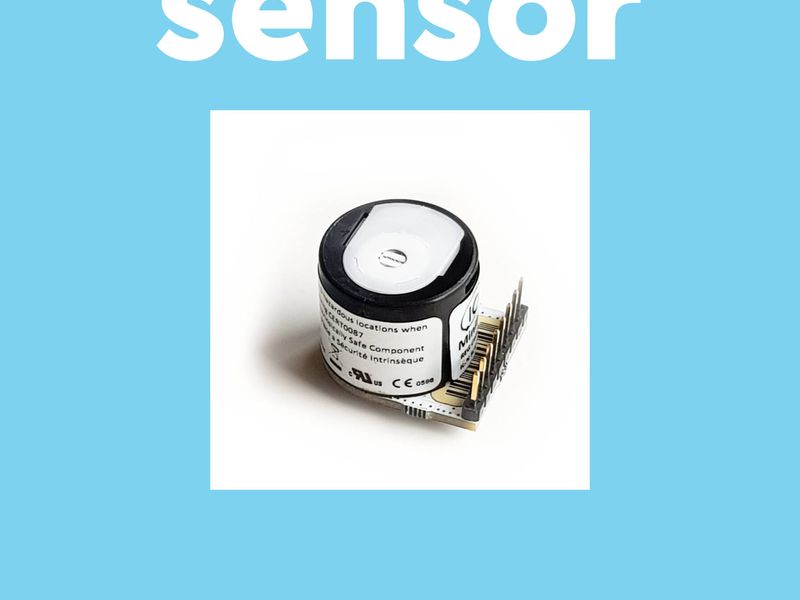
Volatile organic substances are measured using a resistive sensor. Molecules that "dock" onto the sensor's surface cause a change in the sensor's electrical resistance. The advantage of our sensor is the manufacturer's individual sensitivity calibration and its very low cross-sensitivity to temperature and humidity.
Cross-sensitivities are the (desired) main feature of this measurement principle. The VOC sensor is calibrated to alcohol (ethanol), but also reacts to aldehydes, ketones, hydrogen, methane, and others — an all-rounder, in other words.
Using a special additional VOC PID sensor, even better measurement results are possible. This very high-quality sensor uses a different, ionization-based measurement method. The current generated this way can be measured.
Measuring VOC:
As a particularly powerful and comprehensive indoor air quality measuring device, the air-Q air analyzer is also equipped with a sensor that can measure VOCs, or volatile organic compounds.
You can find plenty of information about the device's technology here. The air-Q can be ordered from the air-Q shop.
More measured values / sensors