
Wood as a Building Material – Does It Ensure Healthy Air, or Not?
Wood has been used as a building material for thousands of years and is considered especially eco-friendly due to the fact that it's a renewable resource. But what effect does wood have on air quality?

Wood is considered a very eco-friendly building material, since even after being felled it can still store CO₂ and bind it for 40 to 100 years – as long as it doesn't rot or get burned. When using domestic wood, both transport distances and the energy required for supply and processing are lower than, for example, for tropical wood or the production of other building materials, giving it a much better environmental footprint. If forests are intact and sustainably managed, wood is accordingly also sustainable as an energy source and building material — however, burning wood without appropriate filtering produces particulate matter and leads to poor air quality.
Advantages of wood as a building material
The advantage of wood construction is that the material is strongly insulating and heat-retaining, even at only a small wall thickness, which also makes it very well suited for energy-optimized buildings. The material also has low weight but high load-bearing capacity as well as high compressive and tensile strength. It's essential that the material is dry before being installed, since it then usually doesn't need further chemical treatment when used indoors. On the other hand, for example, freshly processed wood without adequate ventilation can suffer mold infestation within a short time.
Wooden floors can also be helpful for regulating humidity and the indoor climate – as long as they aren't sealed with varnish but only treated with wax or oil. At a relative humidity above 30 percent, it partially absorbs this moisture; when humidity drops, it releases the moisture back into the room. Untreated wood can thus help create a pleasant indoor climate.
Wood releases VOCs into the air – harmful, harmless, or even healthy?
Over time, untreated wood can emit VOCs, i.e. various chemicals, into indoor air, which are responsible for, for example, the typical wood smell.
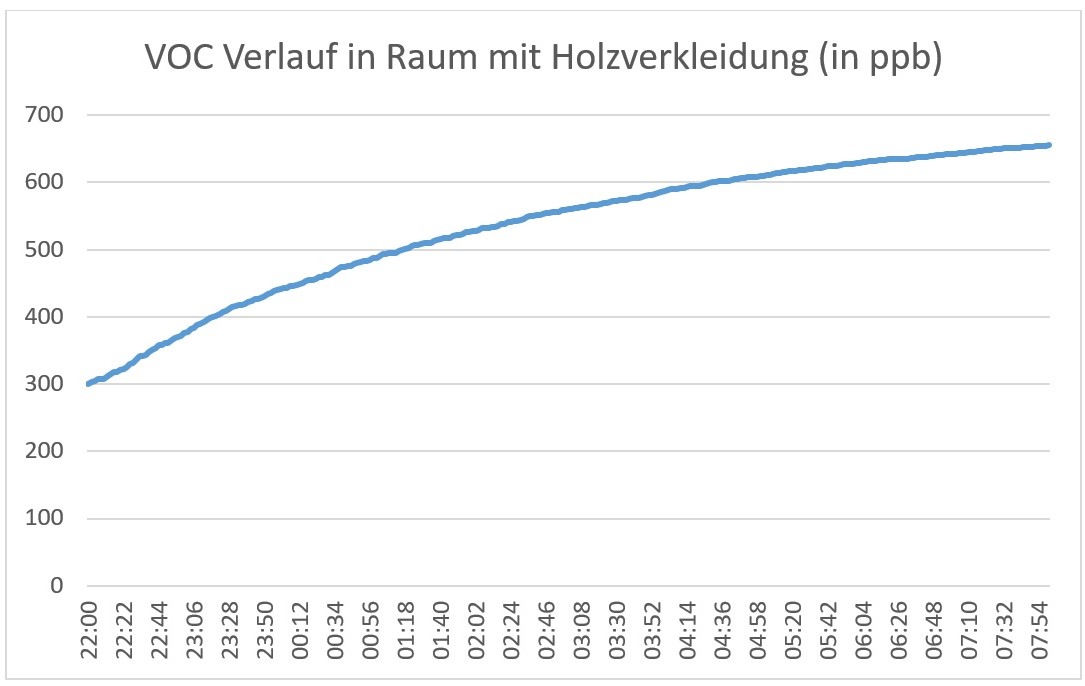
The gaseous substances released by wood are mainly monoterpenes (e.g. α- and ß-pinene), aldehydes (pentanal and hexanal), and acetic acid. However, the concentration of VOCs in the air that can arise from wooden furnishings can be significant, as the chart shows. Due to this VOC exposure from indoor air caused by both building materials and wooden furnishings, the question arises of a possible hazard potential from the VOCs released into the air by wood.
However, the all-clear can be given. Scientists at the Fraunhofer Institute for Wood Research in Braunschweig, together with the Institute for Environmental Medicine and Hospital Hygiene at the University of Freiburg, exposed volunteer test subjects to significantly elevated wood VOC concentrations in a large test chamber across various trial series, to test the hypothesis of potential harm. Freshly dried pine wood and freshly manufactured pine oriented strand board were used for the experiment, since these are known to be strongly VOC-laden. In ten long-term trial series with up to 25 people each, no health-harming effects whatsoever could be detected, neither in health parameters nor in subjective well-being complaints. In further studies, human lung cell cultures were exposed to significantly elevated VOC concentrations, in which likewise no health-impairing effects could be detected.
Treated wood can release formaldehyde into the air
The scientists' findings apply exclusively to untreated wood. If the wood is treated with artificial wood preservatives like varnishes or paints, or if certain adhesives were used – e.g. in particleboard, furniture, and other engineered wood products – solvents like formaldehyde and other chemicals can off-gas over a longer period and be released into indoor air.
Whether the VOCs and other gases that wood releases into indoor air are healthy or even health-promoting cannot yet be conclusively proven. However, based on current knowledge, there is no health-harming risk posed by wooden furniture, wooden floors, and other wooden furnishings, provided they were processed properly and without the use of health-harming chemicals. Wood can therefore very well be healthy, since it helps regulate and stabilize the indoor climate — temperature and humidity.