
VOC Sources in the Household
It's not always easy to fully grasp everything covered by the term VOCs. This is because many different substances fall under this broad umbrella term, which trace back to a wide range of sources. So what can VOC sources in the household be?
Many different substances are grouped together under VOCs (Volatile Organic Compounds) – see our blog article about VOCs or our wiki about VOCs.
At low concentrations, VOCs are usually completely odorless and therefore not perceptible, but depending on the type and source, they can already be harmful to health. However, volatile organic substances can be measured: VOCs are often measured using a resistive sensor – as is the case in the air-Q. Molecules that reach the sensor's surface cause a change in the sensor's electrical resistance, which is converted into a reading. Cross-sensitivities are an unavoidable (and in this case desired) feature of this measurement principle. The high-quality VOC sensor in the air-Q is calibrated to alcohol (ethanol) and also responds to other VOCs such as aldehydes, ketone, toluene, benzene, acetone as well as hydrogen and methane and others.
Porous surfaces in particular can release VOCs more easily and likewise absorb them from other materials. Due to their volatile nature, VOCs are very unstable, meaning that the circumstances under which emissions are released and how high they are can fluctuate greatly. Due to differing ventilation conditions and potential artificial sources, VOCs indoors are often more harmful than outdoors.
Interpreting an elevated VOC reading requires a bit of skill and knowledge of sources of volatile organic compounds. Below, we look at possible VOC sources in the household to give an overview. In almost every room, there are usually some materials, furnishings, or devices that contain VOCs.
Paints & varnishes
Paint fumes are probably one of the best-known VOCs and arise during mixing as well as during drying. Certain compounds are used in paints and varnishes, both to keep them liquid before use and to ensure a faster drying process after they've been applied.
Paints, varnishes, paint strippers, and sealants contain a large amount of chemicals, many of which can be toxic if a person is exposed to them over a longer period. For example, some compounds in paints that are now banned can still pose a risk, since toluene, benzene, or acetone can still off-gas even after years. Many VOCs in paints, paint thinners, and varnishes give off an odor perceived as unpleasant, which indicates that off-gassing is being emitted more heavily. Nevertheless, it should be kept in mind that the absence of such an odor doesn't mean that VOCs are no longer being released.
To reduce exposure to VOCs from paint, adequate ventilation of the rooms should of course be ensured during and after painting. In addition, wearing protective equipment for the eyes, mouth, and hands can help minimize inhalation and surface contact. Newer products also make it easier to reduce VOCs, since some brands now have a lower VOC content. Nevertheless, even low-VOC or VOC-free paints aren't necessarily completely free of these compounds.
Flooring
While materials like paint tend to release VOCs mostly at the beginning of application, with flooring it's mainly long-term use that's problematic. In particular, floors made of vinyl, carpet, wood, and engineered wood products can continue to emit VOCs for years after installation. Formaldehyde is one of the most common VOCs used in flooring, as it's frequently a component of the material, especially in vinyl, laminate, or treated hardwood. It's also used in the sealant that protects the floor from wear damage.
How frequently the flooring is used or worn can be a decisive factor in when and how much is emitted from it. Due to regular contact with people and the resulting wear, the release of VOCs also increases over time due to surface wear. Adhesives used to seal the material to the subfloor also play a role, since these can likewise contain VOCs.
Furniture
As with flooring, VOCs in furniture can arise during the manufacturing process or during treatment after construction. Furniture pieces made of plywood or particleboard in particular contain higher amounts of formaldehyde and toluene. Upholstered furniture is often made from polyurethane foam, which is associated with VOCs as well as SVOCs (Semivolatile Organic Compounds). Surface coatings on many upholstered furniture pieces or mattresses – e.g. to prevent stains or make them flame-resistant – usually also contain VOCs. Office furniture also off-gasses, especially components made of plastic. In office spaces, additional VOCs are also produced by printers and copiers.
To reduce VOC emissions, it can help to choose, for example, furniture made of solid wood (not particleboard). Buying used furniture can also help, since off-gassing from furniture decreases over time. Some mattresses tend to contain more toluene, which is why they need some time to off-gas before use. This is especially important for beds for babies, children, older people, and people who suffer from chronic respiratory problems or other illnesses.
Cleaning and disinfecting products
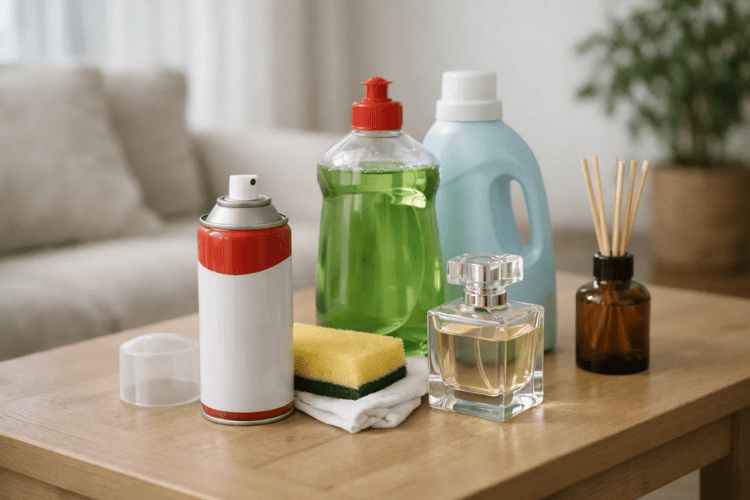
You also frequently come into contact with VOCs when using cleaning and disinfecting products. For example, bleach, ammonia, and other solvents produce strong-smelling VOCs. Many cleaning products contain VOCs like isopropanol or acetone. Some cleaners have fragrances added to mask the smell of the chemical fumes. However, these fragrances are also VOCs.
Using cleaning products with a lower VOC content is one of the easiest ways to reduce VOC emissions. However, some studies have shown that it can be harder to eliminate the buildup of VOCs in the materials being cleaned when using fragrance-free cleaning products. So finding the right approach is a balancing act. In addition, aggressive chemicals shouldn't be used without open windows or doors, or without running ventilation.
Dry cleaning
Dry cleaning of clothing, upholstery, or other textiles is usually done using perchlorethylene (PER) – a substance that releases VOCs and is harmful to the environment and health. Since a small amount of the cleaning agent usually remains in the textiles, these can also continue to emit VOCs.
Some dry cleaners now offer an alternative method – now also awarded the Blue Angel eco-label – and clean using carbon dioxide as the cleaning agent.
Personal care products
Many personal care products contain paraffin, which is derived from petroleum and contains VOCs. This can increase the likelihood of health effects. Products in which VOCs are commonly used include nail polish, nail polish remover, creams and lotions, deodorants, shampoos, or perfumes. Due to their intended use, these personal care products often contain strong fragrances to mask unpleasant odors. However, a pleasant scent — or even no scent at all — by no means means a product is free of VOCs.
Using products with a lower VOC content is one of the easiest ways to reduce VOC emissions. Natural products tend to contain fewer, or more harmless, VOCs.
Plastics
VOC emissions from plastics in the household are relatively high, due to the frequent use of the material and the fact that they very easily release chemicals or VOCs into liquids. Plastics come in many forms, e.g. in toys, kitchen utensils, or technical devices. Many plastics in the household are made from polyvinyl chloride (PVC), which can release so-called phthalates, used mainly as plasticizers for plastics. Food and water are often stored in plastic containers, which over time can release VOCs into the food or water. Filling plastic containers with hot contents, using a microwave, or using a dishwasher can further increase VOC emissions into the air.
Craft supplies
Leisure and hobby products can frequently also contain VOCs and release them over time; these include adhesives (especially spray adhesives), modeling clay, as well as the paints, varnishes, coatings, and treated wood products already mentioned above. Some materials emit VOCs during their curing process and then release fewer or none once they're fully dry.
As with other materials, the length of time you're exposed to VOCs matters. This is especially important to watch for with small children in hobby activities.
Natural VOC sources
Besides the VOC sources already listed, which are mainly of human origin, there are some VOCs that trace back to biological sources. These include mold, plant oils, soil, animal hair, animal droppings, manure, and decay and decomposition processes, among others.
To reduce an increase in VOCs from organic sources in the household, when cleaning clothing, bedding, and other textiles, care should be taken to wash them at high temperatures, to kill bacteria, mold, mildew, and other residue. To eliminate another VOC source, pet bedding should also be changed regularly and animal hair removed.
In the domestic setting, there are hardly any laws governing the handling of VOCs, since the effect strongly depends on the type of substance and monitoring and controlling it is relatively difficult. While manufacturers can be legally restricted in the amount of pollutants their products are allowed to emit as VOCs over a certain period, households aren't bound by such limits on VOC-emitting materials that they use in a particular room or in their homes in general. Accordingly, it's important to pay attention to which products and materials are bought and used in the household. The Federal Environment Agency's recommendations on VOC limit values should also be noted.