
Noise Poisons the Indoor Climate & Makes You Sick
We modern humans are often exposed to constant noise: from clanging trams to honking cars to radio noise in open-plan offices. With far-reaching health consequences, because we can't switch off our ears. We show how noise affects our body and mind, and which technologies help you track down noise sources.
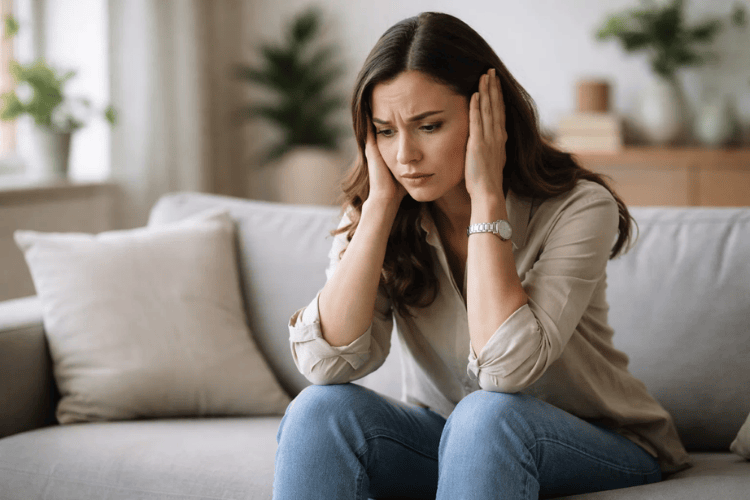
Loud music, a passing airplane, traffic noise or arguing neighbors: one person ignores it, for the next the soundscape is bearable, and yet others feel strongly disturbed. Everyone perceives noise differently. This is because the perception of noise depends both on the situation in which we encounter the sound, and on whether we feel positively towards the "noise source". If we find the source likeable or can even estimate the duration of the noise, we accept it far more calmly.
Since we cannot switch off our ears, however, they are essentially receptive at all times. Around 15,000 hair cells pick up sounds and then send signals to the brain.
How Is Noise Measured?
Whether a quiet whisper or an ear-splitting jackhammer - physically speaking, all sounds consist of sound waves. Tones are produced when an object vibrates. This sets particles in motion in wave form, both in air and in water. Sound events and their intensity are described in the unit decibel (dB), where 1 decibel represents the quietest tone audible to the human ear.
From What Limit Value Are Sounds Perceived as Noise?
When we whisper, a noise level of around 40 decibels is produced. Main roads or even a loud open-plan office, on the other hand, quickly reach a sound level of 80 dB. While sounds up to 65 decibels are generally described as "normally" loud, continuous exposure at a volume of 80–85 dB can cause permanent hearing damage. We are particularly noise-sensitive during sleep. Here, values as low as 25 dB are enough to disturb our sleep. These limit values are assumed by the German Professional Association of ENT Physicians, the Federal Ministry for the Environment, and the World Health Organization (WHO).
The sound pressure and its pitch determine how disruptive the volume is perceived to be. Here, the air pressure fluctuations per second are measured in Hertz. The higher the frequency, the louder the human ear perceives the sound to be. Surprisingly, low as well as very high tones appear less loud than tones of medium frequency. As a result, the ear perceives tones of different frequencies as equally loud at different sound pressure levels. At a value between 120 and 140 decibels, sound waves are perceived as pain.
Note: An overview of noise-related limit values according to the German Federal Immission Control Act is provided by our reading table.
However, the sound scale does not increase constantly, but logarithmically. An increase of just ten decibels is perceived as twice as loud. Even small decibel reductions therefore make a noticeably perceptible contribution to noise reduction.
How Does Noise Affect Physical & Mental Health?
Noise (Lp) affects the entire organism and puts us on high alert. This means stress for the body. This inner state of arousal is a remnant of our ancestors' fight-or-flight readiness. If the noise level rises to 60 decibels or higher, the human body releases the stress hormones cortisol and adrenaline, for example. This increases heart rate and blood pressure. But noise doesn't just change the hormone balance - it also affects metabolism and brain activity. Persistent noise can therefore lead to permanent hearing damage and promote depression. The World Health Organization WHO even ranks noise as the second-greatest environmental hazard to physical and mental health in Europe.
These physical reactions to noise are possible:
- Increased heart rate & associated cardiovascular problems
- Constriction of blood vessels & decrease in skin temperature
- Hearing impairment up to tinnitus
- Muscle tension
- Headaches
- Circulatory problems
- Stomach and intestinal illnesses
- Thyroid disorders
- Elevated blood lipid levels
- Hormonal disturbances
Noise affects not only physical but also mental health, thereby permanently restricting quality of life. Possible effects include:
- Decline in performance & increased error frequency
- Reduced resilience
- Learning difficulties, especially in children
- Nervousness & irritability
- Sleep disturbances
Particularly high sound peaks as well as continuous sound damage human hearing by attacking the so-called hair cells of the inner ear due to noise. The result is lasting impairment of acoustic perception, since these hair cells cannot regrow. Noise can therefore lead to chronic or temporary ringing in the ears, such as tinnitus, or even to loss of hearing.
How Does Noise Affect Our Sleep Quality?
During sleep, we go through two sleep stages: REM ("Rapid Eye Movement") and non-REM phases. While we do not sleep deeply during the REM phase and our eyes move back and forth regularly, we are in deep sleep during the second phase. Over the course of the night, however, the deep sleep phases become shorter and shorter. This means that the phases of light sleep increase. If we are then exposed to an elevated noise level, we wake up significantly faster and more often. Whisper-level sounds of just 30 dB are enough for this. If the noise level even reaches values of 40–45 dB, roughly the strength of a conversation at normal room volume, the body releases more stress hormones. The sleeper cannot come to rest. This also impairs performance during the day. It is therefore worth observing the noise level in the bedroom and getting to the bottom of the causes of poor or restless sleep.
Monitoring & Evaluating Noise Exposure
Independent noise measurements are therefore worthwhile. With these, you get a good impression of the actual noise level in your living environment or at your workplace. Especially through long-term measurements, you can critically question the noise level and your exposure. For this, you can use the air-Q . Thanks to the integrated noise sensor, vibrations are continuously recorded and captured. The incoming noise readings are output every two seconds as a live value and stored as a 2-minute average. Here, the measuring device offers both an overview of the underlying "normal" noise reading, where values are averaged and stored over a period of two minutes, and a noise peak level. This value shows acute, i.e. brief noise events in the historical data, such as a bang - which would not be visible in the average noise level. Using the noise peak level, events are documented that can abruptly interrupt rest periods and thus cause stress and sleep problems. This way you check both short-term sound levels and longer-term continuous exposure. In the air-Q app you can view the analyses in detail.
The air-Q meets all modern data protection standards: using an air-Q does not create any audio recordings, unlike various smartphone apps for noise measurement. This is because the device measures sound pressure only.
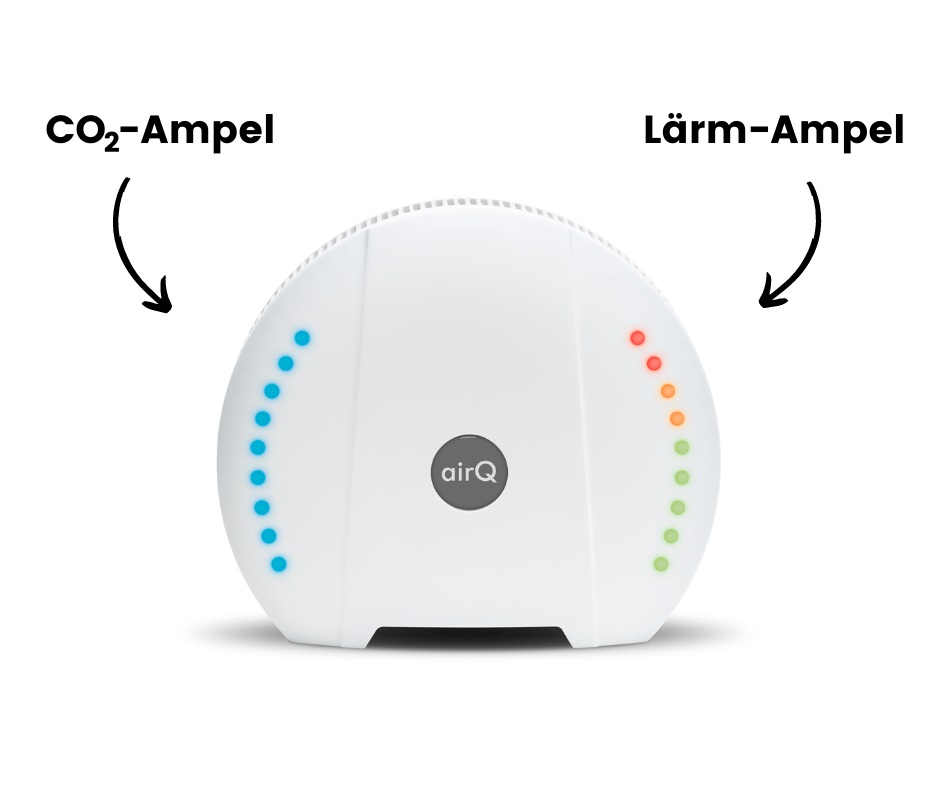
Equip Your air-Q with the Noise Peak Level via an Update
Do you own an air-Q and want to benefit from the new noise peak level? Then all you need is a software update to extend the already integrated noise sensor with the new feature. The noise peak level will then be automatically added as a new sensor in the air-Q app. We provide the update free of charge for all devices.