
"Laser Printers and Copiers Should Be Mandatorily Placed in Separate Rooms"
Laser printers and copiers are an often underestimated factor for healthy indoor air in the office – they emit fine dust, nanoparticles and pollutants. In an interview with Heike Krüger from the nano-Control Foundation, we discuss health risks, awareness-raising and a current campaign.
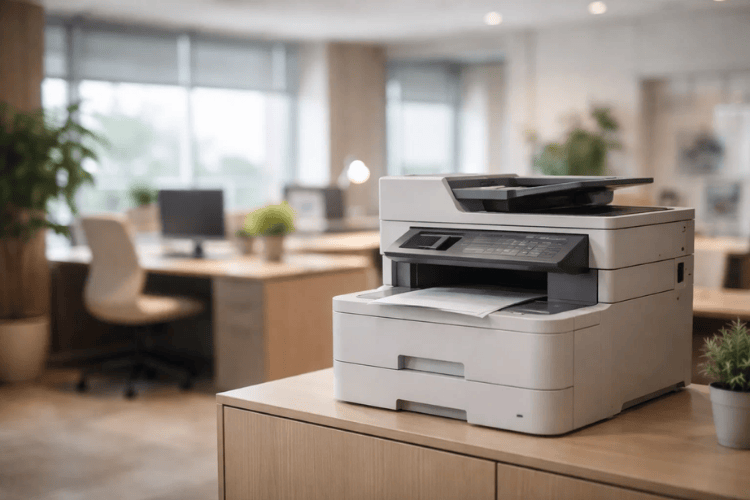
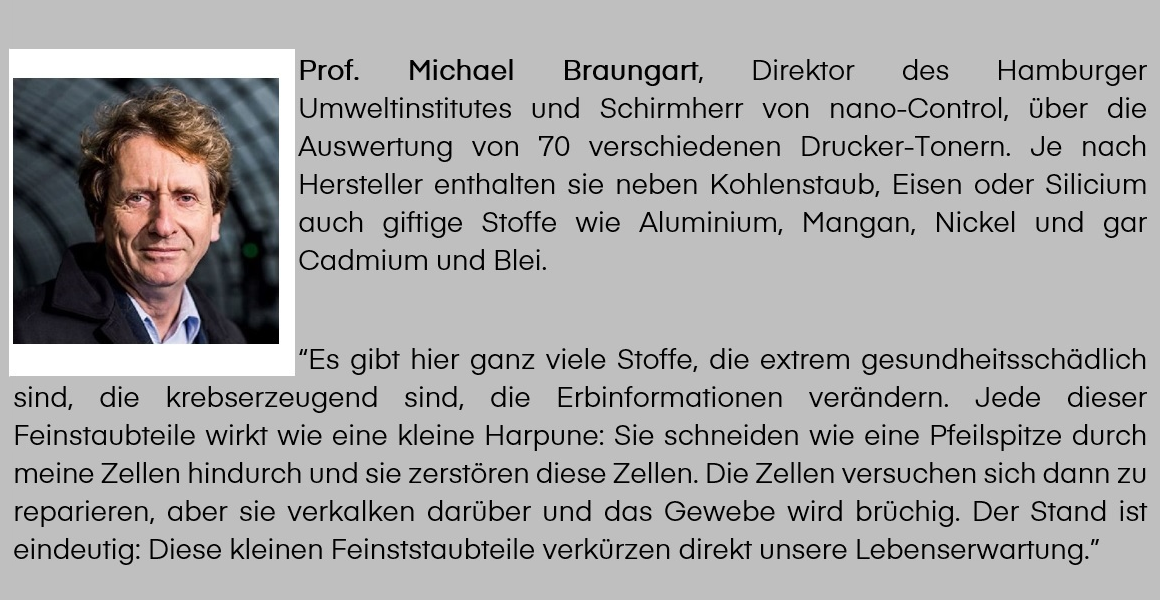
nano-Control is an international foundation whose purpose is to advocate for healthy indoor air – with a particular focus on laser printers and copiers. There are around one billion of them worldwide. The foundation's patron is the globally respected Prof. Michael Braungart, director of the Hamburg Environmental Institute and known worldwide for his Cradle-to-Cradle concept. We spoke with the chairwoman of the board, Heike Krüger.
Ms. Krüger, a crowdfunding campaign is currently running on Betterplace.org – what goals are you pursuing with it?

We have planned a 5-part project series titled "Good to Know" ("Gut zu wissen"). We were already able to complete the first project, "Dangerous Metals in Toner," via Betterplace.org and, with the donated funds, examined a total of 71 toners for the metals they contain. With our current project, "What Dangers Are Posed by Laser Printers and Copiers?" (go directly to the crowdfunding campaign on Betterplace.org), we want to expand our public relations work, in particular the orchestrated use of new media – and inform even more people about the dangers posed by emissions from laser printers and copiers.
The series is set to continue shortly – for example, we want to use smaller studies to examine the effects of indoor air on the immune systems of people who have regular contact with laser printers.
Your commitment closely aligns with our fight for healthy indoor air – since when has nano-Control existed?
The nano-Control Foundation was established more than eleven years ago now, in 2008, in Erfurt. Its purpose has always been to raise awareness of the risks posed by laser printers, with the support of research initiatives, and to eliminate these risks by informing those affected on the one hand and institutions from the fields of politics and occupational safety on the other.
Beyond that, people already affected were to be supported through counseling and assistance, since there was no point of contact for this group of people. Doctors, expert assessors, lawyers and authorities are of little help - incidentally, to this day. At the time, the ITG, the Interest Group of Toner-Damaged Persons within the Federal Association of Citizens' Initiatives for Environmental Protection e.V., had already registered 1,800 affected people. Today there are almost 4,000.
Laser printers and copiers often emit a dangerous mixture of fine dust, nanoparticles and pollutants unfiltered. What dangers specifically lurk here?
The human pilot study by Prof. Mersch-Sundermann from the IUK Freiburg from 2013 examined 28,000 gene action mechanisms and biological effects. The study's conclusion: persistent inflammation, triggered by indoor air pollution such as emissions from laser printers, can lead to cancer.
In 2017, Harvard University published a meta-study on the topic, examining 54 studies from around the world. The result here too: there is compelling scientific evidence regarding the biological activity of so-called toner-based printing equipment, i.e. printers based on toners. It leads to cellular oxidative stress, inflammation of the respiratory tract, cell damage and moderate epigenetic changes. In short: the carcinogenic [cancer-causing, ed.] and mutagenic [genetically altering, ed.] potential clearly poses a health risk.
What size are the fine dust particles that laser printers distribute in rooms?
These are both fine and ultrafine particles. The metals contained are nanoparticles bound in the toner, but they can be released during the printing process at around 200 degrees and thus enter the indoor air. As part of the toner study by the University of Gießen on behalf of the Federal Institute for Risk Assessment, in which measurements were carried out in 63 rooms, a significant average increase in the concentration of fine and ultrafine particles with a diameter between 0.01 μm and 1 μm was determined.
In almost two-thirds of the office spaces examined, the study also found a concentration spike at the start of the standard printing process. This initial burst sometimes led to a multiplication of particle concentrations in the office air.
Your foundation doesn't just raise awareness - you and your colleagues also conduct your own research – what insights have you gained from this?
Quite a few: in 2008, in Rostock, toner particles were detected in the lung cells of a service technician who had died of cancer. In March 2009, further studies were presented showing that laser printers also emit metallic particles - in addition to Volatile Organic Compounds (VOCs), also Polycyclic Aromatic Hydrocarbons (PAHs).
And with the human pilot study at IUK Freiburg already mentioned, plastic nanoparticles were also detected in emissions for the first time. The laser printers polluted the indoor air with an average of 15,379 particles of a size of 10 to 1,000 nm per cm³. At peak, there were 51,670 particles per cm³. By calculation, the test subjects inhaled 69 (!) billion particles from laser printers over the three days (3 hours each).
How would the industry need to change the devices so that they pose fewer dangers?
They should definitely install filters. One manufacturer, Konica Minolta, has meanwhile opted for this. This means the devices can no longer emit emissions to their full extent. From our point of view, this is one approach, but not 100 percent protection, since the printing technology is based on the use of health-hazardous substances, heating these substances to 200 degrees, and the resulting necessary ventilation of the devices. The air exchange is uncontrollable as long as the devices are not operated in an enclosed, extraction-capable environment.
Our proposal to reduce emissions into the breathing air is to make it mandatory to install the devices in separate rooms with controlled indoor air. This includes filtering the exhaust and circulating air using state-of-the-art filter technology (cleanroom technology). This is particularly urgent in sensitive spaces such as kindergartens, schools, hospitals, medical practices or nursing homes.
Are new political guidelines needed, such as limit values for ultrafine dust in indoor air?
In 2017 we submitted a 10-point plan to the Federal Ministry for the Environment. In addition to separating the devices, we called for warning notices and specific limit values. Specifically: the creation of limit values for ultrafine particles and nanoparticles indoors. Based on the exposure-risk relationship for asbestos, we proposed a provisional limit value of 10,000 particles per page printed for assessment purposes.
Is there any prospect of such a limit value coming?
It is our greatest wish to achieve limit values indoors. The values of up to 1,000 µg/m³ indoors measured by the Federal Environment Agency in 2006 are completely unacceptable if we have to endure them in the office for eight hours a day, over years and decades.
Whether we achieve this protection remains to be seen. As in the emissions scandal, mistakes have been made by industry and authorities in the past. Legacy issues such as asbestos-containing materials or the toxic substances from the history of wood preservatives still lurk indoors. Many people are no longer aware of this.
We believe it is time for us to take the step toward new limit values, because one of our greatest treasures are the people who have brought our country this far and will successfully lead it into the future. This only works when healthy, productive and motivated. Health-hazardous substances hinder this and should be removed from indoor spaces immediately.
We wish you the greatest possible success in this, Ms. Krüger. Thank you very much for the information.
(Images: nano-Control)