
Household Toxins: What Substances Exist, How Dangerous Are They & How Can You Protect Yourself?
Indoor air can make you sick. That's because toxic substances, so-called household toxins, often float unnoticed within it. Take action before the effects become a chronic burden, and investigate the causes of initial complaints. We introduce you to the 8 most important household toxins, uncover pollutant sources, and reveal how to protect yourself from toxins.
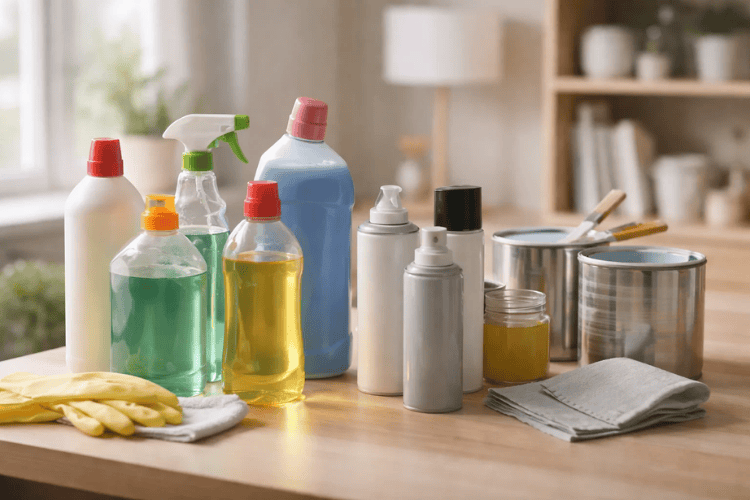
Environmental toxins hide in a wide variety of materials, such as building products, furniture, or other furnishings, and off-gas health-harming pollutants into ambient air. This poses a health burden especially in enclosed rooms. We answer the most important questions about these toxins:
- What are environmental toxins or household toxins?
- What household toxins exist?
- Where do household toxins lurk?
- What complaints do household toxins trigger?
- How can you protect yourself from household toxins?
1. What are environmental toxins or household toxins?
The pollutant exposure in our ambient air is increasing. New products and modern materials gain supposedly more attractive properties through chemical additives: for example, they last longer, are more durable, more color-intense, or easier to care for. The reason for these conveniences lies in the chemical treatment of the objects. But the products release these substances again in small doses — into our indoor air and thus, through breathing, into our bodies. This means concentrations that burden health quickly add up.
Household toxin refers to all substances that occur in inhabited rooms and impair the well-being of the people present indoors, or even harm their health.
2. What household toxins exist?
Mold spores
Mold is one of the most widespread indoor health hazards. The development of spores is favored by moisture and inadequate air exchange. If moisture accumulates on cold surfaces and walls, there's a risk of mold formation. A musty smell and dark speckles announce this household toxin, which usually appears in damp rooms like the bathroom, unheated rooms like the bedroom, or at cold bridges around window frames.
Reading tip: Do you notice a musty smell in your home but can't find the cause? In our article, learn how to track down hidden mold.
Formaldehyde
The universal solvent formaldehyde (CH₂O) is used to manufacture plastics, such as urea and phenolic resins. The cosmetics industry uses the substance as a preservative. It's also used as a smoothing agent in textile finishing. Formaldehyde compounds are volatile. That means they're gradually off-gassed from their carrier material. The household toxin mainly enters indoor spaces via wooden furniture. But carpets and other home textiles can also be affected.
Plasticizers
Plasticizers are used to make brittle materials like plastics more pliable. The most common pollutants are phthalates (phthalic acid esters) and nonylphenol. Favored by sunlight, humidity, room temperature, and physical wear, the chemical compounds become gaseous and escape. With air-Q devices, you can measure these pollutants in the air. The substances can also be absorbed through friction and skin contact. This is how plasticizers from toys or PVC and linoleum flooring enter our bodies. Since plasticizers have a special molecular structure, they can act similarly to hormones in the body. Via wastewater, these environmental toxins even reach groundwater.
Volatile organic compounds (VOC)
Solvents make paints and varnishes brushable and sprayable. They're also found in other household products: for example in cleaning products, adhesives, or dyes. Solvents often consist of volatile organic compounds (VOC). Due to their very low boiling point, VOCs become gaseous already at room temperature and off-gas into their surroundings. How dangerous the substance is depends on the boiling point of the solvents used. The lower it is, the faster the household toxin becomes gaseous and enters indoor air. Through breathing, the small particles then enter the bodies of humans and animals.
Flame retardants
Flame retardants mainly occur in textiles and insulation materials. They're used to reduce the flammability of products. They're therefore also used in manufacturing upholstered furniture or electronic devices. Phosphorus- or halogen-containing agents are harmful to health.
Wood preservatives
Wood preservatives are usually more of a legacy issue. Up until the 1980s, wood preservatives were enriched with the chemicals PCP and lindane, classified as carcinogenic and neurotoxic. If you're planning to convert your attic in an existing property, you should urgently wear a mouth and nose protector when sanding. Otherwise, you could stir up and inhale toxic dust. In addition, the fine dust could spread throughout the house and contaminate other rooms.
Even today, some wood preservatives contain health-harming substances like PCP. Besides wood, the household toxin is also used to treat other materials like leather. But wood treatment products based on linseed oil or wax also release components into ambient air, which combine with oxygen and can oxidize into concerning aldehydes. There are also natural solvents like terpenes that off-gas from untreated wood. Sensitive people can also react to these.
Pest control agents
Pests like moths like to infest textiles and nest in upholstered furniture, food, or carpets. To prevent this, furniture is treated with corresponding protective agents. Pyrethroid is actually of natural origin. However, many insecticides consist of chemically modified variants and are harmful to health, for example the variants incorrectly labeled as bio-insecticides that are used for pest control on carpets.
Tobacco smoke
Cigarette smoke is harmful. And not just directly while smoking, but for a long time afterward as well. That's because tobacco residue spreads with the smoke throughout the entire room and settles on various surfaces. From here, it repeatedly re-enters indoor air. This, by the way, doesn't just apply to standard cigarettes. Our practical study shows that e-cigarettes also significantly affect indoor air quality. If you want to know what effect vaping in the home has, our self-experiment will interest you.
3. Where do household toxins lurk?
Household toxins can occur in various materials. Our table lists the most important pollutant sources.
| Household toxin | possible sources |
| Mold | behind furniture/in window recesses: anywhere there's moisture, standing water, or cold bridges |
| Formaldehyde | insulation materials, adhesive in particleboard/engineered wood, varnishes, wall paints, carpets & other home textiles |
| Plasticizers | toys, cosmetics, paints, varnishes, building plaster, flooring, carpets |
| VOC | paints, adhesives, plastic flooring, furniture, flooring, air fresheners, varnishes, building materials |
| Flame retardants | flooring, insulation materials, varnishes, curtains, electrical wiring |
| Wood preservatives | wooden furniture, particleboard & construction lumber, paints (e.g. for windows & doors), varnishes, wood stains |
| Pest control agents | furniture (with textile upholstery), flooring, facade paint, primers, wood stains, insect spray, insect/pest traps |
| Tobacco | smoking "regular" cigarettes as well as e-cigarettes in the home |
4. What complaints do household toxins trigger?
Household toxins sometimes off-gas only slowly, settle on dust particles and surfaces, and burden air quality over long periods. Attached to small particles like household dust, they spread throughout the entire home. Through skin contact or inhalation, the pollutants enter the body. Our table below lists what complaints and health effects the respective household toxins trigger.
| Household toxin | Health risks & complaints |
| Mold | irritation of eyes & airways, asthma, dry or reddened skin, altered smell & taste perception, fatigue, concentration problems, headaches, irritating cough, gastrointestinal complaints |
| Formaldehyde | headache, nausea, asthma, irritation of the nasopharynx/throat mucosa/upper airways, conjunctivitis, allergies, eczema, cancer, kidney damage |
| Plasticizers | infertility, reproductive toxicity in the fetus, liver & kidney damage |
| VOC | headaches, burning eyes, general malaise, sleep disturbances, constant fatigue, reduced performance, allergies, infertility, cancer |
| Flame retardants | cancer, nerve damage, impotence |
| Wood preservatives | immune deficiency, headaches, nerve damage, damage to the nervous system, skin irritation/allergies, sleep & concentration disturbances, skin irritation, irritation of mucous membranes when inhaled |
| Pest control agents | hormonal effects, cancer, bacterial resistance to antibiotics |
| Tobacco | cancer, nerve damage, impotence, lung damage, asthma |
5. How can you protect yourself from household toxins?
Ideally, you avoid the most important indoor health hazards already when building a house or buying new furniture and other furnishings. However, making your own four walls completely pollutant-free isn't always possible. But you've made a start if you find the source of exposure and react accordingly.
Smell test
You can smell many household toxins. So if you notice the typical synthetic "new smell," consider it a first warning sign of a high pollutant concentration. Volatile organic compounds or plasticizers can be a cause of the unpleasant smell of new furniture or home textiles. Ventilate especially intensively in the first days after purchase. If the "new smell" doesn't fade after several weeks despite ventilating, we recommend taking a closer measurement with a special device or filing a complaint.
Watch for quality seals, certificates & ingredients
Pollutant exposure in furniture, toys, cleaning products, or building materials can be high. To avoid toxic substances, take a closer look at the certifications and ingredient information of your desired products, and when buying furnishings or building materials, look for products and furnishings that are healthy for the home. The Blue Angel seal or the Natureplus label offer good guidance.
Products covered by the Decopaint Directive can be recognized by a corresponding label. The solvent content is also spelled out on the packaging. Only use spray paints outdoors or in adequately ventilated rooms, or opt for water-based alternative products. In general, you can avoid wood preservatives indoors, or at least use solvent- and terpene-free products. The same applies to pest control agents. Prefer untreated products, prevent mold through adequate ventilation, and combat moths with natural remedies like lavender sachets instead of harsh chemicals.
Also opt for natural materials with an eco-label instead of cheap plastic — this applies especially to toddler toys, since these toys are still often put in the mouth, letting plasticizers enter the body even faster.
Air measurement with the air-Q
We take 21,600 breaths a day. It's good to know whether, and which, household toxins are hiding within your own four walls. With the air quality monitor air-Q, you check your indoor air, detect air pollutants, and analyze air quality. For this, the air-Q offers you up to 14 different sensors that check various air components in real time. Thanks to the intuitively readable LED traffic light on the device, you reliably learn how air quality is changing. With the air-Q smartphone app or the web app, you keep everything in view and receive detailed analyses — for your health and safety. Individual alerts and push notifications immediately warn you in acute situations.

Ventilating
Poor ventilation of living spaces is the main cause especially of the household toxin mold. Prevent spore formation through proper ventilation and ensure regular air exchange. Besides preventing mold, ventilating can also help reduce other household toxins. This way, the concentration of, for example, formaldehyde or VOCs, in indoor air can be lowered through regular air exchange. To do this, briefly open the windows wide and ideally ensure cross-ventilation using opposite windows. Air exchange removes most of the humidity, depriving the spores of their growth medium. You can directly check how long you should ventilate with an air quality monitor.
Also pay attention to the right heating setting, since warm air can hold significantly more moisture than cold air. We've prepared separate guides on the topic of mold in the home and needs-based ventilation. For example: "When Do You Need to Ventilate?", "Ventilating Properly: The Best Tips" and "Winter Season = Mold in the Home?"
Air purification
Besides air purifiers that work with filters, various green plants also help improve air quality. Some plant species can even purify the air of pollutants, filtering out substances like formaldehyde. Snake plant, ivy, or dragon tree are especially well suited for this. In various practical tests, we used our air-Q air quality monitor to determine how plants affect the composition of air components. This way, we were able to answer the following questions: "Do Plants Help Improve Air Quality?", "Which Plants Are Suitable for the Bedroom?", "Is the Dragon Tree Houseplant Suitable for the Bedroom?", and we also checked whether planters also have an air-purifying effect.