Carbon Monoxide Poisoning: How Can I Minimize the Risk?
Carbon monoxide is a tricky gas because it's colorless and odorless. The trend toward wood stoves and heavily insulated homes increases the risk of carbon monoxide poisoning. This article covers causes, symptoms, and treatment — and introduces the air-Q CO detector and air analyzer.
Guide to the causes, symptoms, treatment, and detectors for carbon monoxide poisoning
The risk of carbon monoxide poisoning shouldn't be underestimated — according to official figures from the German Federal Statistical Office, 650 people died from carbon monoxide poisoning in 2017 alone. According to doctors, there's also a high number of unreported cases, since not every carbon monoxide poisoning is treated, and symptoms are often attributed to other illnesses. Even when issuing a death certificate, poisoning by carbon monoxide (abbreviated CO) isn't always ruled out beyond doubt.
WDR (a German public broadcaster) estimates that there are 5,000 poisonings related to this gas in Germany each year. Fundamentally, the toxic gas carbon monoxide is released whenever incomplete combustion of biomass, wood, coal, or gas occurs. In the US, for example, there are 20,000 to 50,000 CO poisoning cases per year — costing the American healthcare system $1.3 billion. While the number of deaths is declining in the US, it's rising here in Germany.
Causes: how does CO poisoning happen?
Carbon monoxide always forms when incomplete combustion of carbon-based material occurs. Incomplete combustion requires high temperatures and low oxygen supply.
One cause of carbon monoxide accidents is when gas heating systems form an exhaust backflow and people in rooms with inadequate air exchange breathe in the dangerous gas over several minutes. CO poisoning also repeatedly occurs from improper use of wood stoves, either because air supply is insufficient or because exhaust venting releases carbon monoxide.
If a person inhales the dangerous respiratory poison CO, it enters the bloodstream via the lungs. There, it binds to hemoglobin in the red blood cells. It attaches exactly where oxygen (abbreviated O₂) would normally attach. CO's bond to hemoglobin is significantly stronger than oxygen's — consequently, the red blood cells can no longer transport enough oxygen.
Carbon monoxide poisoning can lead to death within a short time. The gas is thus highly dangerous to humans. Especially treacherous: the toxic CO is invisible and can't be tasted or felt either. It also penetrates rooms where no source is present at all — for example bedrooms or children's rooms.
Symptoms: signs of CO poisoning
Symptoms and signs of carbon monoxide poisoning are considered fairly nonspecific — meaning symptoms like shortness of breath, headaches, cardiac arrhythmia, and dizziness can easily be attributed to other causes, such as dehydration. It becomes clearer once unconsciousness or death occurs.
Also a peculiarity of CO poisoning: symptoms can also first appear up to 40 days after the actual poisoning. This makes it especially hard to identify carbon monoxide poisoning as the cause.
How severe the symptoms are depends on CO concentration (source):
| Concentration | Symptoms |
| 125 - 250 mg/m³ (100 - 200 ppm) | mild headache and drowsiness within 2-3 hours |
| 500 - 1,000 mg/m³ (400 - 800 ppm) | severe headache, dizziness, and nausea within 1-2 hours |
| 4,000 - 8,000 mg/m³ (3,200 - 6,400 ppm) | severe headache, dizziness, and nausea within minutes, death within 20-30 minutes |
| 16,000 mg/m³ (12,800 ppm) | unconsciousness and death within 1-3 minutes |
Heat promotes CO accidents
During the July 2019 heat wave, with temperatures up to 42.6 degrees Celsius in North Rhine-Westphalia, a whole series of carbon monoxide accidents occurred — promoted by the heat, which was also intense inside homes and apartments.
Fire departments, chimney sweeps, and other experts therefore warn of carbon monoxide poisoning from defective gas boilers. In extreme heat, the problem is that the gas boiler's exhaust isn't warm enough to be safely vented outside. Air conditioners and range hoods that exchange air with the outside can intensify this effect.
Treatment for CO poisoning
Treatment for smoke or carbon monoxide poisoning should begin immediately, and at the latest within four hours of the incident, to avoid long-term health damage. The goal is to remove carbon monoxide from the body as quickly as possible. The treatment is also called CO intoxication therapy. Pure oxygen is administered at normal atmospheric pressure. This shortens carbon monoxide's half-life from 320 minutes to under 100 minutes. This acute treatment should always be applied as soon as the patient arrives at a hospital, and continued until all recognizable symptoms are fully resolved.
One step further is CO poisoning's advanced treatment: in so-called hyperbaric oxygen therapy (HBO), rapid detoxification occurs through overpressure in special oxygen chambers. This reduces the risk of later complications. The value of this treatment is shown by the following figures: without HBO, neurological late complications occur in 15 to 40 percent of cases; with the therapy, this rate drops to 1.6 percent.
Carbon monoxide detectors save lives
So how can you minimize the risk of carbon monoxide poisoning? Anyone running a gas boiler in a small apartment, or with a wood stove, should definitely install a carbon monoxide detector in their home. Devices at every price point are on the market. Compact devices equipped with multiple sensors are advantageous, since they're able to monitor all of room air for all potential pollutants. There's no alternative to a sensor, since the toxic gas is also imperceptible to pets. Given the sometimes substantial health consequences, a CO detector in the home is as essential as a (currently legally mandatory) smoke detector.
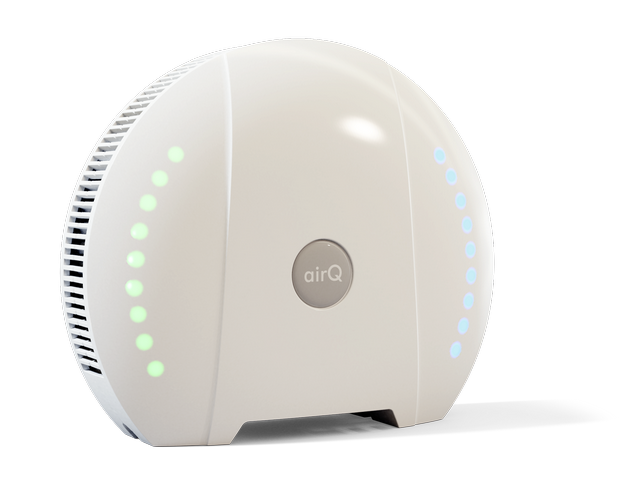
The air-Q air quality analyzer also warns of carbon monoxide. Thanks to its connection with the air-Q app for smartphones, tablets, and web browsers, warning alerts can be reliably delivered even when the homeowner isn't home.
(Image source: image by Karsten Paulick on Pixabay)