
Air Purifier: air-Q Measures Florafilt
With the development of the air-Q, we're fully dedicated to the fight for healthy room air. To lead this fight even more effectively, we're always on the lookout for promising allies. We keep an eye out for innovations like air purifier technology that help us improve the quality of the air we breathe.

One such idea comes from Florafilt, an air purifier startup near Cottbus in the Spreewald region. Founder Reinhard Mietusch and his team have developed a biological air purifier that uses plant roots for air filtration much more heavily than conventional alternatives, which only involve the foliage. Room air is drawn into the air purifier by a small fan and actively routed through the plants' root system. The process is meant to achieve 20 times the effect in purifying the air and filter volatile organic compounds (VOCs) from the air you breathe. Humidity is also meant to quickly rise to a healthy level.
The starting point for effective air purification is a reliable analysis of air quality. That's why we provided our air monitor air-Q for test measurements with Florafilt's newest device, "Apollo." The test's goal was to find out how well the invention can filter a toxic VOC, like toluene, from the air. It also examined how humidity changed in the test room at the Technical University of Dresden.
The aromatic hydrocarbon toluene
Toluene belongs to the group of aromatic hydrocarbons and thus falls into the category of VOCs. Other common names for the chemical are retinaphtha, methylbenzene, and phenylmethane. Toluene mainly serves as a solvent in paints, varnishes, printing inks, and adhesives.
Toluene is a colorless, characteristically smelling, volatile liquid. It burns with a strongly luminous, sooty flame and forms not just readily flammable but even explosive vapor-air mixtures. Its flash point is 6°C — this characteristic property is also used in manufacturing the explosive TNT. Both gasoline and crude oil contain toluene. It can also form during incomplete combustion processes, such as smoking cigarettes.
Inhaling toluene vapors can cause significant health damage. Besides irritation of the eyes and airways and the risk of allergic reactions, nonspecific symptoms like fatigue, malaise, and disturbances of sensation and movement coordination, up to unconsciousness, can occur. Toluene also causes nerve damage and attacks the kidneys and liver. It's considered a reproductive toxin and can even be fatal in larger amounts.
Toluene's narcotic effect can produce states of euphoria and agitation. Regular contact can be addictive.
To reduce the risk from toluene, thresholds have been introduced. The European Union agreed on an eight-hour average of 192 milligrams per cubic meter (mg/m³), or 50 parts per million (ppm), as well as a short-term threshold of 384 mg/m³, or 100 ppm.
The MAK Commission recommends a maximum workplace concentration (MAK) of 50 ml/m³, or 190 mg/m³.
Air purifier measurement at TU Dresden
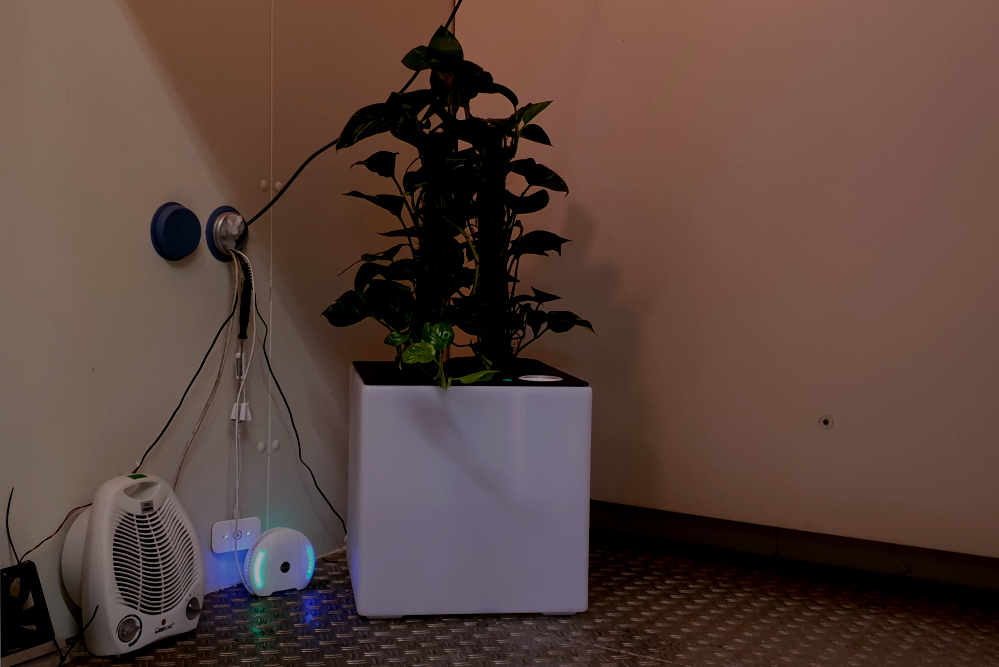
Florafilt's developers, in a four-day test at TU Dresden, examined with their "Apollo" air purifier whether toluene concentration in an enclosed room could be significantly reduced.
To do this, air quality in the roughly seven-square-meter test room was first tracked over a day, to identify periodic effects. Toluene gas was then introduced into the room in a controlled way.
On the first of a total of four test days, it was checked to what extent this concentration dropped due to the plants present in the room, but without the help of the "Apollo" air purifier. No decrease in the toluene reading could be measured here.
The following day, the test setup was repeated, this time with the biological air purifier running. On the curve recorded by the air-Q, it's clearly visible that "Apollo" lowered the VOC reading significantly faster and more strongly. At the same time, the plants in the room raised humidity.
What was especially exciting for us in this test was that Florafilt used both our air-Q and a specialized device measuring only toluene from Dräger (type X-am 8000) for the tests. In terms of measurement result quality, the air-Q held up well against the very expensive specialized device. For example, the air-Q measures with second-level precision. And the VOC sensor we specifically selected for the air-Q responded very well and strongly to the dangerous toluene. On our air-Q's reading curve, this is clearly visible as a sudden spike in VOC concentration.
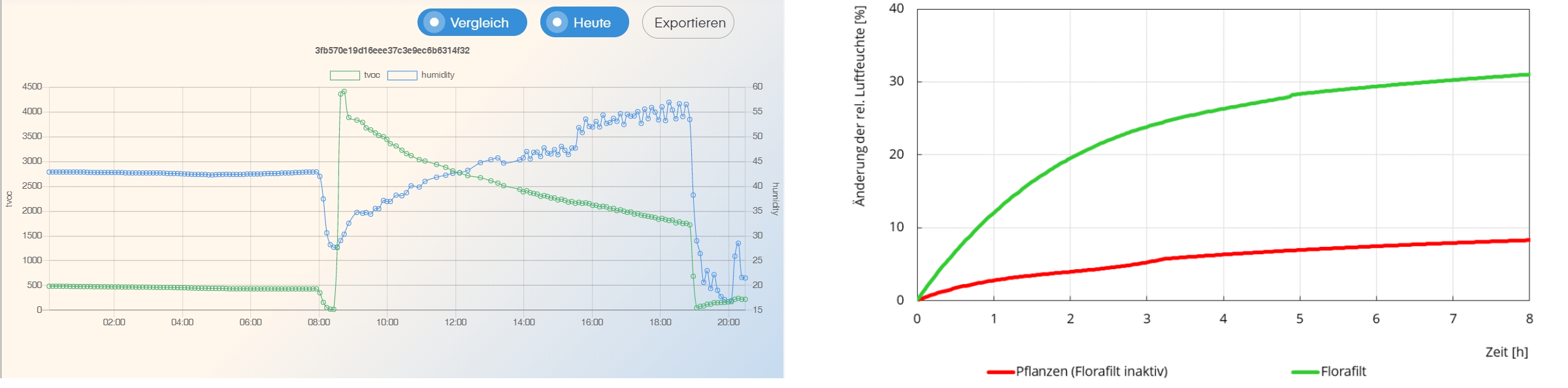
In terms of measurement and analysis capabilities, the air-Q also offers several advantages. It simultaneously monitored other parameters and correlated them with each other. One result: this let us demonstrate "Apollo"'s positive effects on relative and absolute humidity.
Florafilt could also be certain that no other, interfering pollutants were present in the test chamber. Ultimately, our sniffer dog, the air-Q, thus made a decisive contribution to precise and satisfactory test measurements of "Apollo."
(Cover image: Florafilt)