
Radon: The Radioactive Gas in Living Spaces
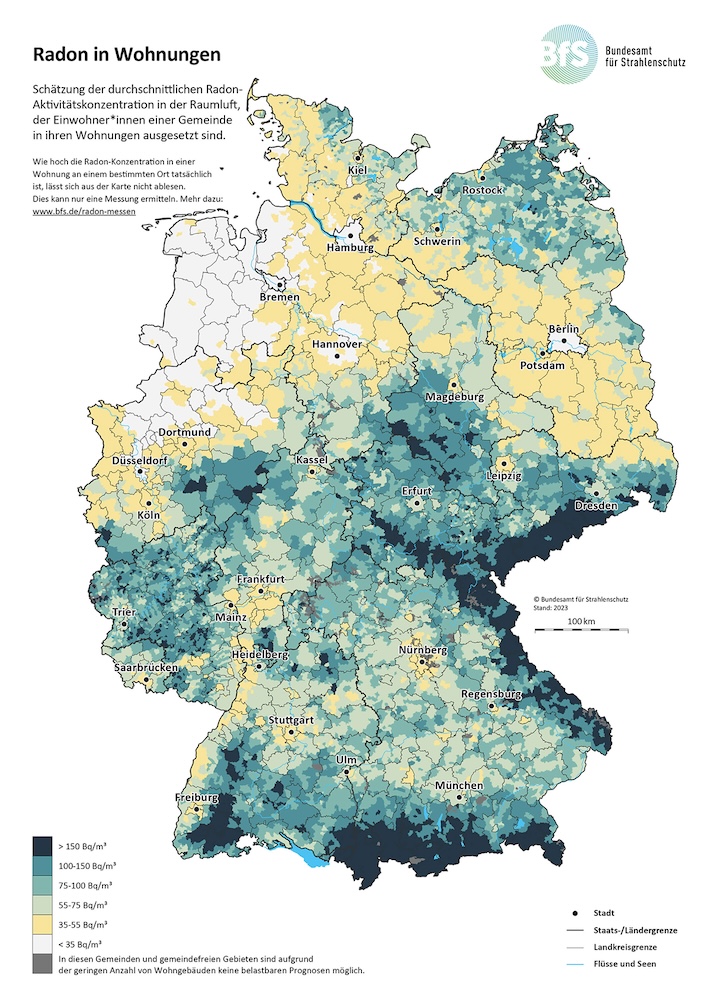
In December 2023, the Federal Office for Radiation Protection (BfS) published a map of radon concentration in Germany. The map shows which radioactive concentration prevails in which region. We take a closer look at the gas and the map and answer common questions.
Radon map from the Federal Office for Radiation Protection
The radon map from the Federal Office for Radiation Protection estimates the regional occurrence of radon in homes, but the actual radon exposure in individual buildings can't be precisely predicted. It's a forecast, not an absolutely accurate statement about radon levels in your individual rooms. For a professional assessment, it's necessary to measure the air component radon — using a radon monitor or a one-time radon indoor air analysis.
Tip: you'll find a zoomable map in the BfS geoportal.
Where in Germany is radon concentration highest?
The radon map illustrates strong regional differences and shows the average exposure people in Germany face in their homes. According to the BfS, a very high concentration of the radioactive gas is found in the low mountain ranges and the Alpine region; a relatively low exposure, on the other hand, in northwestern Germany.
The comparison between big cities and rural areas suggests that people in the countryside are exposed to more radon than in the city. Settlement structure characteristics thus affect radon concentration. While single-family homes with few floors dominate in rural areas, urban areas mainly consist of multi-family homes and multi-story buildings. Since the gas rises from the building ground, exposure decreases the farther the home is from the ground and increases the closer the living spaces are to the ground. In cities like Berlin, Leipzig, Kassel, Hamburg, Regensburg, or Erfurt, the radon map therefore shows lower forecast values than in the surrounding areas of these cities.
What is the average radon concentration in Germany?
In living spaces, the annual average radon level is about 65 becquerels per cubic meter on average — meaning 65 nuclei of the radioactive substance decay per second. According to statistics, about 10.5 million people are exposed to a radon concentration of over 100 becquerels per cubic meter in their homes. Two million of them are even exposed to a concentration of over 300 becquerels per cubic meter. Values above 1,000 becquerels per cubic meter are rarely reached.
The radioactive gas radon
The Radiation Protection Act regulates protection against the noble gas and sets out measures for areas with high radon occurrence. As a guide value for elevated concentration, the Radiation Protection Act cites 300 becquerels per cubic meter. From this value onward, measures to reduce the gas in the building should be taken. Here's what applies:
- Owners of existing private buildings can voluntarily initiate measures.
- Builders of new private construction are obligated to avoid structural measures that would favor the gas's entry.
- In the workplace, the annually averaged reference value of 300 becquerels per cubic meter applies; from this radon exposure onward, there's an obligation to initiate measures to reduce it.
Regardless of the limit value, this applies: the lower the radon exposure, the lower the danger.
What is radon?
Radon is a gas that occurs naturally in the Earth's crust. These properties characterize radon:
- colorless
- odorless
- tasteless
- radioactive
Because of these properties, the noble gas isn't perceived by human senses. An appropriate monitor or dosimeter is needed to measure radon.
Radon forms through the radioactive decay of uranium and thorium, which are present in rocks and soil materials. Since the noble gas is particularly small and unbound, the particles migrate to the Earth's surface and radon easily escapes from the ground. Radon then enters buildings through the tiniest gaps and cracks in concrete. While it disperses outdoors and dilutes to a harmless concentration with fresh air, the particles can accumulate indoors to a health-hazardous amount.
How dangerous is radon, and what health effects threaten?
Since radon is a radioactive gas, breathing it in carries health risks. If radon nuclei decay while in the lungs, the resulting alpha particles can damage the alveoli and promote the development of lung cancer.
If people are exposed to elevated radon exposure over several years, the lung cancer risk rises by about 16% per 100 becquerels per cubic meter of room air. There's no lower threshold that could be considered a harmless, safe concentration. This means radon should generally be avoided. After smoking, the gas is the most common cause of lung cancer. It's therefore advisable to measure radon concentration in living and working spaces and, if necessary, take measures to reduce exposure.
How does radon get into buildings & homes?
The gas is present in some soils and enters the building from the soil air of the building ground. Besides the soil, building materials as well as drinking and utility water can also be a radon-containing source to a lesser degree. Since the particles are extremely small, they even penetrate concrete, thus entering all indoor spaces and spreading there. Concentration is comparatively highest near the ground: meaning in the basement and on the ground floor. Radon can still occur on higher floors, though, caused by air circulation within the house.
What influences radon concentration in a home?
The gas's concentration is influenced by various factors:
- Radon saturation of the building ground: if the soil contains more radon, more gas can also diffuse into the air.
- Soil composition & permeability: for example, sandy soils are more permeable than clay soils.
- Building construction: pressure differences between the interior of the building and the ground can create suction that draws radon into the indoor space. Pipe penetrations as well as leaks in the masonry and/or floor slab also favor the gas's entry.
- Ventilation intensity & intervals: in closed, poorly ventilated rooms, the noble gas can build up to a health-hazardous concentration. Regular ventilation prevents the gas from accumulating in the room.
- Location of the indoor spaces: the farther the room is from the building ground, the lower the radon exposure.
How do you protect a home against radon?
Since radon atoms are extremely small, they can't be filtered. To better protect yourself against radon in your home, you can prepare the building ground accordingly and take radon exposure into account when building your house. You should consider these points:
- a continuous floor slab
- modern moisture insulation & drainage
- a basement
- sealing leaks in the foundation
- improving ventilation with a ventilation system
- a reliable indoor measurement strategy to measure radon exposure
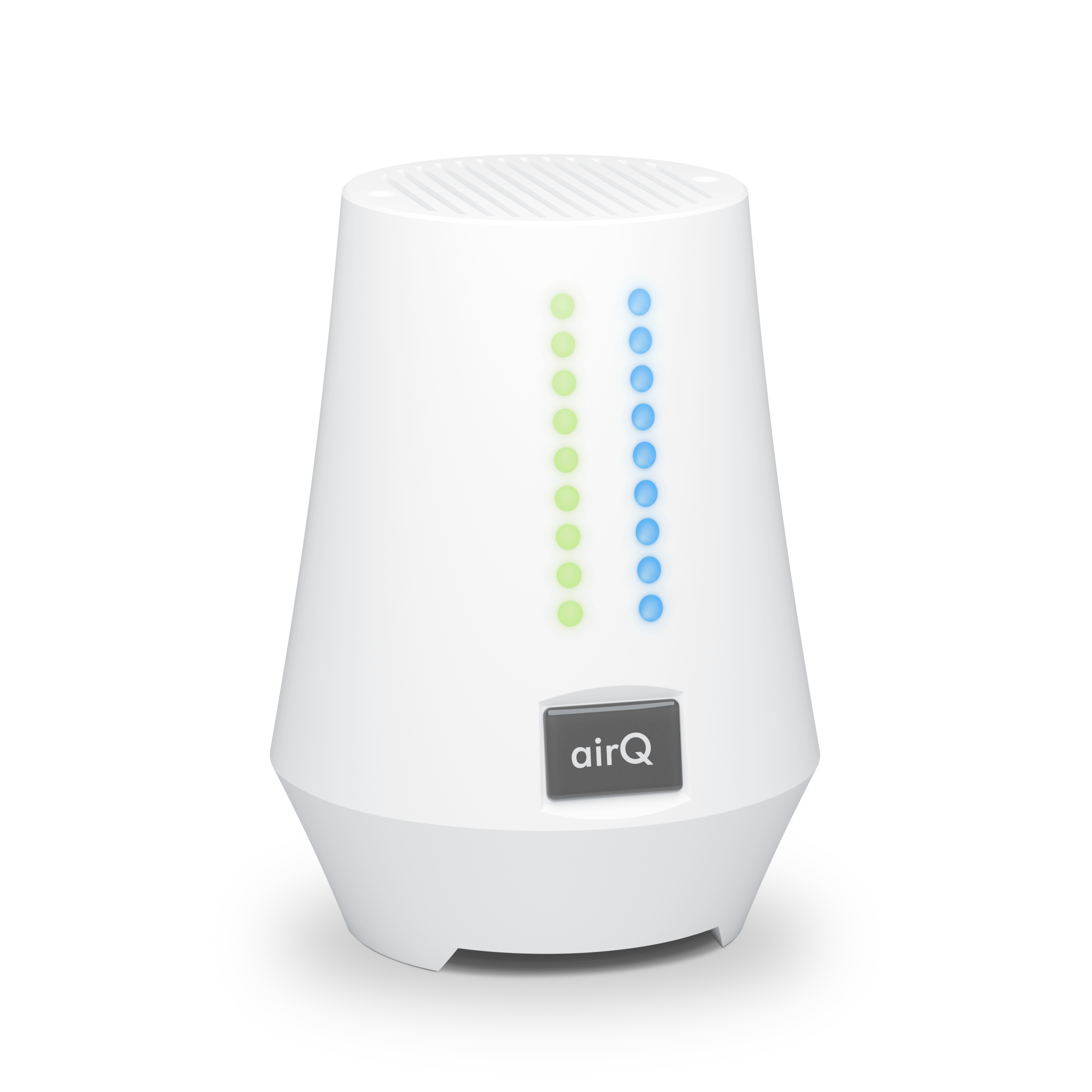
The most important point is proper ventilation. Radon-enriched room air must be exchanged for fresh air, thereby removing the pollutant. Ideally, you ventilate as needed, when the air composition makes an air exchange necessary. Air quality monitors like the air-Q, which measure radon and issue a warning if needed, are well suited for this.
Comparison: radon device vs. radon room analysis
In a radon indoor air analysis, the radon level in your rooms is measured over a period of one week. This gives you certainty about whether and how much radon is in your home or workplace. This makes sense for both private individuals and employees and employers alike. For ongoing monitoring of the gas, purchasing a radon monitor is recommended.
With the air-Q radon sensor, you can not only measure radon exposure at a single point in time, but also constantly detect air components and even recognize other pollutants. The colored LED display shows you the development of air quality and radon concentration and warns you when an air exchange becomes necessary. With the air-Q web app, you analyze all sensors and readings on your PC and keep a detailed eye on air components.
What do you know about radon? Take the quiz: