
Poisoning Risk: Three Carbon Monoxide Sources Especially in Summer
Carbon monoxide is a highly toxic gas produced, for example, during combustion processes like in stoves and fireplaces. However, there are also carbon monoxide sources in summer that can become dangerous and pose a risk to people indoors.
Carbon monoxide (abbreviated CO) is a colorless, odorless gas with significant hazard potential. It forms from the incomplete combustion of carbon-based materials. This type of combustion requires high temperatures and a low oxygen supply. Carbon monoxide can also occur in rooms where there's no source at all. This is especially dangerous in bedrooms like adult or children's bedrooms, where a risk of gradual CO poisoning can exist at night if the gas enters from outside.
When the gas is inhaled, it enters the bloodstream via the lungs, where it binds with the hemoglobin in red blood cells. This happens exactly where oxygen would normally dock, which is why the red blood cells can no longer transport enough oxygen. Due to the resulting oxygen deficiency, carbon monoxide can quickly lead to unconsciousness and death at high concentrations.
Three causes and sources of carbon monoxide
Gas boilers and fireplaces
Defective or unmaintained gas boilers and fireplaces pose a source of danger. Accidents involving carbon monoxide keep happening there in summer too — this can happen especially at very high outdoor temperatures. Exhaust gas backflow can occur, since the gases aren't hot enough compared to the outside air to escape, and thus can no longer be properly vented. Modern devices often have a protective mechanism that detects such backflow and can automatically shut off the device. If this is defective, though, or doesn't exist as with older gas boilers, this can lead to an unnoticed rise in carbon monoxide in room air. Using range hoods and air conditioning can likewise pose a risk or intensify the effect, since this can release oxygen-rich air outside, but the resulting negative pressure then draws CO through the exhaust pipes into the indoor space.
Grills and patio heaters
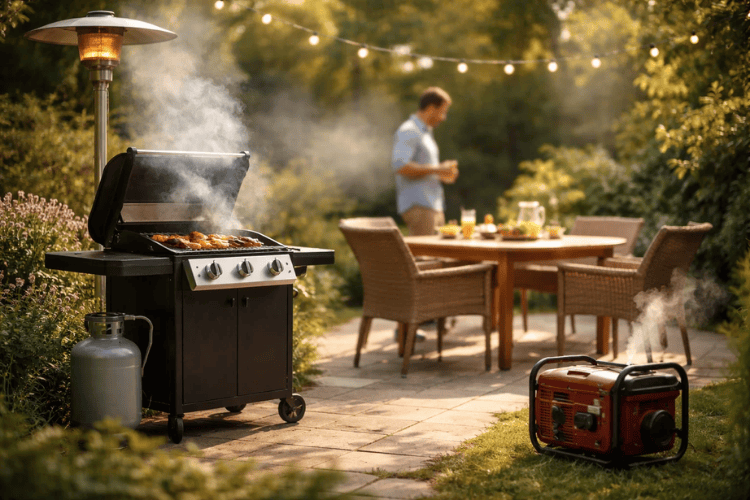
Another risk, and one of the most common causes of accidents in summer, is using patio heaters on cooler summer evenings as well as charcoal grills in enclosed or only semi-open spaces like garages, loggias, or garden sheds. There, the smoke and the resulting carbon monoxide can't escape sufficiently, which can create life-threatening situations from high CO concentrations.
Gasoline-powered generators
To secure the power supply in remote garden sheds, gasoline-powered generators are often used — for example, to run an energy-hungry air conditioner in the warm summer. The mobile generators produce exhaust fumes, which can drift into the indoor space. Especially during the engines' startup phase, combustion doesn't run optimally, since operating temperature hasn't yet been reached. This produces increased amounts of dangerous CO.
The air-Q air quality monitor as a CO detector
The symptoms of carbon monoxide poisoning initially appear nonspecific — signs and symptoms include, among others, headaches, drowsiness, or dizziness. For prevention, not only is regular maintenance of fuel-powered devices recommended, but also installing carbon monoxide detectors in your spaces.
The air-Q measures carbon monoxide and also functions as an active CO detector. Even at small amounts of the dangerous gas in room air, the gas monitor sounds an alarm, warning you in time so there's enough time to respond. Low, not-yet-critical concentrations can also be examined through trend analyses, to detect dangers preventively. This way, the smart air quality monitor offers good protection and helps prevent possible accidents involving carbon monoxide.