
Optimal Air Quality in the Workplace Thanks to Smart Technology: The air-Q Air Analyzer & the ASR A3.6 Directive
Imagine feeling fresher, more focused, and more productive in your office. The foundation for this is good air quality. To ensure this, the ASR A3.6 directive sets clear standards. We explain what this occupational safety directive means and how, as a company, you can ensure that the air in your premises is optimal.

Healthy workplace
A healthy work environment is essential for employee productivity and well-being. The quality of the air we breathe plays a central role in this. The Technical Rules for Workplaces (ASR) set standards to ensure that the work environment matches the current state of technology, occupational medicine, and occupational hygiene. ASR A3.6 specifically sets out the requirements for ventilation in workspaces. In this context, the air-Q air analyzer offers an innovative solution for monitoring and optimizing compliance with these standards.
What is ASR A3.6?
ASR A3.6 defines the requirements for ventilating workplaces in enclosed rooms. The goal is to provide workers with a sufficient amount of air that's beneficial to their health. The benchmark here is outdoor air quality, as long as it's not impaired by exhaust air from extraction or ventilation systems, heavy traffic, or poorly ventilated locations. If this is the case, separate measures must be taken as part of the risk assessment. Possible optimization measures could include, for example, eliminating the sources or relocating the intake opening for ventilation systems.
The safety directive also takes into account factors such as physical exertion or the number of people present in the room. Furthermore, besides the workplace itself, ASR A3.6 also includes recommendations for break rooms, standby, first aid, and sanitary rooms, and accommodations.
The rule covers various aspects of air quality, including controlling substance, moisture, and heat loads. ASR A3.6 sets out specific measures to minimize or eliminate this pollutant exposure.
What are substance loads?
Causes of substance loads can include, for example:
- the presence of employees and other people, who produce CO₂ and odors
- emissions from building products or furnishings, such as volatile organic compounds (VOC), formaldehyde, or other pollutants
- contaminated air entering from other rooms or areas (e.g. from activities involving hazardous substances or biological agents)
- contaminated outdoor air, for example from particulate matter
- poorly maintained ventilation systems
- mold spores
- radon, which can enter buildings from the ground
How should air quality be checked according to ASR A3.6?
To detect substance loads, determining the CO₂ concentration in the room is a common method. That's because CO₂ exposure affects workers' ability to concentrate and causes symptoms like poor concentration, fatigue, or headaches.
For occupational safety directive A3.6, the Committee for Workplaces developed corresponding proposals, which were published by the Federal Ministry of Labor and Social Affairs in the joint ministerial gazette. According to ASR A3.6, the following measures are recommended per CO₂ concentration in the room.
| CO₂ concentration [ml/m³] or [ppm] | Measures |
| less than 1,000 |
|
| 1,000 to 2,000 |
|
| more than 2,000 |
|
Besides CO₂ concentration, the occupational safety directive also recommends keeping room temperature, including corresponding humidity, as well as noise within a reasonable range. While no measurements are mandatory under the occupational safety directive, poor room air often can't be detected without air measurement. This is especially true if you're in a room for a long time, get used to the declining air quality, and therefore no longer notice it by smell. In addition, many pollutants, like volatile organic compounds, are gaseous and colorless, escaping notice by both eyes and nose. Poor air quality also promotes the spread of disease, since room air contains a higher proportion of viruses or bacteria. This increases the concentration of pathogens. This is also confirmed by the findings of a study from the UK. The researchers discovered: the more CO₂ present, the more virus-friendly the air becomes.
Continuous air analysis is needed to objectively determine and assess the concentration of these values.
Challenges in complying with ASR A3.6
Complying with ASR A3.6 can be challenging in practice. Factors like the presence of people, emissions from building materials, poorly maintained ventilation systems, or external influences like traffic and industry can significantly impair air quality. Especially monitoring CO₂ concentration and other pollutants requires continuous attention and precise measurements. Air quality monitors like the air-Q are well suited for this, detecting a wide range of air parameters and warning when recommended limit values are exceeded.
How can ventilation be ensured according to ASR A3.6?
Regarding the renewal of room air through direct or indirect supply of outdoor air, a distinction is made between various types of ventilation:
- Natural ventilation: this ventilation occurs through pressure differences from wind or temperature differences between outside and inside, e.g. via window ventilation, shaft ventilation, roof-mounted ventilation, or other ventilation openings, and can be supported by fans if needed.
- Mechanical ventilation systems (RLT systems): using mechanical circulation, the air is cleaned using filters and heated, cooled, humidified, or dehumidified via at least one thermodynamic air treatment function.
- Draft: describes a disruptive air current, which can be caused by both natural ventilation and mechanical ventilation systems.
- Turbulence intensity: is the measure of the fluctuation in air speed and represents the ratio of the standard deviation of air speed to the mean air speed.
The air-Q air analyzer: a smart tool for ensuring air quality
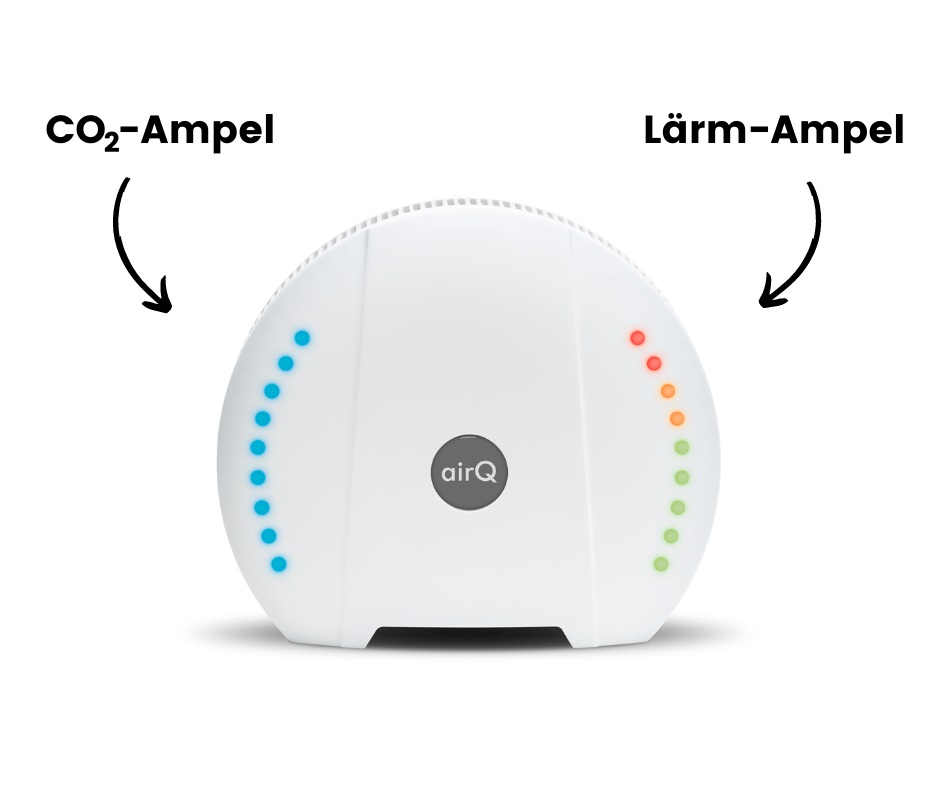
The air-Q air analyzer is a smart device that monitors air quality in real time and provides you with comprehensive data on how room air is developing. With up to 15 different sensors, the air-Q captures not only CO₂ concentration, but also volatile organic compounds (VOCs), particulate matter, temperature, humidity, and much more.
Benefits of the air-Q in the workplace
- Real-time monitoring: the air-Q provides continuous air quality data, which can be viewed directly on your smartphone or computer. This lets you take immediate action when limit values are exceeded.
- Detailed analyses: thanks to the air-Q's extensive sensor technology, you get detailed information on various pollutants and environmental factors. This makes it easier to identify and eliminate sources of pollutants.
- Automated reports: the air-Q generates regular air quality reports, which are helpful for audits and compliance with regulations like ASR A3.6.
- Integration into smart building systems: the air-Q integrates easily into existing building automation systems. This lets ventilation systems be controlled automatically to ensure optimal air conditions.
Practical application of the air-Q for meeting ASR A3.6
By using the air-Q, you as an employer can ensure that ASR A3.6 requirements are continuously met. For example, CO₂ concentration can be monitored and ventilation measures automatically adjusted to ensure values stay below the recommended 1,000 ppm. Monitoring other pollutants like VOCs or particulate matter is also possible with the air-Q, ensuring comprehensive protection for your employees.
Conclusion
Complying with ASR A3.6 is crucial for creating a healthy and productive work environment. With the air-Q air analyzer, employers have a powerful tool available to effectively monitor and improve air quality. By integrating smart air-Q technology, your company can not only meet legal requirements, but also sustainably promote the well-being and health of your employees.
Invest in the future of your workplace — with the air-Q air analyzer, you ensure optimal air quality and a healthy work environment.