
NO₂ Limit Values Explained Briefly: What Applies in Which Situation?
The debate about air quality and appropriate pollutant limit values never stops. Alongside CO₂ and particulate matter, nitrogen dioxide (NO₂) is especially in focus. But the existing limit values confuse citizens and experts alike — what limit values exist, and what applies in which situation?
NO₂ limit values: what applies in the workplace?
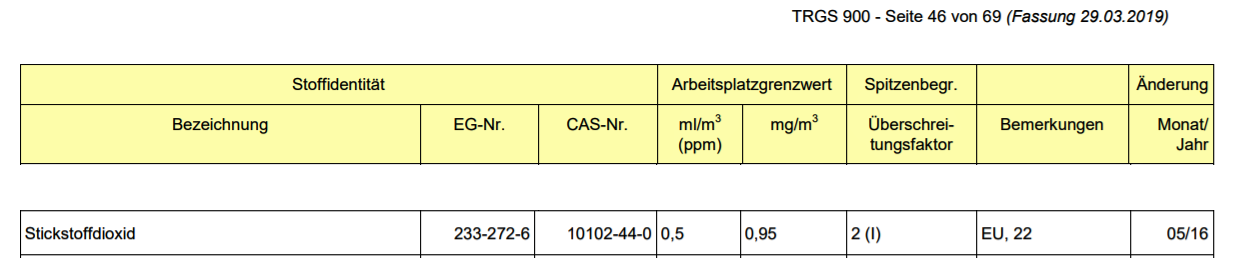
The EU limit value is 40 µg as an annual average, while the so-called workplace limit value is set at 950 µg per m³. Especially regarding air quality in the workplace, however, there are countless misunderstandings that need explaining. Fundamental here is the so-called MAK value (short for: maximum workplace concentration), which is a scientific recommendation from the German Research Foundation. It also corresponds to the workplace limit value for NO₂ (AGW), which is set out under the Hazardous Substances Ordinance.
This AGW applies to workplaces in trades and industry where elevated NO₂ values (more on the nitrogen dioxide reading) are expected due to the specific on-site conditions. And: the recommended maximum workplace concentration assumes a healthy adult.
The AGW assumes a sustained, average exposure to nitrogen dioxide of eight hours a day, five days a week. The value describes the concentration at which neither acute nor chronic damage is expected. For nitrogen dioxide, the workplace limit value is 950 µg/m³.
Only four times per shift, and for a duration of 15 minutes, may this be exceeded by up to 8 times. However, these high limit values are only tolerated because people are regularly examined for their health, are exposed to this load for a maximum of 40 hours per week, and — in particular — are subject to continuous medical monitoring.
Outside these specially regulated workplaces, no special limit values have been set for NO₂. Generally, of course, the air in workspaces should be harmless to health and available in sufficient quantity. This usually corresponds to outdoor air quality. So anyone working in an office or from home, for example, is currently subject to the same limit values that the Federal Environment Agency has also defined for outdoor air. The WHO also recommends 40 µg/m³ as a guideline value for indoor air.
However, at the end of 2018, the Committee on Indoor Guide Values (AIR) published revised guide values for nitrogen dioxide concentration for both private and workspaces. Over a one-hour measurement period, the precautionary value (short-term guide value I) of 80 µg/m³ applies as a matter of preventive health protection. From a concentration of 250 µg/m³, the hazard value (short-term guide value II) becomes relevant, at which health is highly likely to be harmed.
The applicable limit values for outdoor air
Since January 1, 2010, the nitrogen dioxide limit values for outdoor air issued by the European Union have applied. A distinction is made here between three values: the annual average, the hourly value, and the alert threshold.
The statutory ambient air value was set at 40 µg/m³ as an annual average to protect people's health. This value, determined by the World Health Organization (WHO), particularly takes into account sensitive population groups such as children, seniors, pregnant women, and people with pre-existing conditions like asthma and allergies, who are exposed to the pollutant nitrogen dioxide around the clock.
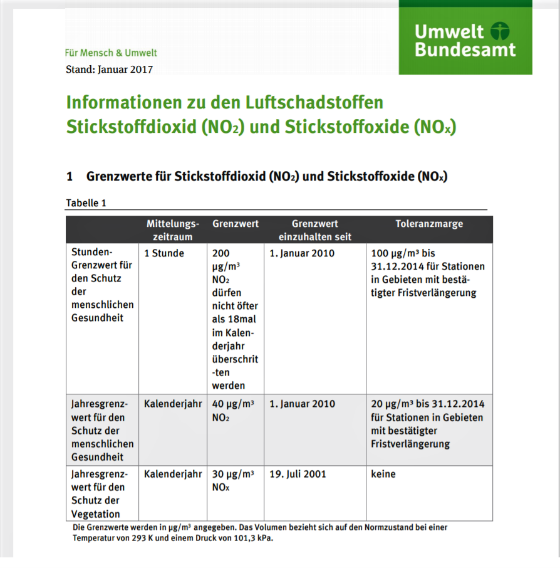
In addition, a special annual limit of 30 µg/m³ has existed since 2001 to protect vegetation. For a one-hour measurement period, a maximum nitrogen dioxide concentration of 200 µg/m³ applies. To protect human health, this may be exceeded at most 18 times in a calendar year.
Furthermore, an alert threshold of 400 µg/m³ has been set for nitrogen dioxide. If this is measured as an hourly average across three consecutive hours, state measures must be initiated immediately.