
Musty Smell in Your Home Without Visible Mold? – Here's What You Should Do Now!
Does your home smell musty, fungal, or earthy, but you can't see any mold? A hidden mold infestation could still be the cause of the smell. We answer the most important questions about possible mold growth indoors and give tips on how to prevent a mold outbreak.

In this post, you'll find the following content:
- How does moldy smell develop in a home?
- What does mold smell like?
- Are mold spores in the home dangerous?
- What causes mold growth?
- Where does mold most often occur in a home?
- What can I do if a wall is damp but no mold is detectable?
- Elevated humidity as the main cause of musty smell in a home
- How can I prevent mold in my home?
- How can I remove musty smell from my home?
How does moldy smell develop in a home?
Mold growth is often only discovered through a noticeable fungal smell. The musty note develops when mold spores release volatile organic compounds of microbial origin, known as MVOCs (microbial volatile organic compounds). These are metabolic products or gases that contain, among other things, various chemical compounds like ketones or alcohols. These MVOCs can't be seen with the naked eye, but they hint at the damage.
What does mold smell like?
There are various types of mold, whose smell varies. Mold spores and bacteria mix, producing various odor notes: for example musty, mildewy, stale, fungal, sweetly rotten, yeasty, dull-moldy, or damp-earthy. Depending on how the smell manifests, different sources may be present, which affect the health of occupants differently.
NEW | air-Q smells mold before you can!
The air-Q is your intelligent early warning system for a healthy indoor climate. With its precise air quality monitoring, it detects early when conditions arise that favor mold growth. Through real-time data on humidity, temperature, and pollutants, the air-Q gives you the ability to take immediate action to protect the health of your family or employees. Trust the air-Q to proactively combat mold and create a healthy, pleasant living and working environment. → More about the air-Q mold-free index.
Are mold spores in the home dangerous?
.png)
According to the Federal Environment Agency, mold spores are fundamentally present in all indoor spaces, since they contribute to the decomposition of organic materials and are therefore part of our natural environment. These spores are tiny, airborne particles found in room air even when they're not visible. In dry room air, they lie dormant. These small particles are particularly resilient and survive even prolonged dry periods. However, if humidity in the room rises, the spores begin to grow and release the typical musty smell that many of us know all too well.
First and foremost, the smell caused by mold MVOCs in a home reduces quality of life in the affected rooms. Depending on the extent of the mold infestation, negative health effects can also occur alongside the musty smell. Particularly sensitive people, such as asthmatics and allergy sufferers, react to mold spores in the air they breathe with congested airways, a feeling of catching a cold, headaches, or reduced performance. These symptoms can not only impair general well-being but also lead to long-term health problems.
It's therefore of the utmost importance to detect mold growth early and take appropriate preventive measures.
Learn more about the effects of mold spores on your health and how you can improve the air quality in your home. Sign up to regularly receive valuable tips, current research findings, and exclusive insights into the world of air quality directly in your inbox. Stay informed and protect your health with our expert guides.
What causes mold growth?
For mold to grow in buildings, it needs a food source. In most cases, an excess of moisture, and thus a large food supply, causes the infestation.
The most common causes of mold growth and musty smell are therefore:
- incompletely dried cellulose in wallpaper, wood, drywall, etc.
- leaky water/heating & wastewater pipes
- severe water damage from a burst pipe
- leaky windows or a defective building envelope, through which moisture penetrates from outside
- thermal bridges where condensation can form
Where does mold most often occur in a home?
Mold hotspots are often found where air can't circulate sufficiently. This means where an obstacle stands in front of a cooler wall or an insulated window: for example pieces of furniture or a heavy curtain made of very densely woven fabric. This creates thermal bridges, because the warm room air can't circulate properly. The result: moisture can accumulate, providing the breeding ground for mold.
You should look for mold here:
- behind large furniture like sofas, cabinets, or dressers
- under the bed
- in room corners
- behind curtains
- behind picture frames
Rarely used sink traps are also breeding grounds for bacteria and mold. A musty smell can also originate here. You can remove it by pouring hydrogen peroxide (11.9%) into the trap. As a preventive measure, you can regularly run hot water down the drain, replacing the standing water.
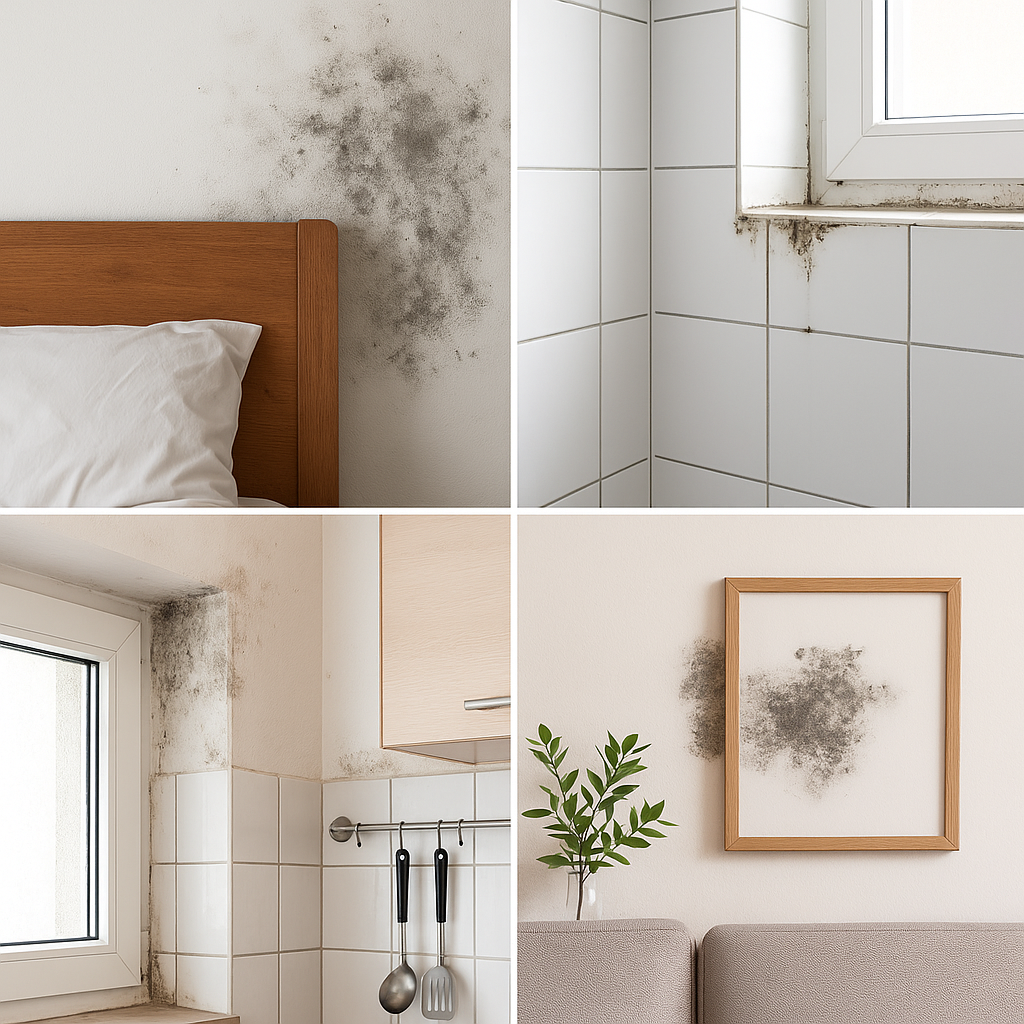
If you've located the moldy smell but don't see any obvious mold growth, the spores could also have spread behind or beneath the surface. Mold likes to "hide" behind wallpaper, paneling, plaster, or baseboards, as well as under flooring like carpet. This could be the case if the wall feels damp but no mold is visible.
What can I do if a wall is damp but no mold is detectable?
There are several reasons why a wall can be damp yet show no visible mold. Possible causes could include:
- Condensation: when warm air meets a cold surface, condensation can form. This can occur on exterior walls, windows, or inadequately insulated areas. Moisture can penetrate the wall and cause moisture problems there.
- Leaks: leaks in gutters, leaky roofs, leaky windows, or cracks in walls can allow water to enter walls. These leaks can be hard to detect and slowly channel moisture into the walls.
- Rising damp: sometimes moisture can rise from the ground through walls, especially in older buildings that may lack an adequate moisture barrier.
- Faulty construction or insulation: poor construction or inadequate insulation can lead to thermal bridges, which promote condensation and let moisture into the walls.
- Indoor humidity: high indoor humidity, for example due to inadequate ventilation, can also lead to condensation on walls and cause moisture problems.
It's important to identify the exact cause of the moisture in order to effectively fix the problem. A specialist, such as a building surveyor or building inspection expert, can help diagnose and solve the problem. A wet wall will sooner or later likely lead to mold, so continuously check your air quality for pollutants and moisture with the air-Q.
Elevated humidity as the main cause of musty smell in a home
While slightly leaky window frames and gaps used to ensure a constant air exchange in a room, today's well-insulated windows and thermal glazing keep moisture trapped in the home. If room humidity can no longer escape outside, it accumulates on the cool areas of your room walls or on windows. If the water pools together and gathers bacteria and other matter, it creates an excellent food supply for mold. This humidity doesn't even have to come from exceptional situations like bathing, cooking, or drying laundry in the home. The occupants' own breath alone is enough to increase humidity. Certain building-mold species already appear at a relative humidity of 70%, and the rest at 80%. To avoid the cause of mold, you should therefore check the humidity in your rooms.
How can I prevent mold in my home?
The most important tool against impending mold growth is controlling humidity and ventilating as needed. We've briefly summarized what helps against mold in our tips.
- Keep the heating on during the day in the cold months too.
- Use a thermostat and ensure a constant room temperature of at least 18°.
- Ensure regular air exchange through needs-based quick ventilation. To do this, monitor room humidity with an air quality monitor like the air-Q. Using the intuitively understandable LED traffic-light system, you can quickly tell when humidity in the room is too high, mold is threatening, and you need to ventilate.
- Don't just tilt your windows open to ventilate, open them fully, and ideally ensure a cross-draft by opening doors during quick ventilation.
- Keep a distance of about 5 cm between exterior walls and large objects to achieve sufficient ventilation.
- Ventilate even when it's raining.
- Don't dry your laundry in a single room, or ensure sufficient air exchange while doing so and vent the humid air out.
How can I remove musty smell from my home?
If you want to remove musty smell from a home, this requires a few steps. First, you need to identify the cause of the smell. Then you can remove the musty smell. Our tips can help:
- Ventilation: ensure good ventilation by opening windows and doors and doing quick airing sessions. Fresh air helps drive out the musty smell. We've compiled how to ventilate properly in our post "Ventilating Correctly: The Best Tips."
- Control moisture: musty smell can often be traced back to excess moisture. Use dehumidifiers to reduce humidity, especially in rooms like the bathroom, basement, or other damp areas.
- Cleaning: thorough cleaning is crucial. Regularly clean carpets, curtains, furniture, and other surfaces that absorb moisture. This helps remove mold or bacteria that could be causing the musty smell. Use cleaning products with mold-inhibiting properties.
- Air purifiers: an air purifier with an activated carbon filter can help neutralize odors and improve air quality.
- Natural air fresheners: use natural air fresheners, such as bowls of baking soda, coffee grounds, or bowls of vinegar, to absorb odors.
- Check surfaces: check walls, ceilings, and floors for signs of moisture or mold. Fix and treat any damage or leaks to eliminate the root cause of the problem.
- Clean carpets & upholstery: carpets and upholstered furniture can absorb odors. Clean them thoroughly or have them professionally cleaned to prevent odor buildup.
- Air exchange with natural materials: use natural materials like wood, bamboo, or linen, which tend to absorb fewer odors compared to synthetic materials.
If the musty smell persists despite these measures, it may be advisable to seek professional help. This is especially advisable if there are signs of mold or other serious problems. An air-Q indoor air analysis can provide initial insights to help get to the bottom of the source of the smell. Building biologists and indoor climate experts can also suggest suitable measures to eliminate structural causes of odors.