
Mold & Higher Heating Costs Because Your Neighbor Doesn't Heat? What You Should Know!
If your own home doesn't warm up despite the radiators being turned up, or mold even develops, your neighbor's heating behavior could be a cause. We take a look at the most common types of mold in a home and how you can protect yourself against a landlord accusing you of violating the ventilation and heating clause in your lease.
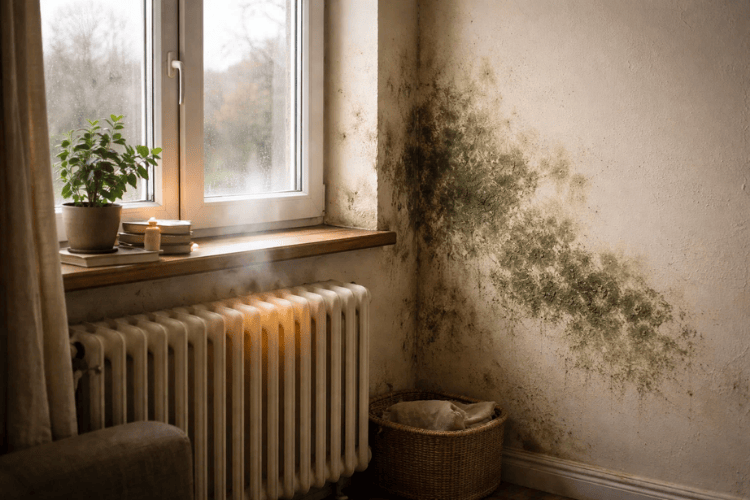
Hidden dangers for tenants from not heating
Outdoor temperatures are dropping, but many people keep their heating on a low setting anyway to save money. This is a particular problem in multi-family buildings with thin, poorly insulated interior walls. That's because there, neighbors' heating behavior also affects adjacent apartments. If one apartment stays cold, the neighboring households are forced to turn their heating up higher if they want to reach comfortable temperatures. Their heating costs rise, and an imbalance in heat distribution throughout the building develops. Individual heating behavior doesn't just create a financial burden for neighbors, it also risks thermal bridges at the adjoining interior walls. In addition, not heating carries the risk of mold growth due to moisture from condensation forming on cold walls. Mold damages the building structure on one hand, and causes serious health problems on the other, especially for people with respiratory diseases.
Dangerous types of mold in a home & health risks
Mold in a home can pose various health risks. It's important to note that all types of mold can potentially be harmful to health when present in large quantities. We introduce three particularly common types of mold considered potentially dangerous.
Stachybotrys chartarum (black mold)
This type of mold is especially concerning for people, since it can produce mycotoxins considered potentially harmful to health. Stachybotrys chartarum is linked to various health problems, including respiratory issues, skin irritation, fatigue, and headaches.
Black mold often has a greenish-black coloring and prefers to grow on materials with a high cellulose content, such as drywall, wood, or paper.
Aspergillus fumigatus
Aspergillus fumigatus is a commonly occurring mold indoors. In people with a weakened immune system, however, it can lead to more serious problems, including respiratory infections, pneumonia, and systemic infections.
Aspergillus fumigatus can have various colors, ranging from white to yellow to green. It often grows on damp surfaces, such as in bathrooms or near leaks.
Penicillium
Some species of Penicillium can trigger allergic reactions and are especially problematic for people with respiratory diseases or allergies. At higher concentrations, Penicillium can also produce mycotoxins.
Penicillium mold can occur in various colors, including blue, green, or yellow. It often grows on food, wallpaper, carpets, and other organic materials.
It's important to note that precise identification of mold types is often done through professional inspections and tests. If you suspect mold growth in your home, it's advisable to seek professional help to have a precise analysis carried out and take appropriate mold remediation measures.
Lease clause: burden of proof for heating & ventilating properly
Under tenancy law, you must use your apartment appropriately. This includes ensuring adequate temperatures and ventilating regularly. These obligations apply to tenants in order to prevent damage in the apartment from mold growth or moisture. Unfortunately, you have no legal recourse if your neighbor doesn't meet these obligations and you're affected by the cold from the neighboring apartment. You therefore can't force your neighbor to heat more, since they only owe this duty to the landlord, not to you as a neighbor.
How to prove that mold growth is caused by your neighbor's behavior
To reduce the risk of damage, you should do quick ventilation regularly. This ensures air exchange and removes moisture from the room. We've covered how proper ventilation works in our post "Ventilating Correctly: The Best Tips."
You can document that you comply with the heating and ventilation obligation in your apartment, thereby preventing mold on your part. Should mold still develop, you have proof that it can't be due to your behavior, but rather to the building structure or your neighbor's heating behavior. With an air quality monitor that checks the relevant readings humidity, oxygen (O₂), air temperature (T), and carbon dioxide (CO₂) in the room. The air-Q measures in real time how the air components change and stores this in clear graphs that you can present to your landlord, should they make claims.