
Household Dust: How Do Dust Bunnies Form and How Do We Protect Our Health?
Household dust, a mix of various organic and inorganic particles, can seriously harm our health. Causes can be natural or human-made. This blog article provides information on what household dust is, what effects the particles have — and how we can protect ourselves from the consequences.
What is household dust?
The dust in our indoor spaces is a mix of various organic and inorganic particles. These particles can remain airborne in gases, including air, for extended periods. On one hand, household dust enters the room from outside — such as soot, pollen, mold spores, rock dust, metal particles, smoke particles, bacteria, and fibers. On the other hand, dust can also form within a room, for example from skin flakes, burning candles or incense sticks, petting pets, or off-gassing of volatile organic compounds (VOCs) from wall paints, wood preservatives, or cleaning products.
Household dust can form through natural processes or human (i.e. anthropogenic) activity via chemical, mechanical, and thermal processes or incomplete combustion. The most important anthropogenic emission sources include industry, agriculture, and road traffic.
Dust is classified either by size or by type. By particle size, a distinction is made between coarse dust, particulate matter, respirable dust, and finally ultrafine particulate matter. Ultrafine particles include, for example, fiber dust, rock dust, pollen, and of course household dust.
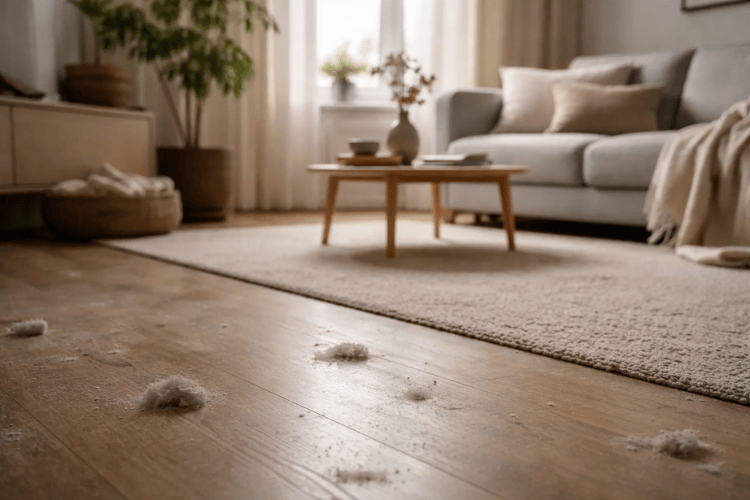
Household dust also contains skin flakes, food remnants, mite droppings, and even microorganisms. The particles float through the air, partly combine with each other and with other pollutants, and after a while sink to the floor due to gravity. There, they're visible to all residents as lint or dust bunnies.
Household dust: what effect do dust bunnies have on our health?
The health hazards from household dust vary depending on particle size and composition, as well as the form in which they enter the body. Three types of uptake are distinguished:
- via breathing (inhalation)
- via swallowing, e.g. in small children (oral)
- via contact with skin and mucous membranes (dermal)
Larger particles are often stopped by the nose, mouth, and upper airways, so they usually don't penetrate as far as the lungs. These household dust particles mainly harm external organs. They attack the skin and mucous membranes and can cause irritation or even inflammation of the eyes.
Smaller dust particles often reach as far as the lungs. Pollutants can enter the bloodstream and eventually all organs. This leads not just to damage to the cardiovascular system but also to as-yet under-researched effects on internal organs. In especially severe cases, various types of cancer can result. Pathogens causing infectious diseases can also attach to household dust. A possible consequence is inflammation in the body. It's even been demonstrated that meningitis bacteria can enter the body via dust particles, causing the life-threatening inflammation of the meninges.
Diabetes, obesity, thyroid disease, and even infertility are also now being linked to polluted air.
Most damage from household dust, though, affects the airways. Patients with pre-existing conditions, for example COPD (chronic obstructive pulmonary disease), experience a worsening of symptoms from pollutant-laden household dust. Dust can also trigger tracheitis or even pneumonia.
Polluted air especially often leads to atopic conditions. These are triggered by allergens — actually harmless substances that the body classifies as harmful and fights accordingly. Pollen as well as dust mite droppings, or pet hair and mold spores, cause allergic reactions as early as the first year of life. Over time, these reactions develop into allergic rhinitis (hay fever), allergic asthma, or atopic eczema (atopic dermatitis).
How do we protect our health?
The dangers of household dust, and protecting against them, shouldn't be taken lightly. Pollutant exposure can already affect a child's development in the womb. It's therefore important to know exactly which pollutants are in the air, so they can be effectively removed.
Should symptoms appear or even worsen, seeing a doctor is essential, to detect and treat chronic or even life-threatening conditions early.
It should also be ensured that windows stay closed during high outdoor pollutant exposure — for an air exchange, widely opened doors or windows facing a courtyard should be used instead. Especially during pollen season, allergy sufferers should only ventilate their living spaces at certain times — in the city, rather in the morning, and in rural areas, rather in the evening.
If particulate matter pollution is high, exercise and heavy physical work should be avoided. That's because faster breathing during physical exertion leads to increased uptake of pollutants.
To make room air healthier, you should always trust your own nose when buying furniture and home accessories. Anything that gives off a noticeable smell contains volatile organic compounds that off-gas and attach to dust particles in living spaces.
Many material-preservation and cleaning products, as well as wall paints, also contain these pollutants. When choosing such products, look for ones containing as few VOCs and other pollutants as possible.
Air filters and air purifiers: from ionization, HEPA, and activated carbon filters to plants
Since pollutants indoors can't be completely avoided even with thorough, regular dusting, air filters or air purifiers can provide relief. However, you should pay close attention to which technology you choose. Devices that use ionization are low-maintenance, have low power consumption, and filter even the smallest particles from the air. But they also emit harmful ozone.
Air purifiers with HEPA filters can't filter all gases and odors or the smallest particulate matter particles from the air. Unlike ionization devices, though, they work with low pollutant emissions.
Purifiers with activated carbon filters also emit no further pollutants. They can even filter odors and gases from the air. However, the filters need to be replaced comparatively often.
An alternative is biological air filters. Currently, some innovations are entering the market that clean the air with the help of plants. Although they actively draw in air to achieve the greatest possible effect, they work very energy-efficiently. Some need no electricity at all. They're also especially low-maintenance and don't lead to unwanted side effects. Since these are relatively new technologies, though, hardly any reliable conclusions can be drawn so far about their actual filtration performance.