
Do Plants Help Improve Air Quality?
Houseplants aren't just decorative — they also improve a room's indoor climate and air quality. They're also credited with an air-purifying and humidifying effect, since they filter pollutants from the air. With the air-Q, we analyzed over 24 hours how plants affect air quality.

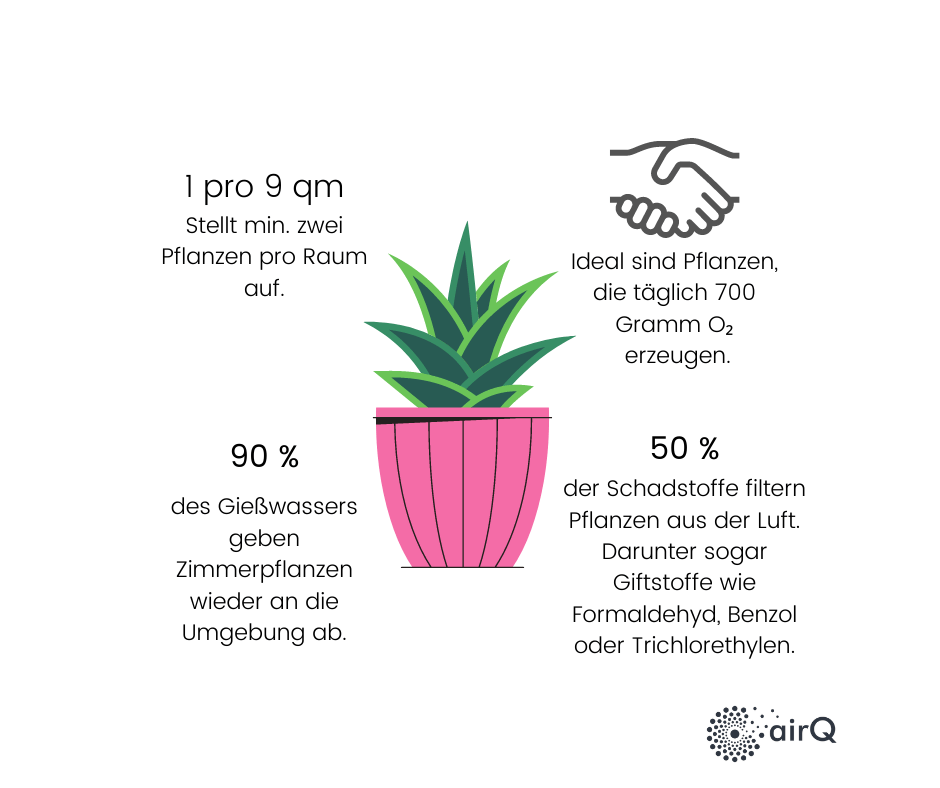
The effects of houseplants in living spaces and at the workplace are noticeable. Plants contribute to improving the indoor climate, since they not only produce oxygen but also filter pollutants from the air. With the innovative indoor climate monitor from air-Q, you always have your rooms' climate in view. These pollutants can, for example, be released from materials present in the room, such as paints, flooring, or furnishings, and enter room air. This lets the substances enter our lungs, where they can harm our health. Certain plant species are especially helpful for absorbing, for example, benzene, formaldehyde, or trichloroethylene — all chemicals that sound dangerous (and are), yet commonly occur indoors. The plants absorb the toxins through their leaves, neutralize them, and convert them into harmless components. Plants also convert the carbon dioxide (CO₂) contained in room air into oxygen and biomass through photosynthesis. At night, though, these air-improving processes stop for most plants. During this period, they even release CO₂, which is especially relevant when it comes to plants in bedrooms.
Houseplants as humidifiers
Plants also help improve living spaces' humidity. They release over 90 percent of the water they're watered with back into the air via their leaves. This is especially health-promoting during the winter months, since heating strongly reduces relative humidity in a room — often to below 20 percent. Humidity in living spaces or offices generally shouldn't drop below 30 percent, though; a relative humidity between 40 and 60 percent is recommended (see our article on minimum humidity). Depending on the plant species, the number of plants in the room, room size, and watering intervals, this can raise humidity by 5 to 20 percent. Plants are helpful in summer too, though. Through the air purification process and the moisture plants provide, temperature can also be regulated.
air-Q Lab: how plants affect air quality
In our test, we used the air-Q to check the effects of houseplants on room air. For the test setup, we placed various green plants together with the air-Q under an airtight glass dome for 24 hours. This was meant to largely rule out external influences on the air. The following readings were then examined:
- Humidity
- Carbon dioxide
- VOC
- and room temperature
These values were measured with the air-Q's sensors and tracked over time. In our video, you can follow our experiment in fast-forward.
The test started in the afternoon at around 3 p.m. At first, the CO₂ reading dropped slightly in daylight, but then rose from around 750 ppm (parts per million) starting at about 6 p.m., up to 1,000 ppm by sunrise. In daylight, the CO₂ value under the glass dome dropped again, reaching about 600 ppm, which is attributable to the plants' photosynthesis kicking in during daylight.
Humidity rose steadily over the course of the test, reaching nearly 100 percent. Temperature also dropped overnight and rose again over the course of the day — not surprising, since it's warmer in the office during the day.
The VOC value, on the other hand, is hard to interpret. It initially dropped slightly at night and rose again during the day for unspecific reasons — though at a very low level. One possible explanation is that the soil in the pot releases VOCs, since it's an organic product with a decomposition process ongoing in the background. This warrants further investigation, e.g. by artificially adding VOCs and then observing the breakdown process.
Conclusion of the study: plants are ideal humidifiers
The test thus confirmed that houseplants fundamentally have a positive effect on air quality. Our test plants were able to contribute to higher humidity. As natural humidifiers, plants significantly reduce the risk of colds. Since 100 percent saturation was quickly reached even under test conditions, it's likely that the effect is also measurable in a room.
It was also demonstrated that plants release more CO₂ once the photosynthesis process stops. Our test setup had an air volume of less than 0.1 m³. A normal 20 m² room, by contrast, has an air volume of about 50 m³. This is a factor more than 500 times larger. If you scale up plants' daytime-positive and nighttime-negative CO₂ balance accordingly, the effect, even for windowsills packed with plants, is in the single-digit ppm range. So there's no need to fear running out of oxygen at night.
Further tests are planned in our air-Q Lab!
(Cover image: Canva/KatarazynaBialasiewicz from Getty Images Pro)