
Detecting Asbestos: What the air-Q Can Do
Asbestos is a dangerous substance once commonly used in building materials. If the micrometer-sized fibers are inhaled, serious health problems can result — including lung cancer and asbestosis. That makes monitoring air quality for asbestos particles important. The air-Q's particulate matter sensor offers initial clues.
What is asbestos?
Asbestos refers to naturally occurring, fibrous silicate minerals. These particles have a minimal fiber diameter of down to 2 micrometers — 1 micrometer equals one-thousandth of a millimeter. Due to its characteristic properties, such as chemical resistance, high elasticity and tensile strength, heat insensitivity, and non-flammability, asbestos was commonly used in building materials in the past. It was used primarily in panels for building construction, in asbestos cement, and for seals and molding compounds.
Why is asbestos dangerous & why should you measure this pollutant indoors?
Asbestos is classified as a clearly carcinogenic pollutant. It's especially problematic that the substance breaks into fine fibers that float in room air and can thus be easily inhaled. The asbestos fibers also settle in the lungs, can migrate to the pleura and peritoneum, and irritate tissue there. Lung hardening from scar tissue can result — so-called asbestosis, an occupational disease recognized as early as 1936. The fibers can also cause lung cancer or mesothelioma, tumors of the pleura or peritoneum. The time span between inhaling asbestos and the disease breaking out can span up to 30 years.
No other material has been used in such large quantities since 1930. According to the German Federal Environment Agency, asbestos consumption between 1950 and 1985 totaled about 4.4 million tons and was processed into more than 3,000 different products. Since the end of 1993, the manufacture, sale, and use of asbestos and asbestos-containing products has been banned in Germany. However, since asbestos-containing building materials were used until then, especially in office buildings, the possibility of asbestos exposure still exists, particularly at the workplace. It's therefore advisable to examine air quality in at-risk areas.
How the air-Q's particulate matter sensor works & its potential use for asbestos measurement
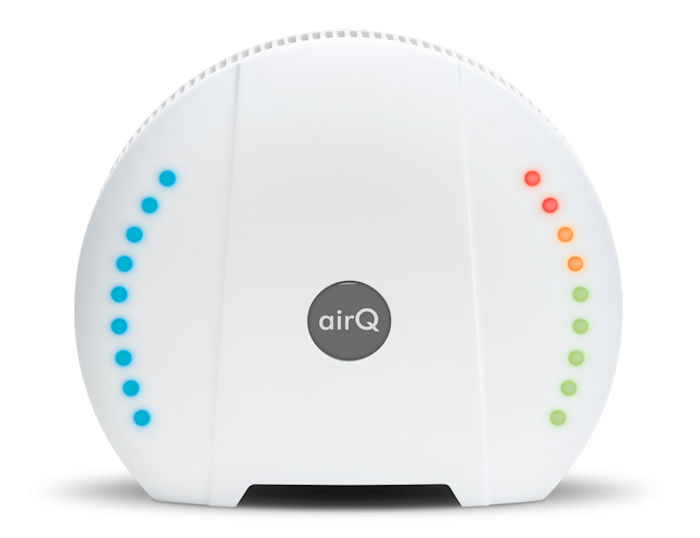
The air-Q particulate matter sensor was developed to monitor air quality by measuring particles in the air. The sensitive sensor can detect even particulate matter particles smaller than 1 µm (1 millionth of a meter / 0.000001 m), offering particularly good measurement precision. Although the sensor wasn't originally designed specifically for asbestos, it's able to detect particles of various sizes. These particles can also include asbestos fibers. So during a room air measurement of the pollutant particulate matter, certain measurement results, such as particle size, can also indicate asbestos. The sensor works on the principle of light scattering. A laser beam is sent through the air samples, and the scattering of the light by particles is measured. This method allows determination of particle concentration and size. However, asbestos can't be distinguished from "normal" particulate matter. So the extremely carcinogenic hazard of asbestos can only be partially captured.
Can the air-Q measure asbestos?
Asbestos fibers have specific physical properties that distinguish them from other particles. They're very thin and long. This lets them penetrate deep into the lungs, making them especially dangerous. The air-Q's particulate matter sensor can detect particles in the micrometer range, which includes asbestos fibers. By analyzing the concentration and size of the detected particles, it can provide clues about the presence of asbestos. However, it's important to emphasize that the air-Q doesn't perform a specific asbestos analysis. For a precise determination of asbestos exposure, specialized methods are required, such as analysis of air or material samples by experts using specialized equipment, including scanning electron microscopes.
Application & benefits of the air-Q
Using the air-Q particulate matter sensor offers several benefits:
- Real-time monitoring: the sensor gives you continuous real-time air quality data, so you can immediately respond to elevated concentrations of potentially hazardous particles.
- Mobility: the air-Q is a portable device you can flexibly use at various locations. This lets you analyze air quality at different locations in a property — especially useful when examining old buildings and renovation projects.
- User-friendliness: the device is easy to use and provides understandable data that can be interpreted even without specialized expertise.
Can you measure asbestos in the air? What other methods exist for measuring asbestos?
Asbestos isn't visible to the naked eye, but it is measurable. This requires professional analysis. After a self-test with the air-Q, which can indicate asbestos exposure, further asbestos measurement methods are possible: such as an air analysis or a material analysis by an expert, with sample evaluation in a lab in each case. For both methods, a specialist takes samples on-site and then examines them.
Asbestos measurement via a dedicated room air measurement
An asbestos room air analysis determines the concentration of asbestos fibers in room air. A special sampling device is set up for this, and its samples are evaluated in a lab under a scanning electron microscope. This variant is very cost- and time-intensive, since for meaningful readings the device should filter air on different days in different rooms, and evaluation by specialized staff is also necessary. A disadvantage is that asbestos can only be measured if it's been released into room air through damaged building materials or other asbestos-containing products. Completely undamaged products release no fibers, though.
Asbestos measurement via material sample
Another variant for measuring asbestos is taking a material sample. For this, a specialist first inspects the property and, where asbestos-containing materials are suspected, takes samples for subsequent lab examination. For this test, the affected building component must be slightly damaged. To rule out health risks, no other people may be in the room during material sampling. To ensure no more fibers are released after sampling, a binding agent is applied to the spot.
Conclusion
Monitoring air quality for asbestos is essential in buildings built before 1993, to minimize health risks. The air-Q's particulate matter sensor offers a practical solution for detecting and monitoring asbestos fibers in the air, since particulate matter measurement results can provide clues to the pollutant asbestos. Through continuous, precise particle measurement, the air-Q can help create safer environments and reduce exposure to hazardous substances.
For a dedicated asbestos measurement, we're planning to develop our own system that can precisely determine asbestos. As soon as we've completed a corresponding measuring device, we'll let you know here.