
Christmas Tree Syndrome — Getting Sick Under the Tree
A Christmas tree is part of the holiday. Yet an estimated one-third of Christmas tree owners suffer from allergic symptoms triggered by their tree. Find out now how to recognize and prevent so-called “Christmas tree syndrome.” We also measured the change in air quality caused by a tree and reveal the results.

For many families, the high point of Christmas anticipation is putting up a real fir tree together in the living room and decorating it festively with baubles, garlands, and candles. Sensitive people, however, react allergically to the conifer. This shows up as hay-fever-like reactions such as a runny nose or coughing. Headaches and fatigue can also occur. But a Christmas tree can also trigger serious problems, ranging from respiratory complaints to asthma attacks with shortness of breath — showing up as rhinitis or asthma symptoms. People with pre-existing lung or respiratory conditions, such as asthma, can be more severely affected by Christmas tree syndrome. In the worst case, breathing difficulties increase drastically and develop into pneumonia.
You can recognize Christmas tree syndrome by these symptoms:
- A runny or stuffy nose
- Itchy or watery eyes
- Coughing, wheezing, chest pain, up to shortness of breath
- Fatigue and lethargy
What triggers Christmas tree syndrome?
The allergic reactions aren't triggered by the Christmas tree itself. Rather, mold spores growing on the conifer are the cause of Christmas tree syndrome. These mold spores settle on the tree quite naturally, which isn't a problem out in nature. But once you bring your Christmas tree into your home, the warm heated air accelerates fungal growth, causing the number of mold spores in the indoor air to rise sharply. What's more, most Christmas trees are cut weeks before the holiday and then stored outdoors in damp air — ideal conditions for mold.
Which molds trigger Christmas tree syndrome?
Once a Christmas tree is in the room, a marked increase in mold spores in the indoor air is measurable after just four days. Depending on ventilation habits, the spore concentration can even increase tenfold within two weeks. While 500 to 700 spores per cubic meter of air are typically found under normal circumstances, a Christmas tree can push levels up to around 5,000 spores per cubic meter. If values exceed the threshold of more than 700 spores per cubic meter, it can be assumed that mold is growing in the room. Inhaling these spores can trigger an allergic reaction. Among the mold species that settle on Christmas trees, many are known to cause allergies.
- Aspergillus: Especially dangerous for people with a weakened immune system.
- Penicillium: This mold is used to produce penicillin and can cause allergic reactions in some people.
- Cladosporium: This widespread mold causes skin infections as well as allergic reactions.
According to the Robert Koch Institute, five out of 100 people react allergically to mold. Among asthmatics, that figure is as high as ten out of 100. In every third person with a hypersensitivity (atopy), inhaling even small amounts triggers an allergic reaction. Children are particularly affected here: roughly one in ten children reacts sensitively to mold. Repeated contact with mold spores further encourages allergies.
Sensitive individuals may also react to the terpenes contained in tree resin. Some Christmas trees are also treated with pesticides, and these substances further irritate the respiratory tract.
Tips for preventing Christmas tree syndrome
Mold spores, terpenes, pesticides: an artificial tree might seem like a good alternative. However, artificial Christmas trees are made of polyvinyl chloride, a petroleum-based plastic. Keep in mind that a plastic tree can off-gas volatile organic chemicals and also collects dust during storage, which in turn can trigger reactions in people with dust mite allergies. Naturally, the same problem exists with Christmas decorations. So you should thoroughly clean both your artificial tree and the decorations before decorating your rooms for the holidays. If you don't want to do without a real Christmas tree, use the following tips to prevent Christmas tree syndrome.
- Choose a freshly cut tree – ideally from a local forestry operation. If you cut your own tree, you avoid the lengthy storage and transport conditions that promote mold growth.
- Don't bring the Christmas tree indoors during Advent — wait until closer to the holiday itself. Clean the tree before bringing it inside. Shake it out well or hose it down beforehand. Ideally, use a leaf blower to remove as many pollen grains as possible.
- Have someone without allergies clean and decorate the tree.
- Since mold spores increase with every day the tree spends in warm indoor air, ideally you should leave it up for only seven days.
- Monitor air quality with an air measuring device like the air-Q and take countermeasures when limit values are reached.
What to watch out for with tree decorations
The Christmas tree isn't the only thing that can cause allergic reactions. The German Allergy and Asthma Association (DAAB) also points to the dangers of Christmas decorations. For instance, paraffin candles release soot and solvents that can trigger headaches, allergic skin rashes, or asthma attacks in sensitive people. Tinfoil tinsel, on the other hand, is now rarely used — which is a good thing, since this decoration contains the harmful heavy metal lead. Here, too, children under three are particularly affected, reacting sensitively to lead with coughing, skin rashes, and headaches.
Low-allergen alternatives for Christmas decorations:
- Stars or baubles made of paper, straw, wood, or glass
- Salt-dough ornaments
Our test results
Shortly before Christmas, we wanted to find out for ourselves and measured our indoor air with the air-Q — before and after setting up the tree. At 6 p.m. we brought the tree into the living room, set it up an hour later, and at 9 p.m. removed the netting and shook the tree so the branches could spread out. Our test measurement clearly shows a spike in PM₁₀ levels after the tree was set up. After that, the particulate matter level regulates itself again and settles into an unproblematic range — though it remains higher than without a tree in the room. This suggests that the proportion of particles in the indoor air rises sharply. Given the particle size the air-Q responds to, this is likely particulate matter or mold spores. From this point on, allergy sufferers would start showing symptoms.
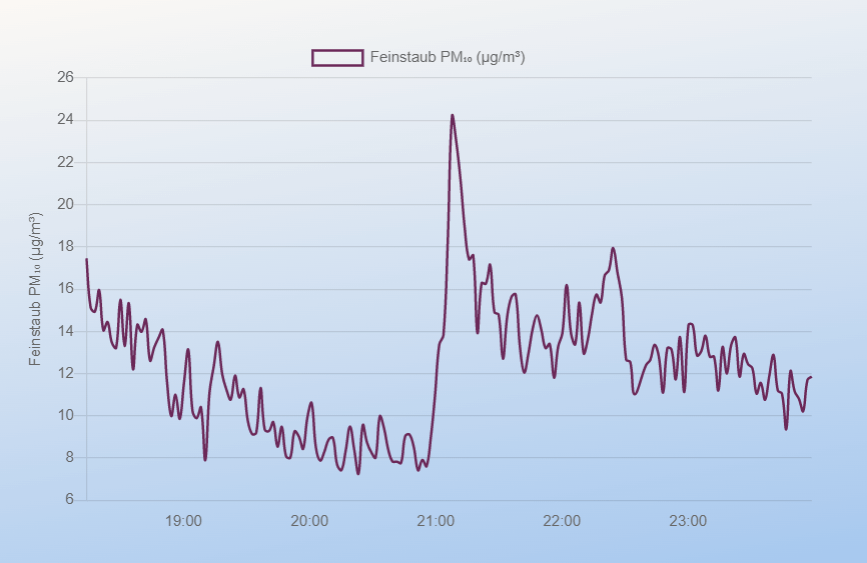
Note: The sensors for PM₁₀ particles are sensitive and respond to fluctuations in the air. This means changes in the air caused by combustion, street pollution, or cooking fumes also show up in the air-Q's readings.
Monitor your air quality with the air-Q
Indoor air quality isn't constant — it's influenced by our breathing, as well as furniture, wallpaper, or carpets in the room. That's why it's important to monitor it. The air-Q air analyzer continuously records all measurements, such as humidity, temperature, and air pollutants, and warns you when limit values are reached. With up to 14 sensors and its own Health and Performance Index™, the air-Q is by far the most comprehensive air measuring device – made in Germany. This lets you see, both on the device and in detail via the air-Q app and web app, how your indoor air is composed, and avoid the negative side effects of polluted air, such as Christmas tree syndrome.