
Surprisingly Efficient – How Much Airing Out the Workplace Really Helps
Headaches, fatigue and difficulty concentrating – indoors, one substance in particular is responsible for this: carbon dioxide. Even in small amounts, it leads to performance deficits and only becomes noticeable once the substance load is too high.

Ventilation routines are nevertheless rarely a topic at the workplace. Yet in almost one in five offices, limit values are regularly exceeded. We used the air-Q to measure how much the CO₂ level can actually change through ventilation.
Why Carbon Dioxide as a Ventilation Indicator?
Carbon dioxide is the substance that rises most strongly in unventilated rooms. The main cause is exhaled air. As the CO₂ content of the air rises, we also automatically breathe faster and deeper, producing even more carbon dioxide.
Even low concentrations above 1,000 ppm lead to reduced concentration, performance deficits, discomfort and even headaches. These symptoms occur long before poor air is consciously noticed. From a CO₂ level of 1,400 ppm, the air is already considered burdensome, and concentrations from 2,000 ppm are classified as unacceptable. In rooms where many people are present, values quickly rise to 5,000-6,000 ppm. With airtight construction and a correspondingly low air exchange rate, the CO₂ level can also quickly reach higher concentrations even with just a few people in the room.
Air Quality Before Ventilating
But what does ventilating actually achieve at the workplace? We ran the test.
For the measurement, the air-Q was placed on the table in the middle of our 25 m² office. The room was occupied by four people and equipped with two PCs and two laptops, all of which were in operation. The room temperature was 24 degrees Celsius, while 5 degrees Celsius was measured outside. Since many offices still rarely have ventilation routines and there is often no air exchange especially in the morning, the roughly 2.80 m high office had, for demonstration purposes, not yet been ventilated on this day.
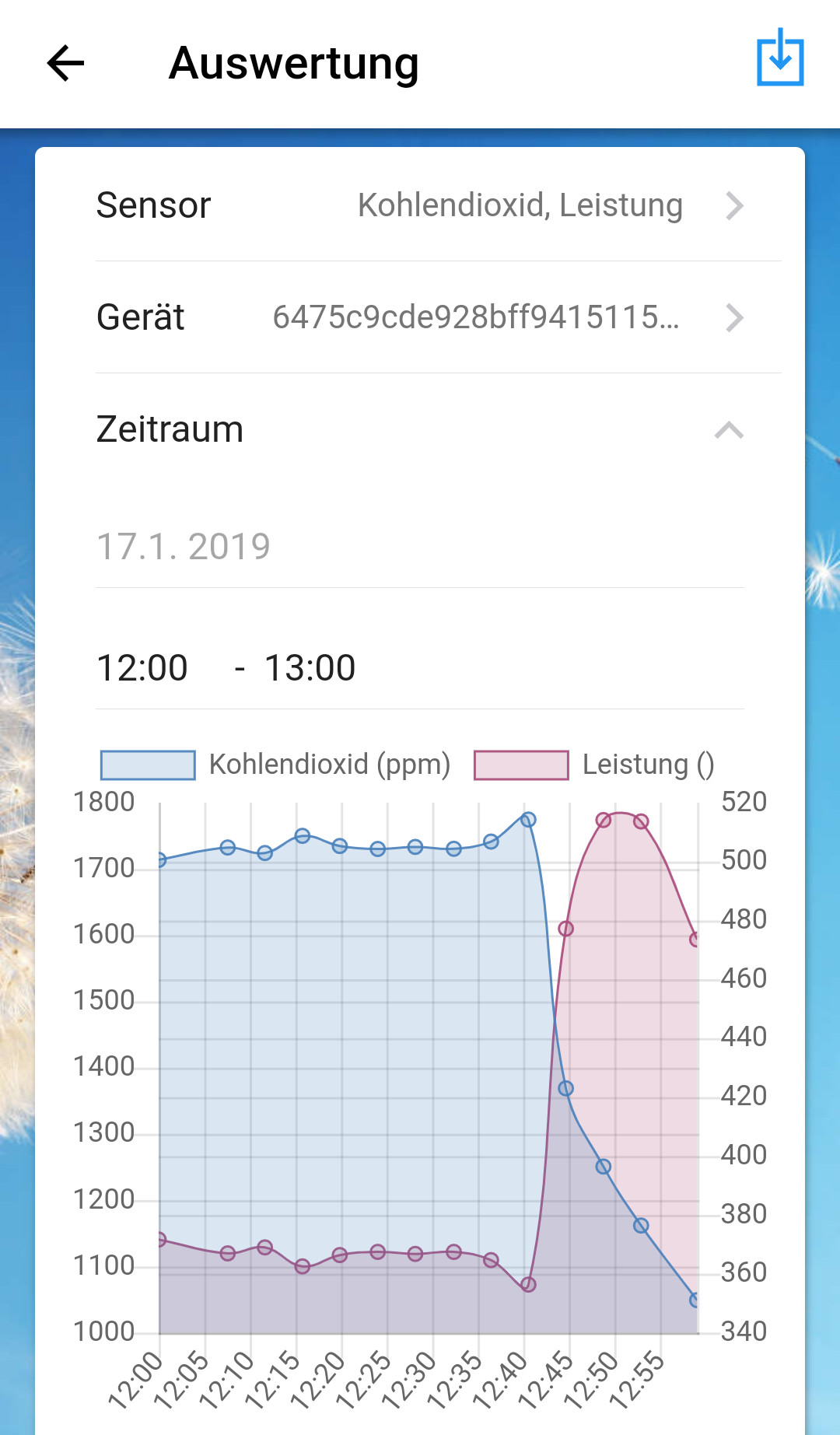
Before the window was opened at around 12:35 pm, the CO₂ level (blue) was already at a critical level of 1,700-1,750 ppm and began to rise to nearly 1,800 ppm shortly before the window was opened. Corresponding to the critical CO₂ concentration, the performance index (red) was also at a very low level. To calculate the index, all substances that directly affect concentration and performance capacity are evaluated. The content and interaction of these elements are interpreted in the performance index and mapped to a value.
CO₂ Concentration During and After Ventilating
At around 12:35 pm, the office window was fully opened for a burst of ventilation. The air flowing in from outside was cold and, naturally, sank to the floor. Since air masses generally only mix gradually, no noticeable drop in the CO₂ level was visible in the first few minutes after opening.
After about 5 minutes and stronger mixing of stale air and fresh air, a significant drop in the CO₂ curve from nearly 1,800 ppm to 1,400 ppm was already visible. After about 10 minutes, the level dropped further to around 1,200 ppm. Correspondingly, the performance index rose very quickly to a significantly higher level.
At around 12:50 pm, the window was closed again. In the room, a continued decline in the carbon dioxide content could still be observed – due to the further mixing of the air masses.
Conclusion: More Efficient Ventilation Plans Through Regular Air Analysis
The surprising thing about this measurement – the CO₂ concentration changes surprisingly strongly through a burst of ventilation. The effect of efficient air exchange should therefore not be underestimated. In general, it is recommended to ventilate every 2 hours. With burst ventilation, about 5 minutes is enough, while air exchange via a tilted window can take up to an hour. This leads to particularly high energy consumption in winter.
How strongly or quickly ventilation affects indoor air quality depends on several factors such as the number of people, temperature, humidity, outdoor air, the amount of technical equipment, the size and height of the room, or energy-efficient, airtight construction. To develop an effective ventilation routine tailored to local conditions, it is therefore important to precisely know and monitor the individual indoor air.
(Image: unsplash/ Tim van der Kuip)