
air-Q Tests: The Effects of Air Conditioning in the Office
Heat drives away concentration. What brings relief in the office on hot days? Clearly, air conditioning! But how does circulating the air affect air quality? Does air conditioning pose a health risk? We checked this and analyzed the effects of the air conditioner in our own office with the air-Q.

An air conditioner works on a principle similar to a refrigerator: to let the liquid refrigerant absorb thermal energy, its pressure is reduced. This lowers the temperature in the cooling circuit. The refrigerant can then absorb the higher temperature of the surrounding air and carries it away. The refrigerant's pressure is then increased, which sharply raises its temperature. Now the thermal energy can be released to the relatively cooler air. In a monoblock unit, the heated air is finally carried outside.
Condensation can form during this process. After all, the air that comes into direct contact with the cooling circuit cools down very sharply. This pushes the air's capacity to hold water to its limit. The relative humidity here reaches 100% — meaning the dew point has been reached.
How air conditioning affects office room air
Air conditioning in an office doesn't just lower the temperature — as a side effect, it also changes indoor humidity. Through the mechanism described above, moisture can be removed from the air. Since colder air holds less water vapor, absolute humidity drops. Depending on the specific design of the air conditioner, relative humidity can change too. How we perceive humidity depends heavily on this value. With colder air, which holds less water vapor, and a constant absolute humidity, relative humidity rises.
Anyone using air conditioning in the office should make sure relative humidity doesn't drop below 40%. Below this value, the air becomes very dry and promotes colds. That's why people often get sick in a car with the air conditioning on: here, the colder, very dry air comes into direct contact with the respiratory tract, whereas in a much larger room it can mix further with the rest of the room air.
Air conditioning as an office risk? Here are the health effects.
Air conditioning is of course meant to lower the office temperature. But poor maintenance or overly aggressive temperature differences pose a health risk. Some employees are also sensitive to artificially cool climates: feeling cold, tension from drafts, and cold symptoms are the result.
Circulatory problems & colds from office air conditioning
Rapid swings between high and low temperatures stress the immune system and thus weaken defense cells. If the difference between office and outdoor temperature is very large, a circulatory collapse can even threaten. The abrupt temperature drop also suddenly cools sweat, which can cause muscles to tighten and lead to tension. In addition, dry air irritates the mucous membranes of the upper airways. This makes them more susceptible to pathogens, letting many types of viruses enter the body more easily and take hold more effectively. Supply your mucous membranes with enough fluids in your air-conditioned office, and drink plenty in cool offices in particular. Since skin also suffers under dry air and can feel tight, you should moisturize it regularly.
For an air conditioner to work properly, windows must be closed. This means no air exchange can take place, letting viruses spread even more easily. The cardiovascular system is also heavily strained. Sleep disturbances, headaches, or circulatory problems are the result.
Serious health effects from a poorly maintained office air conditioner
Besides relatively harmless colds, serious infections can also be caused or worsened by running office air conditioning. The cause is usually poorly maintained air conditioning units. If filters and pipes aren't cleaned or replaced regularly, they become an ideal breeding ground for germs. Germs, fungi, and bacteria then quickly collect and multiply here. These pathogens then enter the human body directly via the airflow.
High humidity in particular, for example from condensation, accelerates the growth of mold, whose spores can trigger severe symptoms especially in allergy sufferers. If your air conditioner gives off a musty smell, this is a clear sign of a contaminated, germ-laden system.
Watery eyes, a dry throat, or frequent coughing and sneezing can also indicate germ contamination in the air conditioner.
Unclean air conditioners can also be a source of infection for Legionnaires' disease. Legionella bacteria aren't found only in large hot-water systems in hospitals, big hotel buildings, or swimming pools, but also in poorly maintained air conditioners. These small pathogens cause severe pneumonia with high fever.
The only prevention is annual maintenance and cleaning of the air conditioner. You should definitely replace the filter regularly, so germs can't take hold here.
The best temperature setting for your office air conditioning
To avoid a situation of "sweating outside, sniffling inside," the temperature difference between the office and outdoor temperature shouldn't be too large. Ideally, the difference shouldn't exceed six degrees. The smaller the difference between indoor and outdoor temperature, the lower the risk of colds and circulatory complaints from the temperature change. This also spares the body, which would otherwise be overly strained by the fluctuation. Ideal values are: 18 to 23 degrees room temperature and 35 to 65 percent humidity in the office. Most employees feel especially comfortable at these values.
Of course, this general rule of thumb is often hard to maintain. If outdoor temperatures exceed 30 degrees, the office temperatures of 21 to 22 degrees recommended by the German Federal Environment Agency are hard to achieve without intensively run air conditioning.
air-Q Lab – air quality analysis
In our own office, we of course always track air quality with the air-Q air monitor. This lets us easily trace a day using an air conditioning unit.
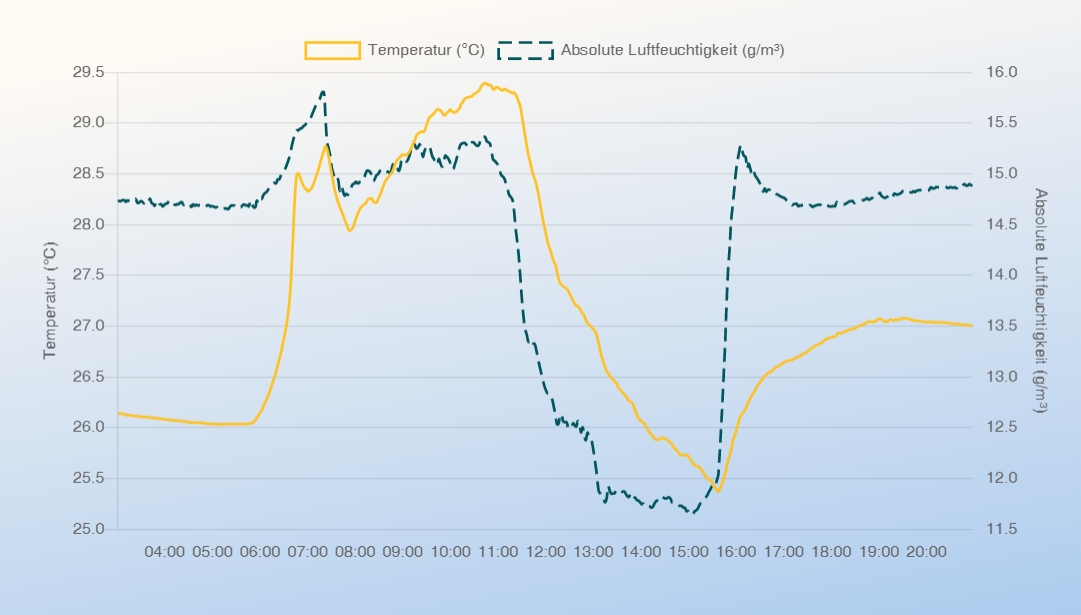
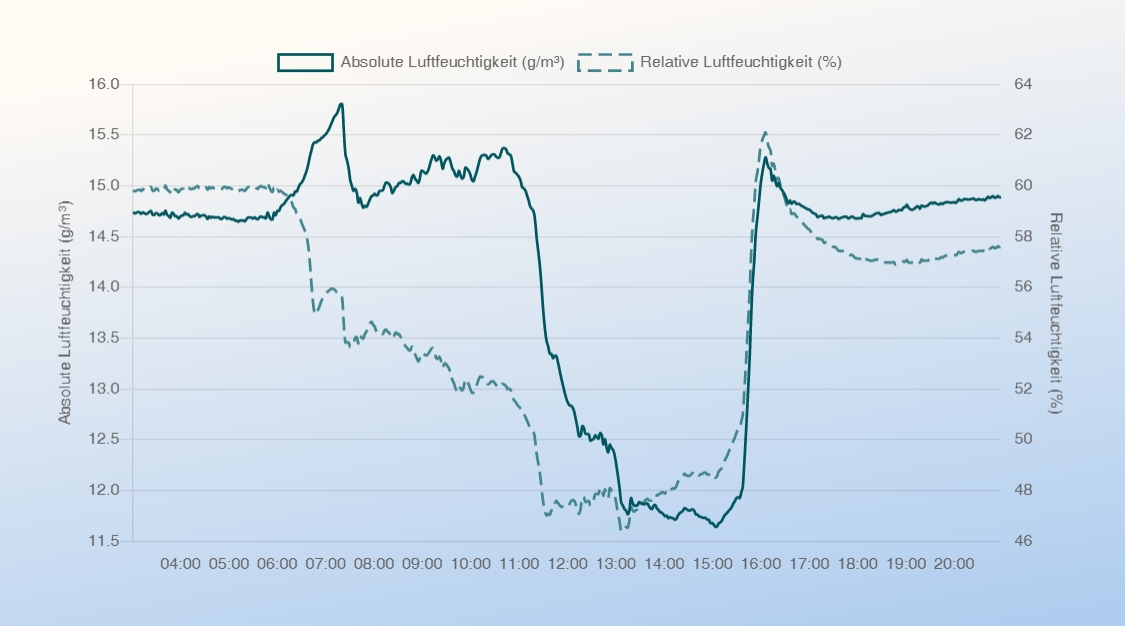
On the test day, temperature rose sharply from 6 a.m. as the first rays of sun entered the office, until the peak value of 29 degrees was finally reached at 11 a.m. From that point, the portable air conditioner was switched on, causing the temperature to steadily drop over the next few hours down to 25 degrees. At around 3:30 p.m., the air conditioner was switched off and the windows opened, since it started raining outside and got cooler. The absolute humidity, constant until then, also dropped while the air conditioner was running; after switching it off, however, it rose noticeably. This is also due to the fact that it was raining and the windows were opened for fresh air. Relative humidity never dropped below 47% during the test period, so there was no elevated risk of colds here.
Air conditioners often also have a particulate matter filter or an additional HEPA filter, which can even improve air quality as a side effect. Incidentally, particulate matter readings in our room were low throughout the entire period, so no change was measured here. With the help of the air-Q and its many sensors, we could easily keep an eye on changes in our office air, analyze the precise effects of the air conditioner, and act accordingly.
For your health: monitor air quality in your air-conditioned office
To keep temperatures cool in your office while also keeping air quality good despite air conditioning, you should monitor air components. Air monitors like the air-Q are ideal for this. Besides humidity, the air-Q tracks many other components and warns you when thresholds are exceeded. It also detects temperature, so with an air-Q you always ensure an optimal climate at your workplace.