
The air-Q in TechStage's Independent Test: An Interview with Editor Kai Schmerer
Kai Schmerer tests various devices for TechStage — his test reports always clarify important user questions and recreate real-world usage scenarios. For the practical test of individual air purifiers, he used our air-Q air measuring device. In our interview, we asked him about his experiences and how important air quality is to him.
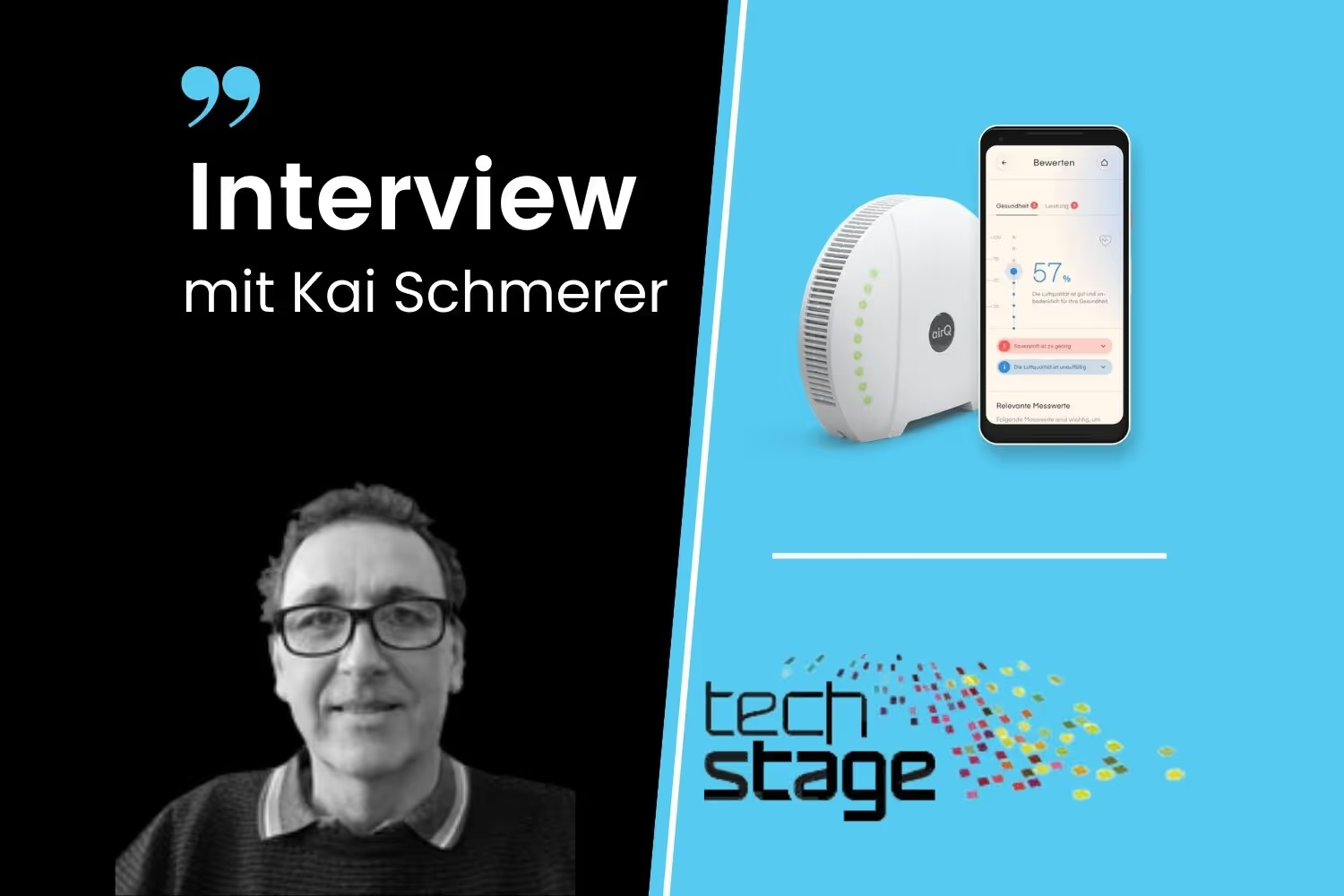
TechStage is a service from one of the most widely used IT news outlets in Germany: heise online. The site focuses on comparison tests, guides, and buying advice for smartphones, smart home, computers, and technology. Compared against nine other air measuring devices, the air-Q was put through a practical test.
Natalie Lament, air-Q: Has air quality been a topic in your office so far, and how did you come across the air-Q air measuring device?
Schmerer: Yes, we've already published various articles on the smart home topic. So far we've tested both air quality measuring devices and simple sensors, for example for temperature or humidity. For our last report, I researched suitable air measuring devices to see what was new, and that's how I came across the air-Q. We'd already used other devices, but with 14 different sensors, the air-Q has the most measurement points. For example, there aren't many measuring devices that can measure ozone. There are of course standalone ozone sensors, but they don't measure anything else.
Natalie Lament, air-Q: How does a test usually work for you – as a practical test, or do specialists or laypeople test in a lab? How did you incorporate the air-Q?
Schmerer: We don't have an in-house lab, and we rely on Stiftung Warentest for selecting the products we test. The devices that perform well there, we test in practice for our guide. We focus on practical aspects like noise level and possible placement, testing these in combination with smart home control. Stiftung Warentest has already established that the devices, say, clean well – this lets us get closer to what matters to consumers. In our test, we paired the air-Q with the air purifier. That works well with smart-home-capable devices such as the Philips air purifier. We integrated the devices via IFTTT and, locally, also via Homey Pro, and connected them with the air-Q.
Natalie Lament, air-Q: Among other things, you tested smart air purifiers with built-in sensors against the air-Q. In your opinion, where does the relevance of an additional air measuring device lie?
Schmerer: That's easy to explain. The purifiers we examined generally only have a single particulate matter sensor built in, which in some cases only analyzes particle sizes down to 2.5 pm. But air purifiers also clean the air of substances that the built-in sensor can only capture indirectly, or not at all, such as VOCs. The idea is that you don't just purify the air based on a single sensor, but work far more efficiently thanks to the comprehensive analysis of a sensitive multi-sensor device like the air-Q.
Natalie Lament, air-Q: You didn't just use the air-Q live – did you also evaluate the data via the app after longer tests (e.g. overnight)?
Schmerer: Yes, that interested me personally too. What's great about the air-Q is that it records the data and then displays it very nicely as graphs via the desktop interface. You don't necessarily have to use the phone with its small screen – you can comfortably follow along on a big screen instead. During the test we were able to observe some very interesting aspects, since the Saharan dust issue in Munich came up during the test period. Every time you ventilated, you might lower the CO₂ concentration in the room, but you'd bring more particulate matter into the apartment.
Natalie Lament, air-Q: What expectations did you have of the air-Q, and were they met?
Schmerer: Yes, absolutely. For example, the Xiaomi air purifier is equipped with an ionizer. According to scientific studies, an imbalance of ions causes discomfort. The Xiaomi air purifier can enrich the air with negative ions, but ozone can be produced during this process. We had a lot of concerned reader inquiries about this. We were able to reassure everyone, because the air-Q was able to demonstrate over a longer period that the ozone level in the air wasn't rising. Another thing I noticed at home thanks to the air-Q is that, for example, when cooking, the particulate matter level rises rapidly even in other rooms. That surprised me, because you don't actually notice it.
Natalie Lament, air-Q: Are there any features you still miss?
Schmerer: I'd still like to see a push notification feature, so that you get notifications directly on your phone, for example when certain values are exceeded. Especially with smart home control, you naturally want the ability to monitor and control things at home from anywhere. But push notifications are supposed to come with the next app version, right?
Natalie Lament, air-Q: Exactly, that's just about to be released.
Schmerer: I'd also like to see even more smart home integrations, since there are so many different hubs out there.
Natalie Lament, air-Q: That's already in the starting blocks too. Many smart home standards are already integrated - including IFTTT, Homey, openHAB and more; also Homekit/Homebridge integration is also already possible. Voice control via Alexa is coming soon. Do you have any further suggestions for improvement or ideas for us?
Schmerer: I've noticed that far too little attention is paid to the topic of air quality. Many things simply aren't known, for example humidity or mold is dangerous not only for health but also for the building structure. Once you've played around with a device like this, or looked at the scientific studies on the effects of air pollutants, for example in the air-Q app, then you realize how important air quality is. And on top of that, there are really excellent explanations of the individual pollutants, which are also available in the air-Q app. There's also the health advisor, which tells you what you can do to improve the air. Air purifiers are one thing, but I read on your company blog that you've also looked into air-purifying plants. Through you, I've discovered the whole topic of air quality completely anew for myself. Many of our readers are interested in this topic too.
Natalie Lament, air-Q: It's great that we could spark your passion for air quality.
Schmerer: You can work on topics like this far better with passion than if you only look at it factually. I wanted to see the connections. By now, not least because of the Corona crisis, we know that air quality is significant for health and the immune system. Northern Italy, for example, has very poor air quality due to its industrial areas and the Alps. The many Corona cases in Northern Italy can certainly be attributed in part to that too. Aside from testing air purifiers, we also want to test 3D printers. With certain devices, air contamination apparently occurs there as well, and we want to check that with the air-Q in the future.
Natalie Lament, air-Q: Thank you very much for testing with our device and for supporting us.
Schmerer: Honestly, I'm not doing this to please you. I simply use the most capable device on the market for the tests we run here. It pleases me personally that we can offer our readers a bit more value than would normally be the case.
Thank you for your time and support. We'd also like to thank TechStage for conducting the practical test and for the opportunity for our air-Q air measuring device to showcase all its advantages. We're looking forward to further tests and results!