
The air-Q on Trial: Particulate Matter and Aerosols in the Crosshairs
Indoor air quality is currently of particular importance, since aerosols that can carry, for example, the COVID-19 virus or other colds quickly build up there. In public spaces with many people, this plays a big role. The air-Q was summoned — to be put on trial in court.
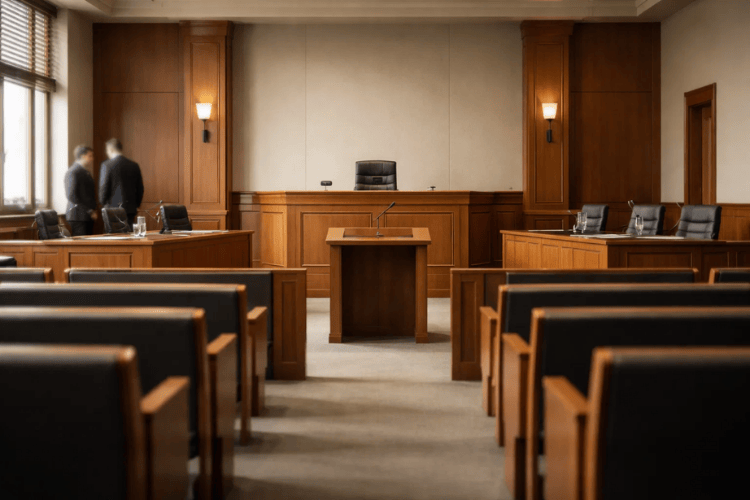
Given the current situation, air quality in rooms where many people work at once (air quality in classrooms or meeting rooms) deserves particular attention right now. Beyond that, air quality can also negatively affect mental and physical performance. A performance-reducing or even sickness-inducing atmosphere can quickly result. Healthy air is especially important where important decisions are made. That's why, at a special customer of ours — a court — we tracked and checked air quality over the course of a week.
The study had the following goals:
- Record, document, and evaluate air quality and pollutants such as particulate matter, nitrogen dioxide, carbon dioxide, chemicals / VOCs, and aerosols over one week,
- Check whether the current precautions regarding Covid prevention are correctly and adequately implemented,
- Derive suggestions for improving air quality
General test setup for the air quality measurement
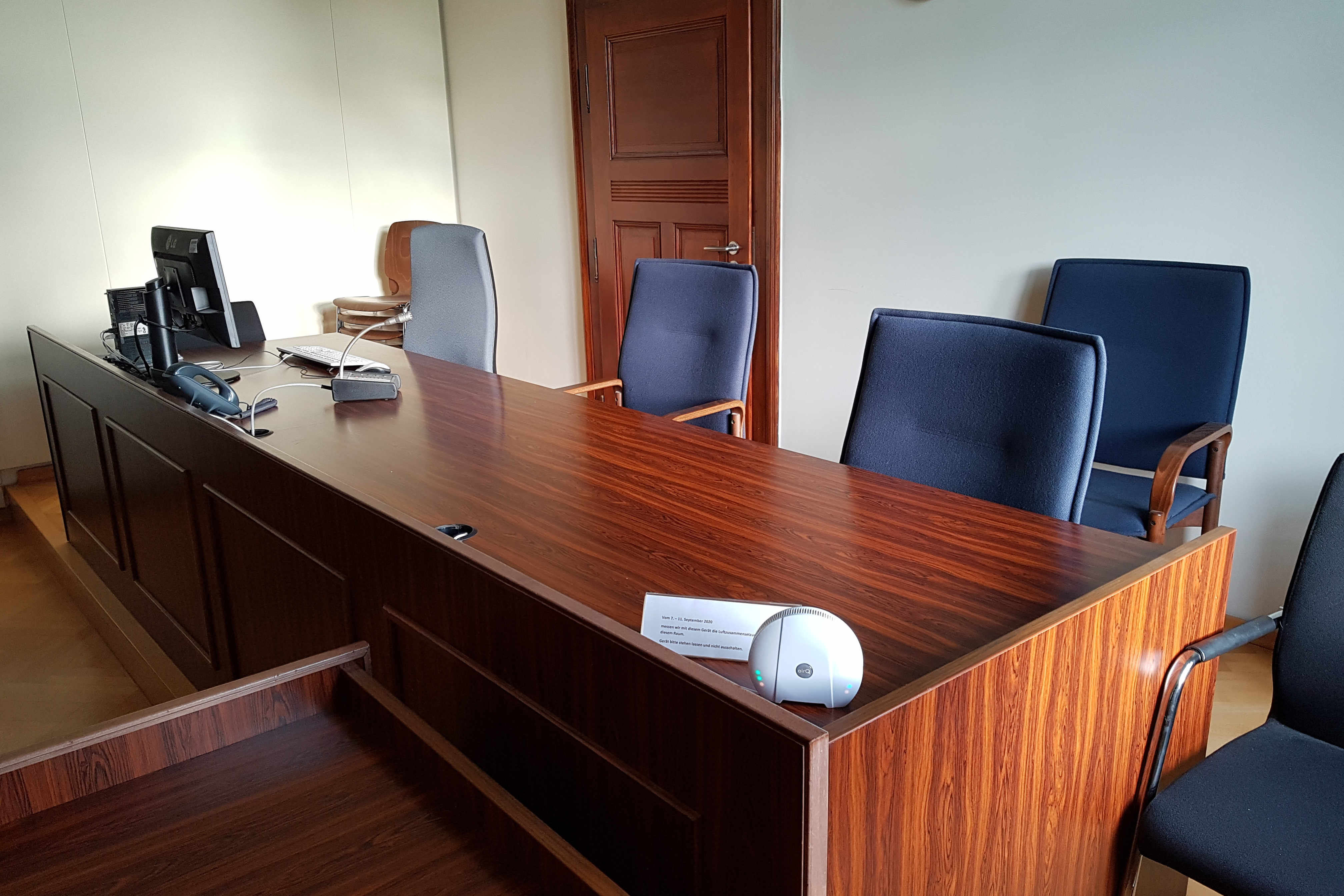
A total of three air-Qs were installed in different rooms — in an employee office where up to four employees work simultaneously, and in a small and a large courtroom, both of which held hearings during the week.
Large-scale air purifiers were already installed in the courtrooms. What effect these had during hearings regarding aerosol and VOC pollution, and whether additional ventilation took place to reduce carbon dioxide, is also shown by the air-Q air analyzers' data. Since the readings and results in the two hearing rooms are very similar, the small room is evaluated below as an example.
Evaluation of the measurements
In the courthouse, the air-Qs were operated without WiFi access, since for security reasons it wasn't possible to use the WiFi available there. The air-Qs were collected after the test and the data was then downloaded from the device. Since there was a very large amount of measurement data, we didn't opt for a data upload but simply removed the SD card and converted the data into a table using our CSV converter, then analyzed it in depth.
1. Air quality in the employee office
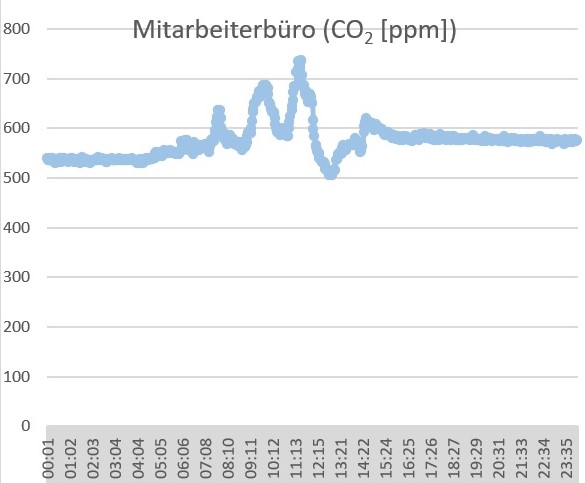
In the employee office, the window was tilted open and burst ventilation happened at regular intervals. This is nicely visible in the sawtooth pattern in the chart. Also, the rise in carbon dioxide between ventilation intervals isn't very strong, reaching a maximum of only 850 ppm. With the window closed, this value would already be reached after a short time.
2. Courtroom
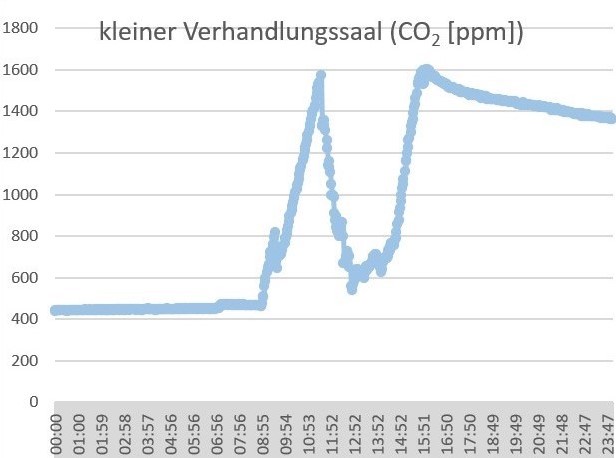
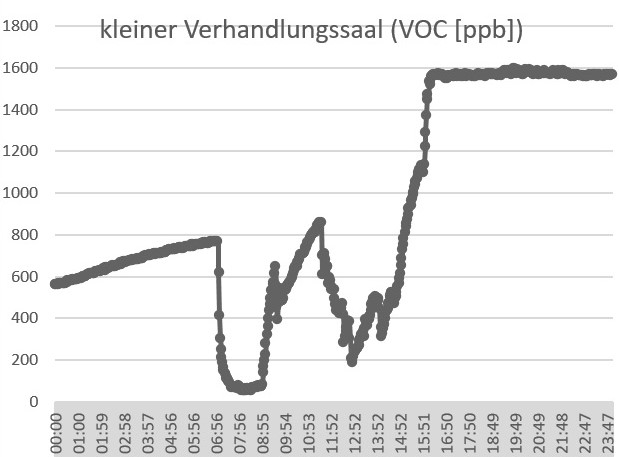
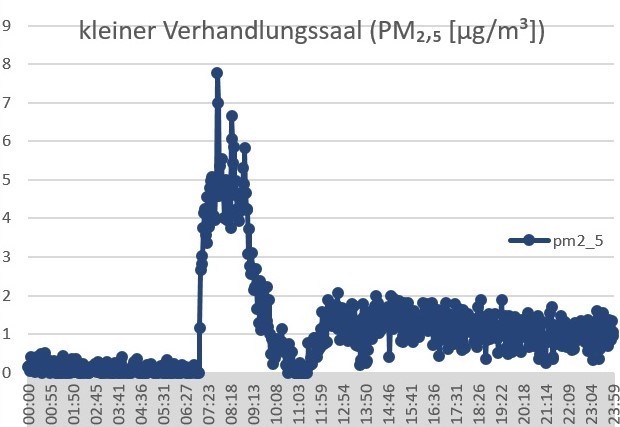
In the small courtroom, the times of court hearings are clearly recognizable — there were two sessions, between which extensive ventilation took place after the carbon dioxide level reached 1,600 ppm — from 9 a.m. and from 12:45 p.m. During the second session starting at 1 p.m., the VOC level rose significantly more than during the first session starting at 9 a.m. This can have various causes, for example:
- a stronger VOC source was present in the room during the second hearing (more people, stronger perfumes, type of lunch)
- the VOC level was reduced during the first hearing by an activated air purifier
While the window was closed shortly before the first session at 9 a.m. (recognizable by the sharply rising CO₂ value from 9 a.m.), the particulate matter reading (PM₂.₅) dropped very quickly from 9 a.m. down to "0" µg/m³. Unfortunately, no log was kept in the courtroom about the use of the air purifier present there. However, the pattern of the readings does suggest use of the air purifier — without an air purifier, the particulate matter reading would have stayed high for longer, declined only slowly, and possibly never dropped to "0." (See also our test of the Dyson air purifier.)
Comparison with the second session: after the first hearing ended at around 11:30 a.m., the particulate matter reading rose again, since the window was opened (again visible by the sharply dropping CO₂ value). From 12:45 p.m., the CO₂ value rose again quickly due to session attendees — the window was now closed again. This time, though, the particulate matter reading (PM₂.₅) stayed consistently high (albeit at a low level of just 2 µg/m³). With an active air purifier, the value would have quickly dropped back to "0." At the same time, the VOC value rose sharply to 1,600 ppb — considerably more than during the first hearing, by comparison. Both factors together (steady particulate matter reading and very high VOC value) suggest that the air purifier present was deactivated during the second hearing.
Conclusion — ventilation behavior and air purifiers work
The court follows strict anti-COVID-19 rules. In the offices, regular ventilation takes place, and the window is even tilted open the whole time at minimum. This can substantially reduce the risk of a COVID-19 infection, based on current knowledge.
In the courtrooms, it's not possible to keep the window open constantly. Opening it during a session is likewise impractical. For this reason, high-capacity air purifiers were installed. These do their job as hoped, are sized large enough, and can circulate room air strongly enough to reduce aerosols and thus potential viruses in the air during hearings. However, care should be taken to ensure the air purifiers are actually activated for every hearing. After hearings, thorough burst ventilation takes place, counteracting potential viral load as well as generally poor air and reduced ability to concentrate.