
Air Pollution in Major Cities: These German Cities Are Most Affected
Smoking cars, ships, chimneys on private homes or factories: urban life is shaped by exhaust fumes. Air measurements show just how bad the air really is in German major cities. We compare the readings of ten German major cities and reveal what health effects the pollutants have.
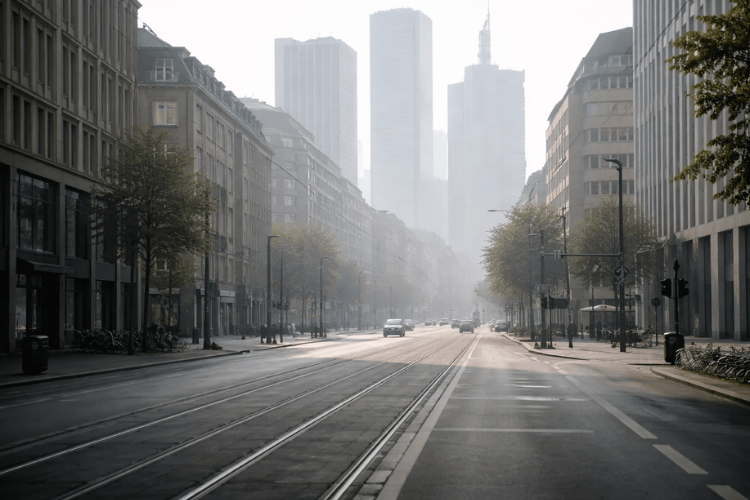
Due to the high volume of traffic and the sheer mass of people, the air in major cities is enriched with high amounts of pollutants, posing a serious health risk! Besides the high volume of traffic, power plants and district heating plants, heating systems, and metal and steel production cause air pollution in major cities. In these urban areas, a large number of pollutants enter the air and swirl around as tiny particles. Particulate matter and nitrogen oxides in particular minimize air quality here.
What are the health consequences of air pollution in major cities?
Air pollution in major cities demonstrably affects the cardiovascular system and can lead to chronic diseases here. The small particulate matter particles in particular enter the cardiovascular system via our respiratory organs – the smaller they are, the further they penetrate. While particulate matter with a particle size of 5 to 10 µm can only penetrate as far as the nasopharynx, particles of 3 µm already reach the bronchi. Even smaller particles manage to reach lung tissue and settle in the alveoli (air sacs). From here, the particles can either only be broken down very slowly, or often can't be removed again at all.
It's also believed that ultrafine dust particles can reach the brain via the olfactory nerve. Here, the pollutants affect cognitive performance by about two percent for every additional microgram of particulate matter in the air. For this reason, ultrafine particles are also considered to promote dementia.
Since particulate matter also attaches to pollen, the particles also enter the body via pollen dispersal. Since they can intensify the allergenic effect, asthmatics and hay fever patients in particular are affected by the effects of air pollution.
Which German major city has the worst air pollution?
We analyzed the annual reports of the Federal Environment Agency and examined 10 major cities with particularly poor air quality for their particulate matter and nitrogen oxide levels. This is our ranking:
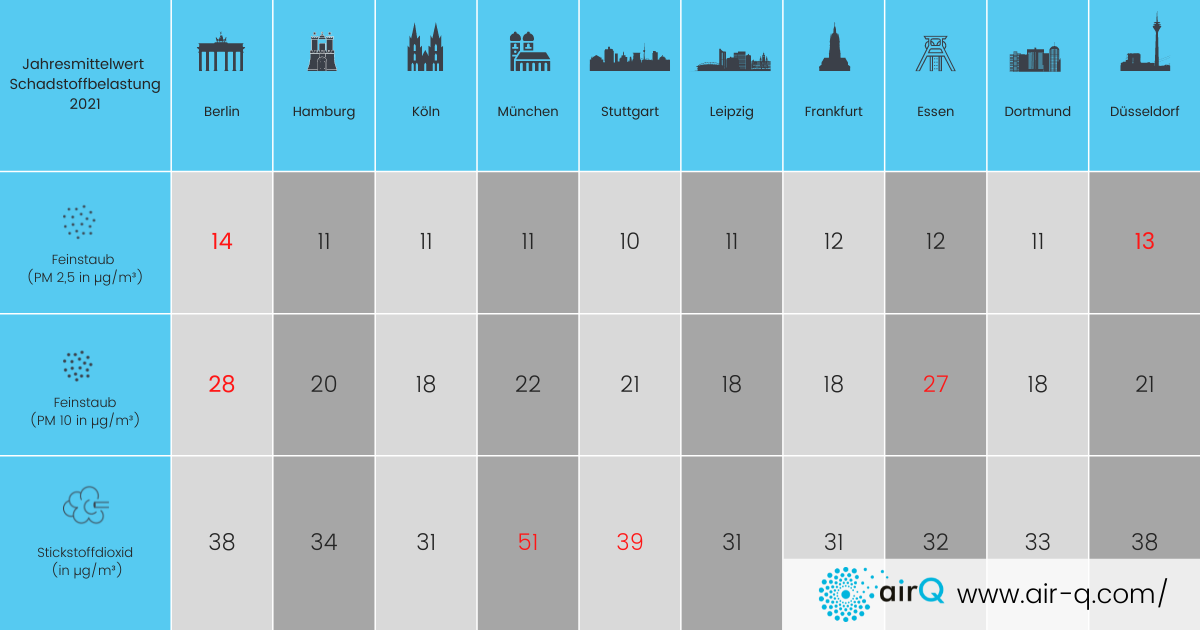
In the ranking, Berlin shows the highest particulate matter levels for both the larger PM₁₀ and the smaller PM₂.₅ particles. Essen closely follows in particulate matter levels. Berlin also shows high nitrogen dioxide levels at 38 µm/m³. Stuttgart, however, reaches 39, and Munich even 51 µm/m³.
But it's not just the major cities themselves that are affected. Due to wind and precipitation, particulate matter and similar pollutants travel many kilometers beyond city limits into the surrounding rural areas.
How can you protect yourself from air pollution in major cities?
Simply keeping the windows closed in major cities doesn't protect against poor air quality, though. That's because outdoor air quality in cities, despite air pollution, is usually still many times better than indoors. The reason: outdoor air renews itself because it circulates. This isn't the case indoors. Here, air quality declines without air exchange. To know when pollution levels are rising and air quality is reaching critical values, an air quality monitor like the air-Q is recommended. The air-Q reliably monitors particulate matter and nitrogen dioxide and warns you when action is needed.
.jpeg)