
10 Tips: How to Save Gas & Heating Costs This Fall & Winter!
We're in the middle of a gas crisis! Energy costs are exploding and everyone is bracing for the next heating bill or the upcoming gas purchase for their home. We'll tell you how to save gas, reduce your heating costs, and explain what your thermostat setting has to do with it. Discover many previously unknown tips now!
In our article, you'll find the following tips:
- Tip 1: Save gas with a high-performing heating system
- Tip 2: Adjust heating settings & reduce your heating bill
- Tip 3: Keep your radiators clear
- Tip 4: Heat individual rooms differently
- Tip 5: Save gas through demand-based heating
- Tip 6: Ventilate correctly & check air quality/room temperature
- Tip 7: Use (electronic) thermostats correctly
- Tip 8: Save gas with underfloor heating
- Tip 9: Insulate heating pipes & radiator recesses
- Tip 10: Check the insulation of windows, doors & roller shutter boxes
Tip 1: Save gas with a high-performing heating system
A functioning heating system is of course a prerequisite for saving gas and heating costs. So service, bleed and clean your heating system regularly. If your heating warms up unevenly and you hear gurgling noises, there's probably air in the heating system. Then it's time to bleed it. You can easily do this yourself with a bleed key. To make sure the water pressure is right, check it both before and after bleeding, and top up with water if necessary.
Check & top up water pressure
The rule of thumb for heating system water pressure is: to overcome a height difference of ten meters, a heating system needs a water pressure of at least 1 bar. For a single-family home or an apartment, the pressure should be between 1.5 and 1.8 bar. First check the pressure gauge on your heating system before topping up the heating water. There's often a marking to guide you toward the ideal range.
After checking the water pressure, you need to switch off the circulation pump and turn the thermostat valves on your radiators to the highest setting. Then connect the heating system to the tap – either via a permanent connection to the fresh water system or with a garden hose. Now you can open the filling valve on the heating system and top up with enough water.
Tip 2: Adjust heating settings & reduce your heating bill
If you have your own heating system, you should adapt it to your building and your own routine – this saves between 10 and 15 percent in energy. Program your personal heating profile with tailored time control and set your heating phases as well as setback periods.
Switch your heating off completely in summer or set it to hot water operation only.
Tip 3: Keep your radiators clear
If a radiator is blocked, e.g. by furniture, curtains, or textiles drying on it, the heat gets trapped behind this obstacle. The warm air can't spread evenly through the room or circulate freely. As a result, it takes longer to heat the room. The rule is: keep your radiators clear and maintain at least 30 cm of distance from furniture and similar objects. Also avoid radiator covers or floor-length curtains if they cover the heater.
Pro tip: Clean your heating regularly – including between the internal fins. Dust and lint can settle there, preventing optimal heat output.
Tip 4: Heat individual rooms differently
Depending on how a room is used, you need different temperatures. After all, it's fine for the living room to be warmer during a movie night than the bedroom under your duvet. So adjust your heating settings to match how each room is used, and avoid heating hallways or unused rooms. This lowers your energy needs and helps save on heating costs. Also close the doors of heated rooms so the warmth can't escape.
Our temperature recommendations per room:
- Bedroom 16 – 18 degrees
- Kitchen 18 – 20 degrees
- Living room 20 – 22 degrees
- Bathroom – 22 degrees
Caution: Rooms left unheated for long periods carry a risk of mold. That's why you should heat these rooms more intensively for a few hours from time to time in winter, and ventilate them as well. Check the absolute and relative humidity with an air quality monitor, for example the air-Q. This way you'll know when it's time to exchange the air, save on heating costs through demand-based ventilation, and prevent mold growth.
Tip 5: Save gas through demand-based heating
Also, only heat when it's actually necessary. After all, if you're not in your apartment or house, the rooms don't need to be heated up either. Anyone who lowers the temperature also lowers their heating costs and thus their heating bill.
The widespread myth that "leaving the heating on overnight saves energy" is not true. As a general rule: the less you heat, the more energy you save and the lower your costs. So always turn off the heating when you're asleep, at work, or leaving your home for an extended period.
With a programmable thermostat, you can set the exact temperature and even a time schedule. For example, the thermostat can be set so that your heating runs in energy-saving mode overnight or while you're at work, or even switches off entirely! Use the timer to set the heating to kick in at, say, 6 a.m. if you get up at 7 a.m. and want to enjoy warm rooms. You can likewise deactivate the heating on a schedule, for example an hour or half an hour before you leave, since the heating continues radiating warmth for a while even after it's switched off.
Tip 6: Ventilate correctly & check air quality/room temperature
Unfortunately, this point is often underestimated. A window left ajar provides far less fresh air than you'd think and results in an extremely high loss of heat. Instead, rely on regular but brief burst ventilation. With an air quality monitor that measures carbon dioxide (CO₂), you can precisely track when the air is stale and it's time to ventilate, as well as when you can close the window again to avoid losing unnecessary heat. Some devices measure not only air quality but also temperature, so you can also check whether it's getting too warm.

This winter, amid the gas crisis, it pays to keep a close eye on everything and track it carefully. Because heating has never been this costly.
Tip 7: Use (electronic) thermostats correctly
Use an electronic thermostat – it saves around 10 percent energy compared to a standard thermostat. Set your electronic thermostat to your desired room temperature. Use our temperature recommendations as a guide. Because for every degree lower you set it, you reduce your consumption by roughly another 6 percent. This noticeably lowers your energy needs.
Electronic thermostats don't display settings, but the actual temperature. This lets you fine-tune your temperature setting precisely. Standard thermostats, on the other hand, display settings. What these settings mean and how to find the right temperature is shown in our graphic.
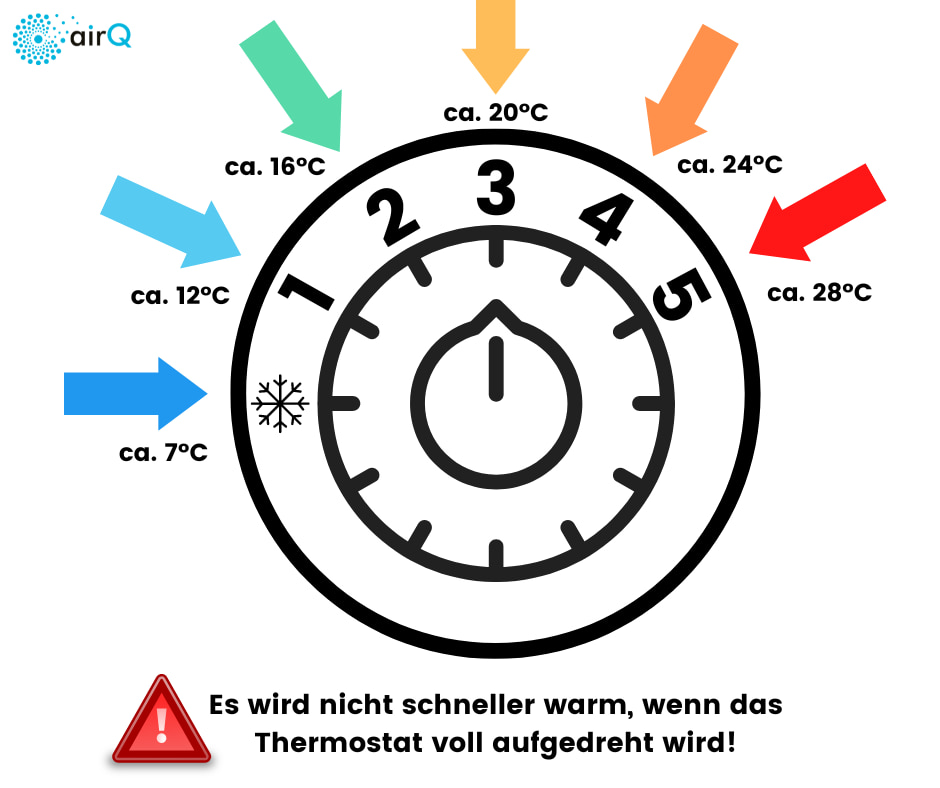
The gap between each setting is about 4 degrees, so the small marks between the settings each represent 1 degree.
Tip 8: Save gas with underfloor heating
With underfloor heating, you need to factor in the long lead time when planning your heating schedule. However, once the floors are warm, they retain that heat for a long time. So timers and heating profiles are ideal here too. Increase the temperature before you arrive or wake up. Some underfloor heating systems take several hours to reach the desired temperature. However, you can switch them off at least an hour before leaving the house, since your underfloor heating will keep radiating warmth for a long time afterward.
Tip 9: Insulate heating pipes & radiator recesses
Make sure your heating pipes are well insulated. Even just a few meters of uninsulated pipe running through, say, a cold basement, can cause enormous heat loss. Insulation noticeably lowers your heating bill. In fact, insulating your pipes saves up to 20 euros per meter of pipe in heating costs each year.
Older buildings also often have radiator recesses in exterior walls that aren't well insulated. Thin wall sections combined with hot radiators multiply heat loss – you lose around 15 euros of heating warmth per square meter each year. Good insulation is the only remedy here, for example with polyurethane panels or aerogel mats. Ideally, the insulation should have an aluminum facing that reflects heat radiation back into the room. Make sure the insulation material seals airtight against the wall on all sides, otherwise there's an increased risk of mold.
Tip 10: Check the insulation of windows, doors & roller shutter boxes
Leaky doors, windows, and roller shutter boxes also encourage unpleasant drafts, which cause heat loss. Check whether your windows and similar fixtures are properly sealed by holding a candle in front of them or clamping a sheet of paper in the gap. If the flame flickers or you can pull the paper out easily even with the door or window closed, it's leaky and the insulation is essentially zero. In that case, it helps to readjust the window sashes or replace the seal. Stop drafts at doors with a so-called draft excluder.
Insulating your roller shutter box is also worthwhile. Every insulated square meter saves up to 15 euros a year. You can use either a custom-fit part, a flexible insulation panel, or high-performance insulation panels made of polyurethane or phenolic resin, which have lower thermal conductivity.
We wish you successful energy savings this fall and winter, and a lower utility bill in the coming year.