
Winter Season = Mold in the Home?
Mold in the home is harmful to health. Often, however, the danger isn't immediately visible to the naked eye. Nevertheless, mold spores in the air negatively affect health and ideally shouldn't be allowed to form in the first place. We explain how you can detect, and even prevent, possible mold infestation based on air components.

This article covers the following topics:
- Mold in the home can make you sick
- How mold forms
- Mold and humidity
- How to prevent mold in your home
- Controlling humidity with the air-Q
There are different types of mold, some of which are suspected to be especially dangerous (e.g. black mold). So far, there are no limit values for the respective mold exposure, since it's unclear at what concentration of mold spores in the air a health hazard exists. Nevertheless, mold in the home should generally be avoided.
Mold in the home can make you sick
Mold in the home can cause various complaints. The inhaled spores and mold byproducts (VOC gases from decomposing organic material) can cause allergic or irritating reactions or worsen existing conditions — especially respiratory ones. Symptoms are nonspecific and range from burning eyes, headaches and joint pain, to inflammation of the mucous membranes and breathing problems, to gastrointestinal complaints. To avoid this, mold in living spaces should be removed as quickly as possible for hygiene and health reasons. Better still, mold shouldn't form in the first place.
How mold forms
Mold infestation can occur in both old and new buildings, since the fungus only needs warmth, water, and organic material. The latter can be found everywhere; for example, wood, wallpaper, plaster, adhesive, or even dust can serve as a growth medium. Indoor mold is almost exclusively a winter problem. Warm heating air creates optimal conditions for mold. The underlying problem: due to cold temperatures, rooms are often not ventilated regularly. Breathing and moisture from people, plants, and animals then increases indoor humidity. A perfect climate for health-harming spores.
Mold and humidity
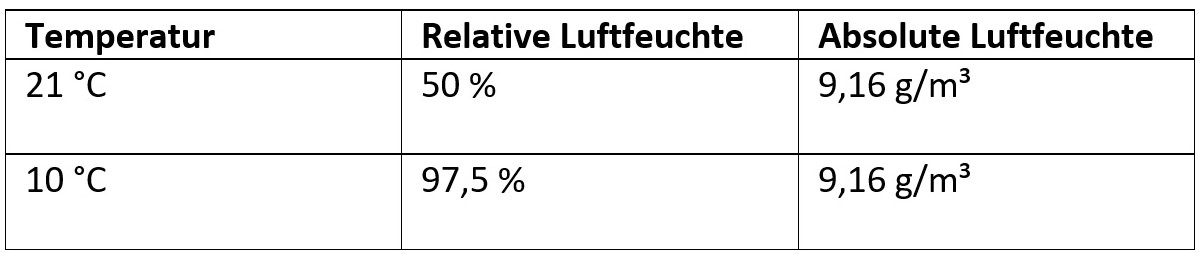
Things get critical when humidity in the room is especially high. Water then begins to condense, for example, on exterior walls, windows, or window frames. The reason for this lies in the very uneven temperature distribution in the room. While the middle of the room has a pleasant 21 degrees, it's often several degrees cooler near windows or directly against the wall. This affects humidity. Although absolute humidity is the same throughout the room (9.16 g/m³ in the example below), relative humidity can quickly rise to the condensation point (see also dew point). This causes condensation to form.
Mold formation often occurs especially in the bedroom, since this is usually the coldest room. In addition, the room's humidity rises sharply at night due to exhaled breath. Due to the lack of air exchange, condensation can then form on cold surfaces, such as windows. Mold also quickly forms in the kitchen. Here, cooking or washing dishes produces water vapor, which generally increases the room's humidity. If there are large temperature differences between the various rooms in a home, this can also promote mold in the cooler rooms. Aquariums or plants also contribute to an increase in humidity, since they continuously release water vapor into the air.
Humidity and mold: protective measures for a healthy home
The relationship between humidity and mold formation is a decisive factor for health and safety indoors. Mold fungi are microorganisms that thrive in damp environments. When humidity in a room stays consistently above 60%, mold spores can easily settle and grow. This can lead not only to structural damage in your home, but also to significant health problems, especially for people with allergies, asthma, or other respiratory diseases.
Why is controlling humidity important?
Proper humidity is crucial for preventing mold formation. In many households, the importance of humidity is often underestimated until visible signs of mold appear. Excessively high humidity creates a perfect environment for mold, while too-low humidity can also cause problems, like dry skin and irritated airways. It's therefore important to find a balance and keep humidity in an optimal range between 40% and 60%.
How does humidity affect mold formation?
Mold needs moisture to grow. When humidity is high, water condenses on cold surfaces like walls, windows, or floors, creating perfect conditions for mold. Areas with poor ventilation, like bathrooms, kitchens, and basements, are especially at risk. In these rooms, humidity can rise quickly if not adequately ventilated.
Strategies for controlling humidity
- Ventilate regularly: Open windows and doors regularly to improve air circulation and remove excess moisture from the room. Especially after showering or cooking, it's important to direct the humid air outside.
- Use a dehumidifier: In rooms with consistently high humidity, using a dehumidifier can help reduce moisture. These devices draw excess water out of the air and help keep humidity at a safe level.
- Heat properly: Make sure your rooms are adequately heated, especially in winter. Warm air can hold more moisture, which reduces the risk of condensation and thus mold formation.
- Minimize moisture sources: Repair leaky faucets, pipes, and roofs to eliminate additional sources of moisture. Also make sure dryers and range hoods are properly vented to the outside.
- Install humidity sensors: These devices help you monitor humidity in your rooms and take timely action before mold forms.
How to prevent mold in your home
Proper heating and ventilation are essential for preventing mold infestation. You should ventilate generously after showering, bathing, cooking, or even ironing. This lets the water vapor produced escape outside. To do this, ideally open windows fully and ensure thorough airflow for five to ten minutes. In addition, if possible, you should avoid drying laundry in living spaces. If this isn't possible, ensure a regular supply of fresh air. When placing furniture, make sure radiators aren't covered. Only this way can warm indoor air always circulate well in front of the cooler exterior walls, to avoid cold-warm bridges (i.e. spots where the dew point can easily be reached).
So the higher the humidity, the better the conditions for mold. Accordingly, humidity should always be monitored, especially in winter. The maximum limit value is 60 percent humidity. If humidity stays below 60 percent, you prevent mold infestation as best as possible. Nevertheless, relative humidity shouldn't be too low either, to prevent the mucous membranes from drying out (see blog article on minimum humidity).
Controlling humidity with the air-Q
By measuring humidity throughout the day, humidity peaks become visible. This lets you take countermeasures and thus prevent mold. This can be easily accomplished with simple hygrometers or, even more easily, with the air-Q. The air analyzer continuously monitors and records all readings like humidity, temperature, and also air pollutants. In the air-Q, absolute humidity is determined by a relative humidity sensor with very high accuracy. From the measured value, the air quality monitor precisely derives absolute humidity.
(Cover image: Pixabay / StockSnap)