Why Do You Need a Formaldehyde Meter?
Formaldehyde (CH₂O) is colorless and has a pungent smell. The dangerous part: at room temperature, the substance becomes gaseous and enters the body through breathing. We explain how formaldehyde forms, what symptoms and health risks threaten, and which furnishings contain CH₂O.

Formaldehyde: The foul-smelling household toxin
Indoors, CH₂O occurs almost exclusively as a gas, since room temperature causes the substance to evaporate. Since formaldehyde is contained, for example, in adhesives and thus in wooden furniture, you quickly come into contact with the gas. You can recognize an elevated concentration by a typical chemical smell. To detect even low concentrations, it's advisable to monitor this air pollutant. With an air quality monitor like the air-Q, you detect it in indoor air and are warned when limit values are exceeded.
How does formaldehyde form?
As an intermediate product of metabolism, formaldehyde is formed in mammalian cells. The substance is also a completely natural component of fruits and is absorbed through food. CH₂O also occurs in wood, meaning furniture and other wooden furnishings release small amounts of the gas. In addition, incomplete combustion and other oxidation processes of longer-chain organic substances, e.g. methane and volatile organic compounds (VOCs), release the gas. Formaldehyde is also released during smoking, entering the room this way. During industrial processes, CH₂O is produced through the so-called catalytic oxidation of methanol.
Where does formaldehyde occur indoors?
Since formaldehyde is a component of adhesive, it's used in many engineered wood products and furniture. Particleboard and plywood are primarily affected here, since they're especially heavily infused with the substance and can therefore off-gas it. It's also used as a preservative and as a starting material and component for many chemical compounds of plastics, making it one of the most important basic organic substances in the chemical industry. In addition, CH₂O is water-soluble and is therefore used as an aqueous solution for preservatives and disinfectants.
Effects of a high formaldehyde concentration
- Allergies
- Respiratory, eye, & skin irritation
- Impaired memory & concentration
- Sleep disturbances
- Carcinogenic & mutagenic
Why should you have a formaldehyde meter at home?
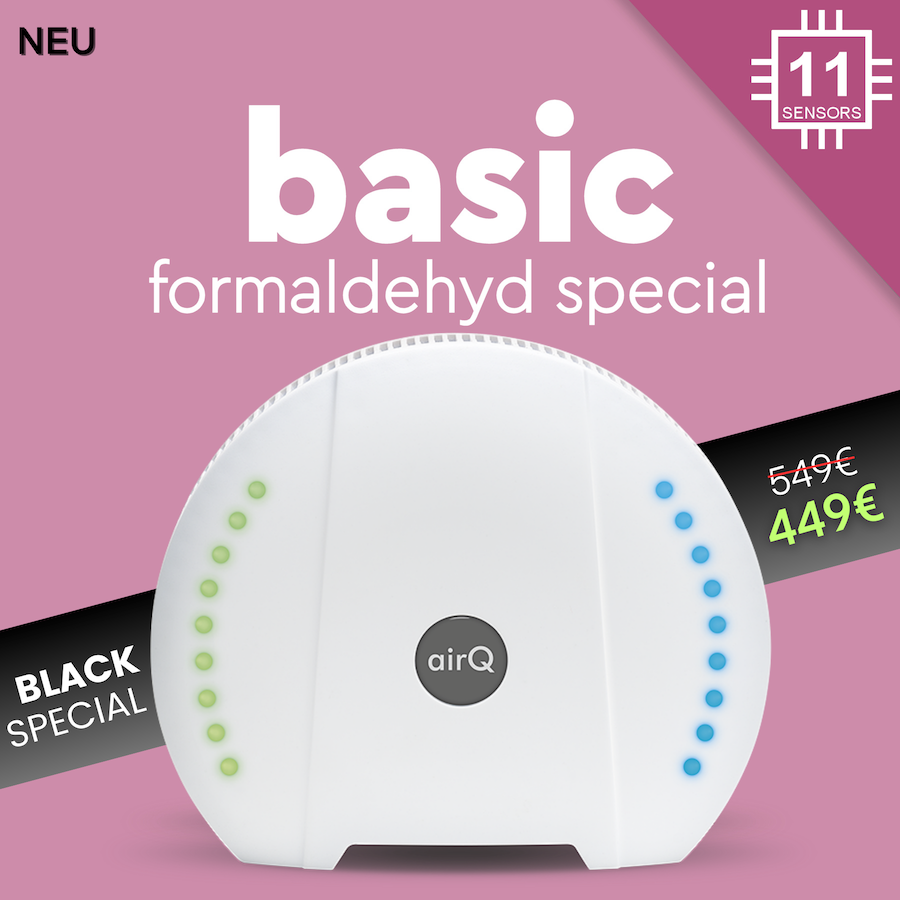
Wooden furniture, cheap adhesives, or other plastics off-gas toxic substances. With every breath, the gas enters the body and can spread within it. A special air quality monitor like the air-Q "Formaldehyde Special" measures formaldehyde indoors and warns you of hazardous concentrations, so you can protect yourself. If the reading exceeds the set limit, the air analyzer triggers an alarm and/or sends you a push notification.
You can get our air-Q basic "Formaldehyde Special" as a limited special edition at a reduced price until December 2023. During our Black Special promotion, you get €100 off the air quality monitor.