
WELL Certification for Companies with the air-Q Air Quality Monitor
With a WELL certification, companies signal that they are taking measures for a healthy work environment. We introduce the certification and show why the air-Q device plays a crucial role in it. Learn now how to improve well-being and productivity in your workplace.

What is the WELL certification?
The WELL certification is an internationally recognized standard for buildings. It aims to improve the health and well-being of the people who live and work in the buildings. It focuses on various aspects like air and water quality, nutrition, fitness, comfort, and mental well-being. WELL-certified buildings must meet strict criteria for the certification, developed by the International WELL Building Institute (IWBI). To obtain certification for a building, independent analysts verify that the required criteria for certification are met. With the seal, companies and real estate developers can position their buildings as healthy and sustainable environments.
For which areas can the WELL certification be applied?
The WELL certification covers a wide range of areas. All criteria assess how strongly the building's construction or interior fit-out affects the physical and mental living health, comfort, and well-being of workers and residents. Aspects of the users' community are also considered. These areas are referred to as WELL categories and include the following parameters:
- Air: Measures to improve air quality, including controlling pollutants and promoting good ventilation. With the air-Q air quality monitor, you can verify this parameter and qualify for certification.
- Water: Ensuring the quality and accessibility of drinking water as well as promoting responsible water use.
- Nutrition: Promoting healthy eating habits through access to healthy food and eating areas.
- Light: Optimizing lighting to promote visual health and support the natural sleep-wake cycle.
- Movement: Creating environments that promote physical activity and encourage an active lifestyle.
- (Thermal) Comfort: Creating a pleasant and productive work environment through ergonomic design and temperature control.
- Sound: Noise can cause stress, thereby impairing concentration and performance and even having long-term effects on physical and mental health. The certification therefore assesses measures that block outside noise and create good room acoustics by reducing reverberation time and sound reflection and improving speech intelligibility.
- Materials: The focus is on using low-emission and resource-conserving building materials.
- Community: The goal is to create a connection between the building and the surrounding community, to promote health and well-being for everyone.
- Mind: Promoting stress management, concentration, and positive interpersonal relationships in the workplace.
To receive the award, buildings must meet minimum requirements. There are the following certification levels: WELL Bronze (40 points), WELL Silver (50 points), WELL Gold (60 points), and WELL Platinum (80 points).
Why is WELL certification worthwhile for employers?
With a WELL certification, employers present themselves as a responsible and caring organization that cares about the well-being of its employees.
- Employee health & well-being: WELL-certified buildings promote employees' health and well-being. This can lead to higher satisfaction, lower illness rates, and better work performance.
- Attractiveness as an employer: The WELL seal serves as a signal to potential employees that the company cares about their health and well-being. This can help attract and retain top talent.
- Productivity boost: A healthy and comfortable work environment can increase employees' productivity by improving their concentration, reducing their fatigue, and fostering their creativity.
- Reduced illness costs: By creating a healthier work environment, employers can lower illness costs by reducing sick days.
- Sustainability & environmental friendliness: Many of the criteria for WELL certification aim to reduce buildings' environmental impact, for example by lowering energy and water consumption and promoting the use of sustainable materials.
Supporting Your WELL Score with air-Q
The air-Q helps companies implement WELL certification requirements in the Air category based on data. Through continuous measurement of key indoor air parameters, WELL-relevant evidence can be prepared, limit values monitored, and improvement measures made visible.
Which WELL categories is air-Q especially relevant for?
Continuous indoor air measurement can support various requirements within the WELL certification. air-Q is especially relevant for the following areas:
| WELL Category | Max. WELL Points / Status | How air-Q Helps |
|---|---|---|
| A08 – Air Quality Monitoring & Awareness | up to 2 points | Continuous measurement and visualization of air quality |
| A01 – Air Quality | Precondition | Supports evidence of good indoor air via measurement data |
| A03 / A06 – Ventilation | A03: Precondition A06: depending on path, up to 3 points can be supported |
CO₂ measurement as an indicator of sufficient ventilation |
| A05 – Enhanced Air Quality | up to 4 points | Monitoring of additional air pollutants such as particulate matter, VOC, formaldehyde, or CO |
| T01 / T07 – Thermal Comfort & Humidity | T01: Precondition T07: up to 1 point |
Measurement of temperature and humidity |
How many air-Q devices are needed?
For the WELL air quality monitoring requirement, typically at least three relevant air parameters are measured, for example CO₂, particulate matter, and VOC/formaldehyde. In addition, one monitor per 325 m² of occupied floor area, or at least one device per floor, is usually planned.
Occupied floor area refers to areas where people regularly spend time, such as offices, meeting rooms, lounge areas, reception areas, or classrooms. Technical rooms, pure storage areas, or rarely used auxiliary rooms are usually not counted.
With air-Q, operators get a simple foundation for permanently monitoring air quality, documenting measures traceably, and professionally supporting the requirements for healthy indoor spaces.
Note: air-Q does not replace WELL consulting. Final approval of points depends on the specific project, the WELL version, the specific feature selection, and review by IWBI or WELL reviewers.
WELL Certification with the air quality monitor for home air-Q
Air quality significantly affects the well-being and health of people indoors. The WELL certification therefore examines and evaluates air quality very closely. This ensures that the air in a building is clean, fresh, and healthy.
If you're pursuing the WELL certification, the air-Q air quality monitor can support you. For the Air parameter, you need to ensure continuous air quality measurement. The air-Q, the most powerful air quality monitor with the most sensors on the market, meets all the requirements for this. We are therefore pursuing inclusion in the WELL portfolio and will apply for approval. The air quality monitor provides corresponding evaluations for the following criteria:
Air pollutants
With up to 16 sensors, the air-Q captures all relevant air parameters in real time and analyzes them for their effect on health and performance. Based on this measurement data, you can take measures to minimize exposure to air pollutants like VOCs (volatile organic compounds), formaldehyde, and off-gassing pollutants from building products, furniture, and cleaning products, as well as noise or particulate matter.
Humidity & ventilation
By monitoring humidity, you can keep it at an optimal level to prevent mold growth and the spread of pathogens. In addition, via the air analysis you ensure adequate fresh air supply and monitor CO₂ levels indoors, which improves concentration and well-being for users.
Filtration & cleaning
The smart-home-capable air-Q complements your air filtration system. This lets you control your air purifier based on data for demand-based air cleaning. If the air-Q detects a need for action, it activates the air purifier, so that pollutants and particles are removed from the air exactly when necessary.
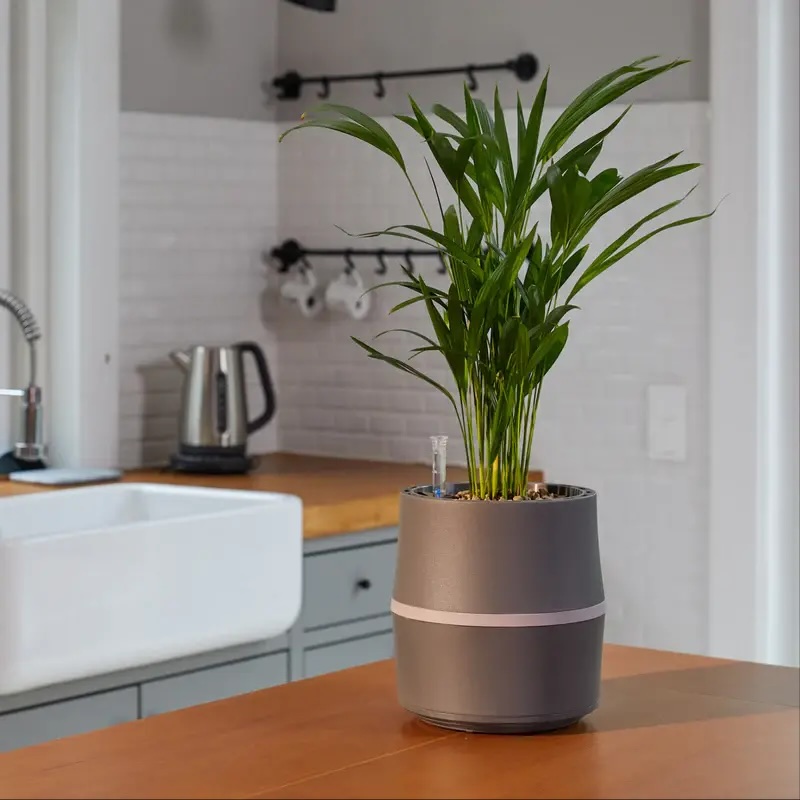
With our partner AIRY, you also contribute to improved air quality. The planters with innovative biofilters and a patented natural indoor air purification system clean the indoor air of VOCs, particulate matter, and other air pollutants. Especially for offices, the air-Q and the AIRY systems are the perfect combination for clean air. We tested the effectiveness of the AIRY systems in a practical test; you can find the results in our article. You can find more information about the smart air purification systems at airy.green.
Smoke-free environment
With the smoke alarm, you ensure a smoke-free office. This lets you detect and minimize exposure to tobacco smoke and even e-cigarettes and vapes, protecting air quality for your employees.
The compact air-Q air quality monitor integrates easily into your office and can even be mounted on a wall. Via the WiFi connection, your air-Q sends the collected data to the air-Q cloud and/or your own system. Using the air-Q health and performance index, you learn how good the air in the office is and what measures you can take to improve air quality. Using clear charts, you can quickly evaluate reading trends, detect limit value exceedances, and stay able to act. The air-Q shows how the air quality in the room is behaving via its intuitively readable LED bar, and also sends push notifications and emails when it's time to exchange the air.