
The Ventilation Plan for Public Spaces: A Step Toward Improved Air Quality
Do you ventilate your home regularly to breathe good air? But what about public spaces like schools, offices, or bars? Belgium and France are using ventilation plans to improve indoor air quality and reduce the spread of disease. We take a look at what this regulation actually contains.

Reasons for the ventilation plan in public spaces
In the wake of the Covid pandemic, France and Belgium agreed on a ventilation plan for all publicly accessible places such as bars, restaurants, cinemas, theaters, or gyms. The legal basis "for improving indoor air quality in publicly accessible enclosed spaces" reflects lessons learned from the pandemic:
- Improving air quality: a fresh air supply dilutes and removes pollutants and unpleasant odors, improving overall indoor air quality.
- Preventing disease transmission: the ventilation plan aims not only to contain Covid-19 but also to minimize the risk of transmitting other respiratory illnesses. This requires good ventilation, which reduces the concentration of pathogens like flu in the air.
Beyond the Covid-specific aspects, good air quality contributes to general well-being and can reduce health complaints like headaches and fatigue. To make the measures verifiable, the agreement mandates air quality monitoring.
Air quality in public spaces: the content of the ventilation plan
Europeans spend 85 percent of their day indoors, and not just within their own four walls. Whether at the workplace, a bar, or a cinema: you should know what's in the air and what substances you're breathing in. The importance of good ventilation in public spaces is often underestimated, though. Besides air exchange, air quality is significantly influenced by room size and the number of people present.
With every exhale, oxygen saturation decreases, carbon dioxide concentration (CO₂) rises, and room air can become enriched with pollutants or pathogens. That's why the amount of CO₂ in room air is used as an indicator of the air renewal rate: if the CO₂ value exceeds the threshold, an air exchange is needed. According to the German Federal Environment Agency, the CO₂ threshold is 1,000 ppm.
Obligations of the indoor air quality law
A well-thought-out ventilation plan comprises various measures and guidelines to ensure adequate air circulation and fresh air supply in public spaces. Starting October 1, 2024, all enclosed public places wishing to implement the law on a voluntary basis must comply with these core elements of the ventilation plan:
- Measuring air quality: continuous monitoring of air quality, especially CO₂ concentration, is essential to ensure ventilation is adequate.
- Transparent display of air quality via a CO₂ meter: a CO₂ measuring device must be present and clearly visible to the public for air measurement. This lets visitors to the indoor space assess the level of indoor air quality. To avoid distorting readings, the measuring device may not be placed in the immediate vicinity of a door or window.
- Conducting a risk analysis: managers of public places are required by the ventilation plan to conduct a risk analysis. This should list all factors affecting indoor air quality — such as existing ventilation and air purification systems. An action plan should also list planned measures to achieve better indoor air quality.
- Regular, needs-based ventilation: public buildings should be ventilated regularly. Ventilation intervals should be based on the CO₂ measuring device's readings, so stale room air is exchanged depending on air quality. This can happen either through natural ventilation (e.g. opening windows and doors) or through mechanical ventilation systems.
- Installing & maintaining ventilation systems: where possible, mechanical ventilation systems should be installed and regularly maintained to guarantee a constant fresh air supply.
- Minimizing aerosol formation: measures to reduce aerosol formation, such as wearing masks and limiting the number of people in enclosed spaces, are also part of the ventilation plan.
The ventilation plan includes two (non-mandatory) target values. These reference levels are treated as guideline values. They are therefore not binding, but rather serve as orientation for assessing existing air quality:
- Level A: a CO₂ concentration of less than 900 ppm (parts per million) should be achieved — meaning 0.09% of air volume is enriched with CO₂. For this, ventilation and/or air purification at a rate of at least 40 m³ per hour and person must be ensured. At least 25 m³ per hour and person of this must come from ventilation with outdoor air.
- Level B: a CO₂ concentration of less than 1,200 ppm (meaning a percentage share of 0.12% of air volume) should be achieved. In addition, a ventilation flow of at least 25 m³ per hour and person should be reached.
The higher the ventilation rate, the greater the air exchange and the lower the concentration of viruses and other pollutants in the room.
Starting in 2025, visitors to public places in Belgium and France are to be informed about indoor air quality via a quality seal. Through the certification and labeling system, the public is informed about how room air is measured and controlled. Starting next year, certification officers will assess the presence of ventilation or air purification systems, the number of people admitted, and the measures taken by the manager, and will award certificates. The labels will also be listed in a central database, so that in the event of another pandemic, targeted measures for different public areas are possible.
Meeting the ventilation plan — with the air-Q air monitor
Air monitors like the air-Q meet the standards of the indoor air quality law, or can be used to implement a ventilation plan. Thanks to its LED display and the ability to keep air quality development constantly visible via Smart Widgets, the air monitor is a valuable aid in complying with a ventilation plan. The advanced air analyzer measures not only CO₂ but also detects up to 14 further air pollutants and reliably warns of dangerous situations like fire, gas, and burglary. With it, you measure a wide range of pollutants such as particulate matter (PM₁ – PM₂.₅ – PM₁₀), carbon dioxide (CO₂), oxygen (O₂), sulfur dioxide (SO₂), volatile organic compounds (VOC), nitrogen dioxide (NO₂), carbon monoxide (CO), ozone (O₃), hydrogen sulfide (H₂S), relative & absolute humidity, temperature (T), dew point (Td), air pressure (p), noise (Lp).
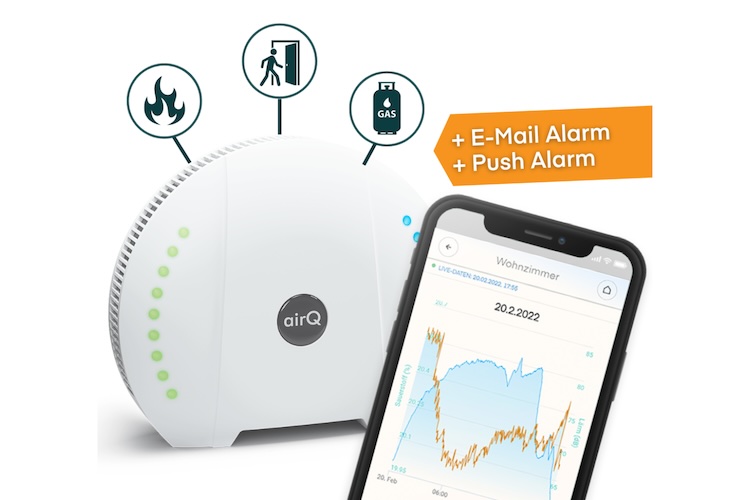
Besides air analysis, the air-Q offers you alarms for various scenarios:
- Fire & smoke: the sensitive sensors warn you early of fires.
- Toxic & flammable gases: the air-Q detects even the smallest amounts of dangerous gases and alerts you via push notification and LED display of an impending gas explosion.
- Cigarette smoke: smoking isn't allowed in your public space? The air-Q detects violations.
- Access/burglary: if you're on vacation or your indoor space is closed to the public, the air monitor informs you of unauthorized access.
- Offline/power outage: should the air-Q go offline due to a power outage, you'll receive a notification about it.
Conclusion
The indoor air quality law in Belgium and France represents a significant step toward promoting public health. Through the ventilation plan's measures, improved air quality in public spaces can be achieved, disease spread reduced, well-being increased, and productivity raised. While these requirements don't currently exist in Germany, awareness of the need for good indoor air quality for health is growing. Comparable regulations are therefore conceivable in the future.
The air-Q air monitor helps you continuously monitor air quality and thus meet legal requirements. Thanks to the LED display and Smart Widgets, air quality development is always visible. This ensures the defined standards are met at all times. This not only protects public health but also creates a more pleasant and safer environment.