
How Well Does the Venta AH902 K Air Purifier Work – The Test in the air-Q Lab
We simply can't live without it: air. But when it comes to air quality, there are big differences. We can't see bad air, but it can still make us sick. To prevent that, there are technical aids known as air filters and air washers. We tested how these work in our air-Q Lab.
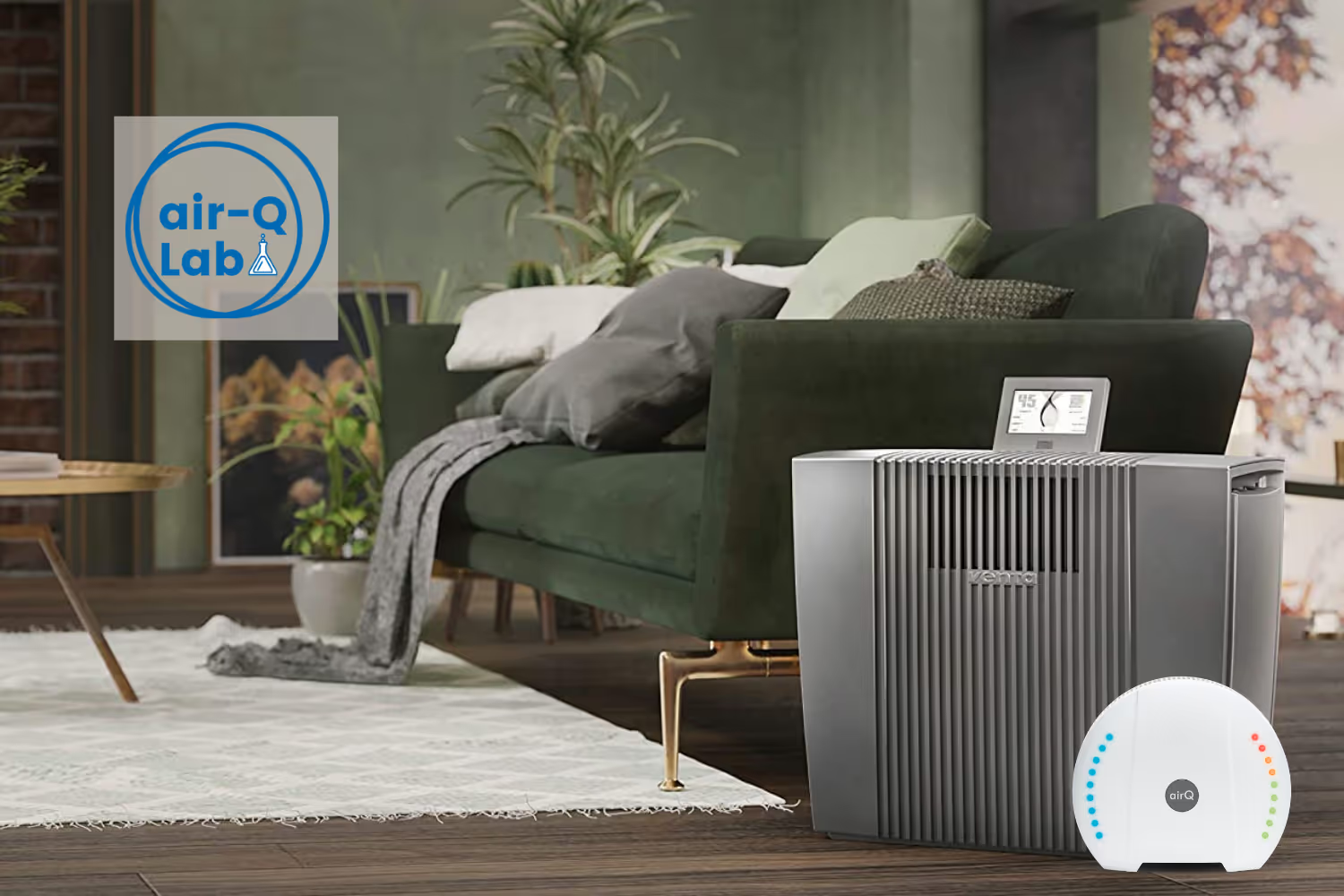
Admittedly, the terms air filter and air washer seem confusing, and at first glance they're also quite similar. Nevertheless, the devices differ. The respective name already reveals which device is responsible for which function.
What can an air filter do?
Air purifiers filter indoor air, removing things like dust, pollen, or cooking odors. There are various types of filters for this: for example carbon filters or so-called "High-Efficiency Particulate Air/Arrestance" filters — HEPA filters for short. You'll find carbon filters, for example, in range hoods that don't vent to the outside. But HEPA filters can do even more and, so to speak, churn over the indoor air. They can filter air particles that are only fractions of a micrometer in size.
What can an air washer do?
Air washers actually wash the indoor air. Unlike air purifiers, though, the air isn't cleaned by filters, but by a water bath. Allergy sufferers know this all too well: when pollen levels outside are high, nothing helps as much as a heavy rain shower. After that, breathing immediately becomes easier again.
Venta AH902 Professional K: the portable air washer with humidification
Our test device, the Venta AH902 Professional K, is an air washer. A fan draws in indoor air and channels it into the water-filled air washer. Inside the device, stacks of plates rotate, catching pollutants like dust or pollen. The air is cleaned in the water, and pollutants are collected in the air washer. Hygienically clean water is evaporated into the room via the plates. In our air-Q Lab, we were able to determine that the air purifier removes both VOCs and particulate matter particles from indoor air.
What is VOC?
Under VOC (Volatile Organic Compounds) we understand the group of volatile organic compounds. This includes gaseous and vaporous substances of organic origin found in our air. For example, these are hydrocarbons, alcohols, aldehydes, and organic acids. Many solvents, liquid fuels, and synthetically manufactured substances can occur as VOCs. But numerous organic compounds that arise from biological processes (such as mold formation) also belong to the VOCs.
If the VOC concentration exceeds limit values, this can lead to an altered perception of smell and taste, or show up as irritation of the eyes or mucous membranes. Other effects are poor concentration, exhaustion, dry skin, eczema, and headaches. The Federal Environment Agency has set guideline values for the concentration of certain VOCs in indoor air.
| Concentration range [mg TVOC/m³] | Hygiene status | CO2 concentration (ppm) | |
| Level 1 |
<= 0.30 mg/m³ | hygienically harmless | < 1,000 ppm |
| Level 2 | 0.30 – 1.0 mg/m³ | still hygienically harmless, provided no guideline values for individual substances or substance groups are exceeded | |
| Level 3 | 1.0 3.0 mg/m³ | hygienically noticeable | 1,000 – 2,000 ppm |
| Level 4 | 3.0 – 10 mg/m³ | hygienically concerning | |
| Level 5 | > 10 mg/m³ | hygienically unacceptable | > 2,000 ppm |
Source: Federal Environment Agency
What is particulate matter?
The term particulate matter refers to a portion of suspended particles, known as "Particulate Matter" (PM). This includes particles in the air that don't immediately settle to the ground. Depending on the particle size of the various particles, suspended particles are divided into different groups: PM1 includes all dust particles with an aerodynamic diameter smaller than 10 micrometers (that's 10 millionths of a meter). This PM10 fraction of suspended particles is generally called particulate matter.
Venta AH902 K air purifier in the air-Q test
In our test, we artificially contaminated the air in a room measuring 20 m² using an incense cone. We lit the cone at eleven o'clock. We checked our experiment with the air quality monitor air-Q pro, which has a total of 14 different readings. The data was observed live on a smartphone via the air-Q app during the test. We then exported the data and evaluated it on a PC using statistics software (see chart). Already ten minutes later, the values rose quickly and reached their peak after about 20 minutes. Both the VOC and particulate matter values in the room were drastically elevated.
When the air-Q, via its red-glowing LED lights, indicated severe air pollution and high VOC values, we activated the Venta air purifier. As we could see in the PC analysis, particulate matter exposure dropped quickly and steadily. After just under half an hour, both VOC and particulate matter values had been cut in half.
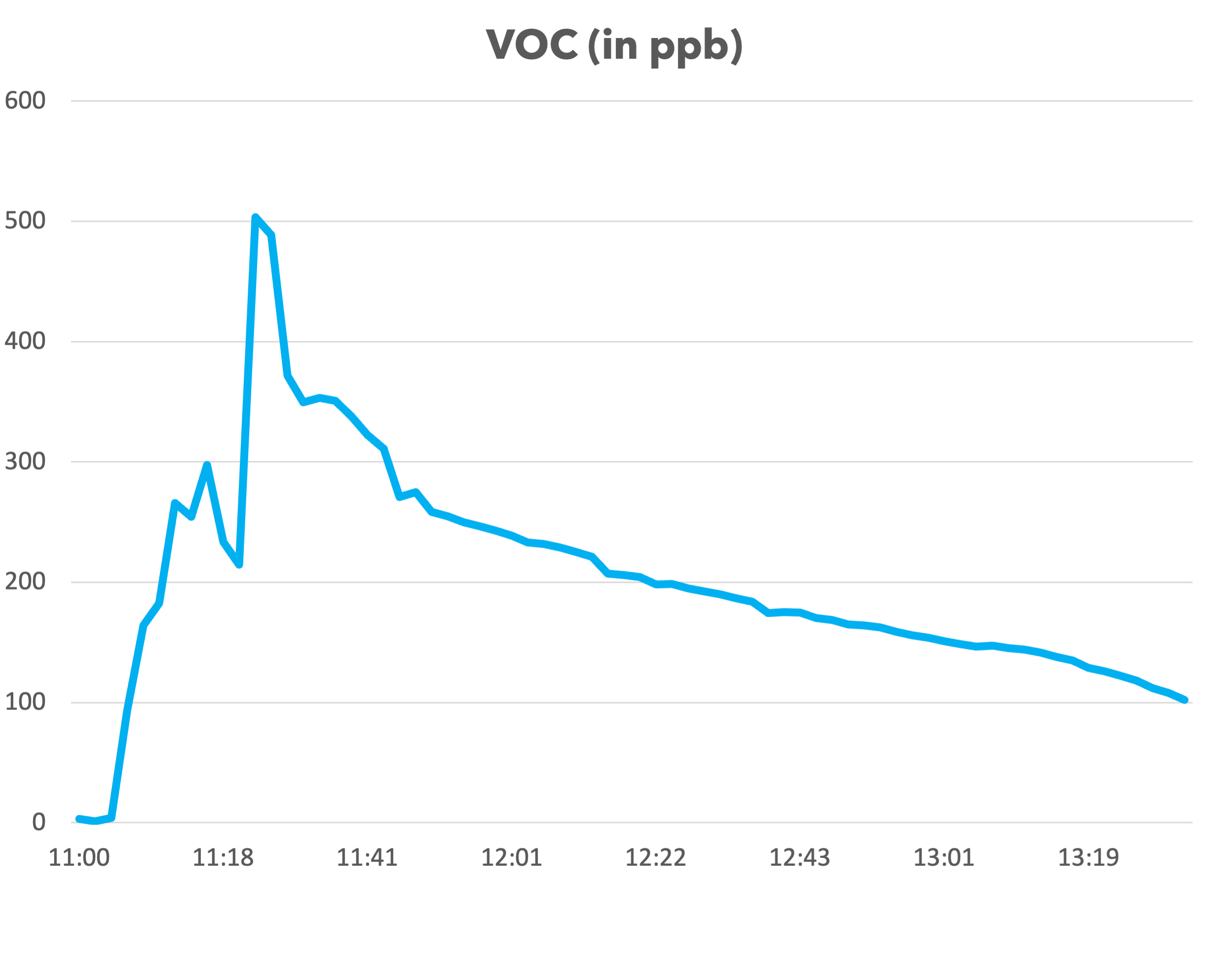
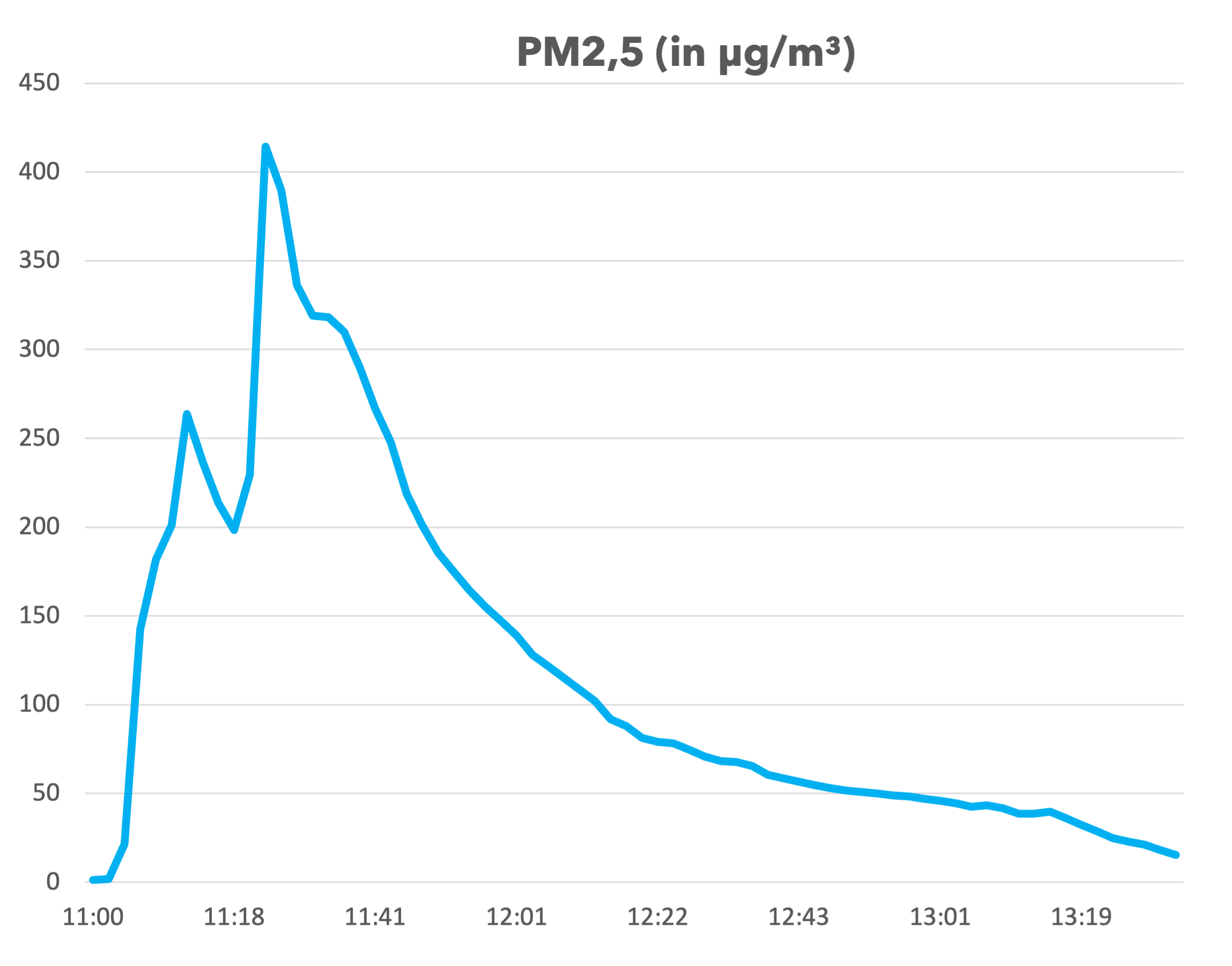
Results of our air-Q Lab test
The Venta air purifier was able to reduce the very heavy contamination by half within just 30 minutes. In continuous operation, the device ensures that excessively high values are never even reached in the first place. You can find our check as a short video here:
(Cover image: Venta product image/ Canva edit)