
Vaping at Home: How Do E-Shishas Affect Air Quality?
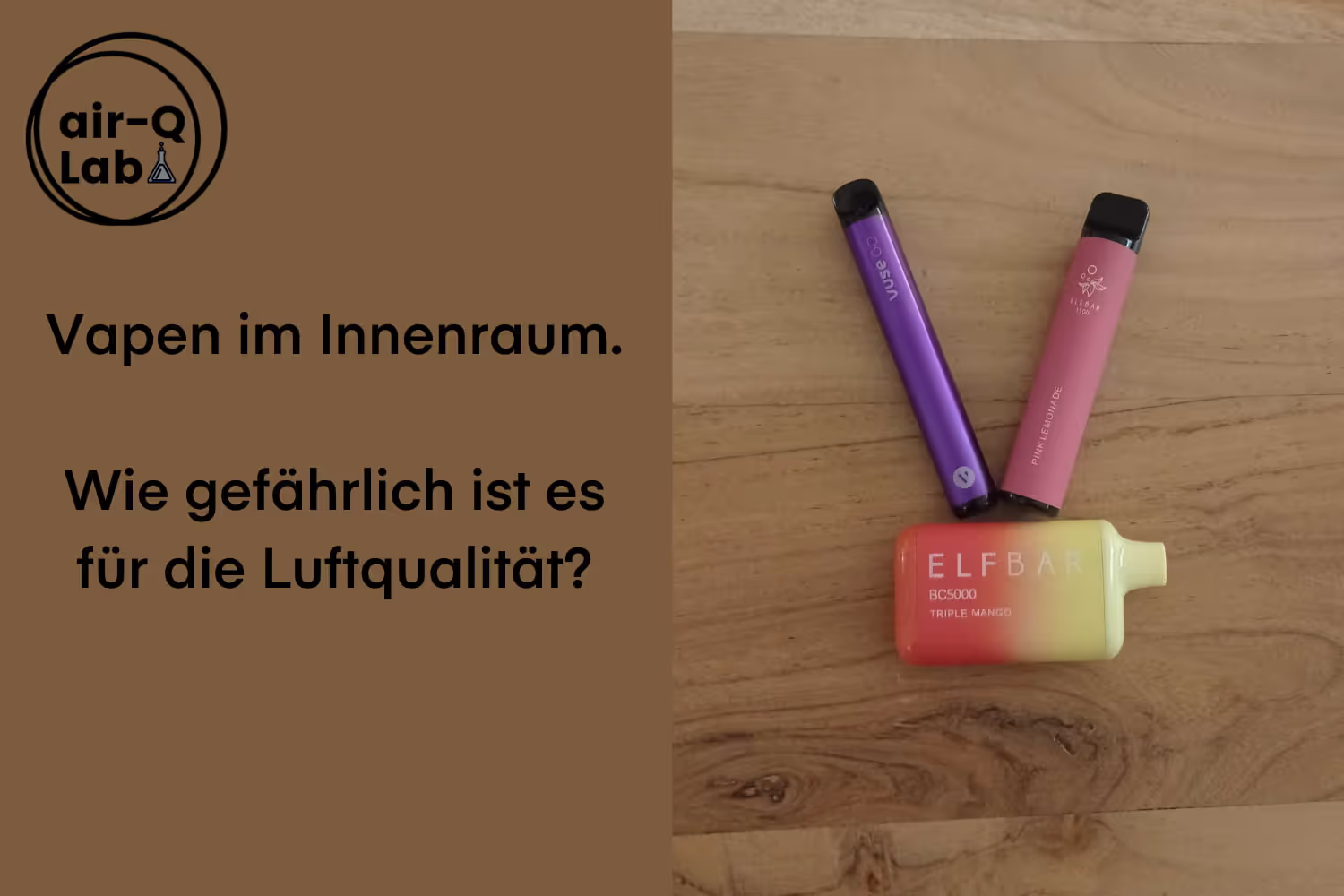
Temperatures are dropping, and it's damp and cold outside. Anyone who used to smoke outside now reaches for an e-shisha from Elf Bar & Co. and vapes indoors instead. After all, vapes don't burn tobacco, they atomize pleasant scents. But how healthy is the vapor really? We measured the effects on air quality with our air-Q air quality monitor.
In this post, you'll find the following content:
- E-shishas: what's behind the vape trend?
- Disposable e-cigarettes – more harmful to the environment than classic cigarettes
- The air-Q experiment: how does air quality change when vaping Elf Bars & co. at home?
- How do the particulate matter and carbon monoxide readings change when vaping Elf Bar and Aroma King?
- Does vaping indoors affect humidity?
- The effect of vaping on the volatile organic compounds reading
- How does smoking an e-shisha indoors change the oxygen and carbon dioxide content of the air?
- What does the air-Q health index reveal about how readings develop while vaping?
- Conclusion
E-shishas: what's behind the vape trend?
Unlike smoking a regular cigarette, e-shishas from manufacturers like Elf Bar, Aroma King, or Salt don't emit an unpleasant tobacco smell, but instead vaporize flavored liquids, depending on the chosen flavor. It smells good. This is exactly where the misconception lies: because of the fairly pleasant scent, the vapor from e-cigarettes is classified as harmless, and the disposable e-cigarette gets used quickly at home or in the office. But vapes contain nicotine salts and release pollutants into room air. We explored just how much the liquids in disposable shishas affect air quality in our practical test.
Note: we're not aiming to give any health lecture. We're only examining the verifiable changes in air components from vaping.
Disposable e-cigarettes – more harmful to the environment than classic cigarettes
A lot of waste is generated from smoking e-shishas. That's because the already plastic-wrapped disposable e-cigarettes from Elf Bar, Aroma King, Salt & Co. are only activated once and disposed of once empty. In addition, the liquid and battery are already contained in the vape, meaning they actually belong in hazardous waste, but tend to end up in plastic waste or public trash cans instead.
Stay well informed, for your healthy life
The air-Q experiment: how does air quality change when vaping Elf Bars & co. at home?
Our air-Q lab experiment took place in a living room of about 22 m². Before starting our experiment, we ventilated until 10:30 p.m., so all values were in the optimal range. Our test subject then vaped an e-shisha indoors for 20 minutes, until about 10:50 p.m., with the windows closed. Using the air-Q science, the following readings were observed: particulate matter (PM₁ – PM₂.₅ – PM₁₀), carbon monoxide (CO), humidity (ρ), volatile organic compounds (VOC), oxygen (O₂), carbon dioxide (CO₂), and the air-Q health index. We also let the air quality monitor keep recording readings after vaping, until 11:30 p.m. This let us track how air quality in the room developed even after smoking the e-cigarette, and see how long the changed air components lingered in the room.
How do the particulate matter and carbon monoxide readings change when vaping Elf Bar and Aroma King?
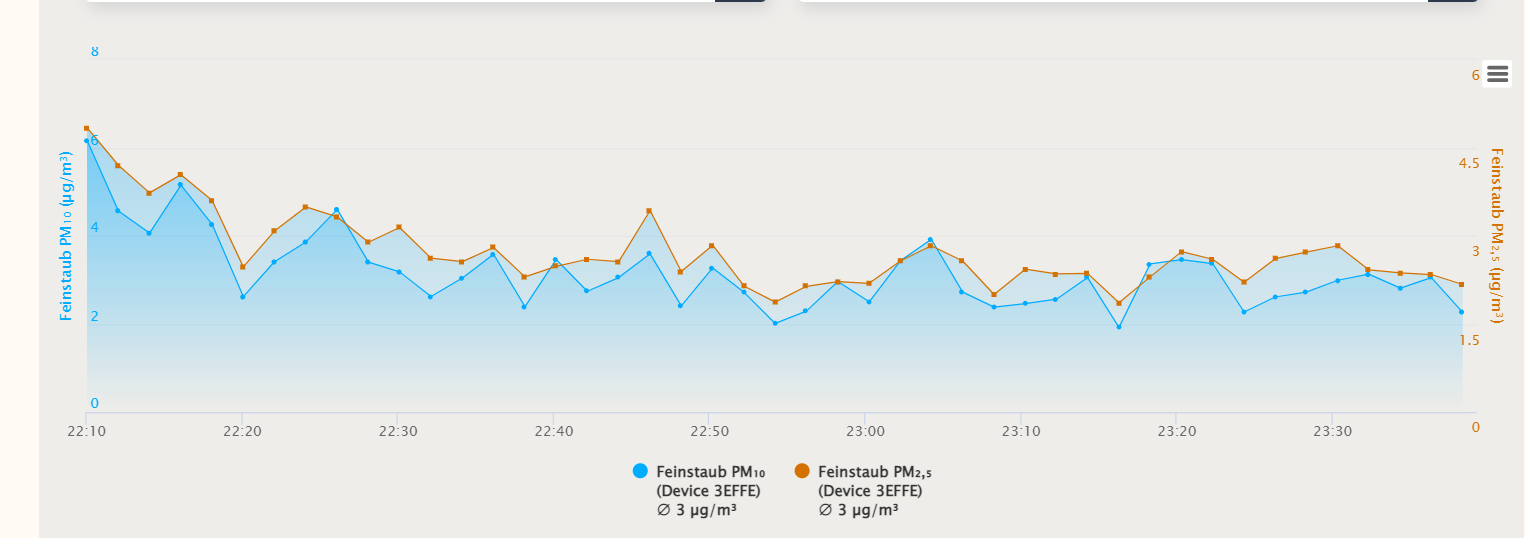
Unlike with cigarettes or real shishas, where combustion processes cause a rise in carbon monoxide and particulate matter, vaping a disposable e-cigarette only involves evaporation. Right at the start of the test phase, particulate matter exposure for particles of size PM 2.5 rose slightly from just under 4 μg/m³ to just over 4 μg/m³. The particulate matter value reached a peak around 10:45. After that, though, the reading dropped again and then fluctuated in an alternately rising and falling line. The particulate matter exposure of the larger PM10 particles, on the other hand, initially dropped and likewise alternately decreased and increased over the course of the test. The relatively low starting value, however, wasn't significantly exceeded throughout the entire test, and average exposure was 3 μg/m³. Our investigation thus shows that smoking an e-shisha at least avoids the harmful particulate matter — compared to smoking a regular cigarette.
In contrast to the slight rise in harmful particulate matter, carbon monoxide content in room air rose continuously in a stepwise line while vaping the e-shisha. Shortly before lighting the e-cigarette, the air-Q recorded a carbon monoxide content of just over 2.65 mg/m³. By the time the vape burned out, CO exposure reached 2.725 mg/m³, and rose further to 2.77 mg/m³ by the end of the test phase — an increase of 4.5 percent. Average carbon monoxide exposure was 2.71 mg/m³.
Does vaping indoors affect humidity?
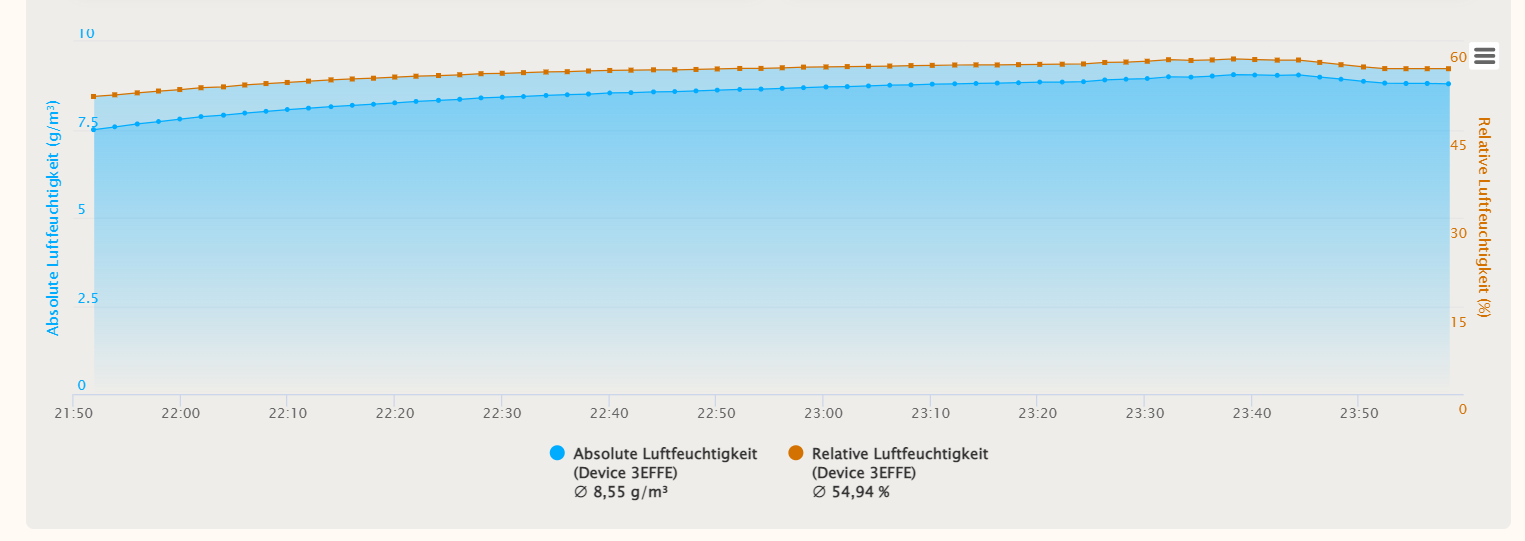
When smoking an e-cigarette, liquid is vaporized. It thus changes state from liquid to gaseous and is exhaled as vapor. In the air, the vapor's temperature drops and the liquid turns back into a liquid, meaning humidity in the room also rises. During our test, both absolute and relative humidity increased. Absolute humidity rose from the vapor from about 7.8 g/m³ to 9 g/m³. The average value was 8.55 g/m³. Relative humidity averaged 54 percent and rose from about 50 to just under 60 percent.
The effect of vaping on the volatile organic compounds reading
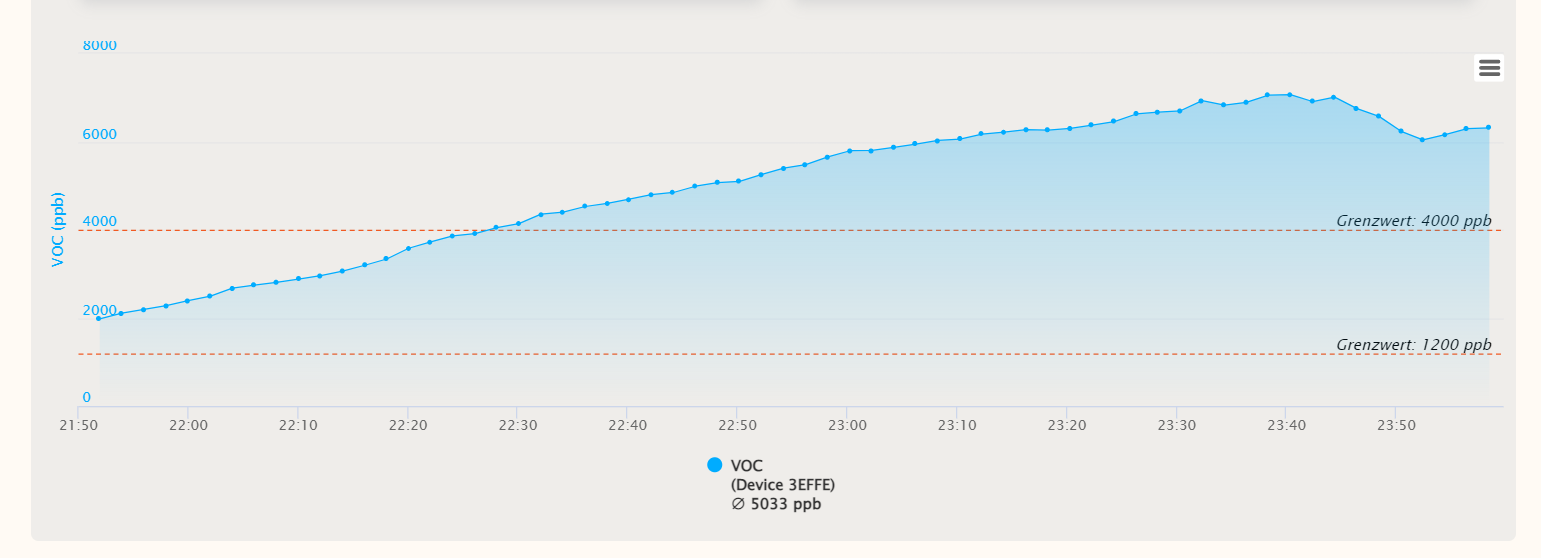
In the test, VOCs rose sharply and significantly exceeded the recommended limit value of 4,000 ppb. While the starting value when lighting the e-shisha was already at 4,000 ppb, it reached its peak of over 7,000 ppb by the end of the test phase — a 75 percent increase. VOCs can trigger headaches, dizziness, and nausea. You may know this effect from the smell of aggressive cleaning products. Whether the VOCs are harmful in this case, we can't say, since a VOC sensor reacts very sensitively to various substances. In the best case, you're "only" inhaling fragrances, similar to a scented candle. In the worst case, you're inhaling dangerous aldehydes, which can even be carcinogenic. How dangerous an e-shisha is varies from liquid to liquid.
How does smoking an e-shisha indoors change the oxygen and carbon dioxide content of the air?
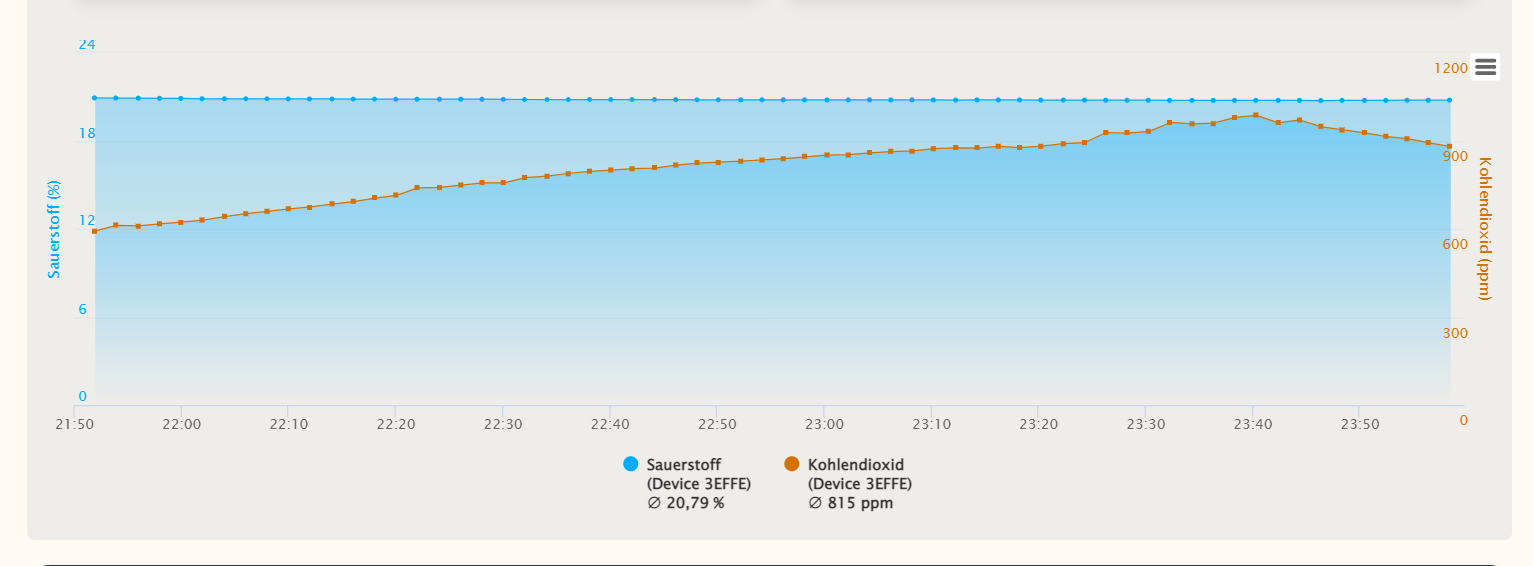
The air-Q couldn't demonstrate a negative or positive effect of vaping on oxygen content in room air. The reading averaged 20.79 percent. The measurement line showed no rise or drop. Carbon dioxide content, on the other hand, increased steadily, rising from an initial 750 ppm when activating the disposable e-cigarette to about 1,000 ppm around 11:40 p.m. — an increase of about 33 percent. However, CO2 content in a room always rises when a breathing person is present, so we can't attribute the slight increase to the e-cigarette alone.
What does the air-Q health index reveal about how readings develop while vaping?
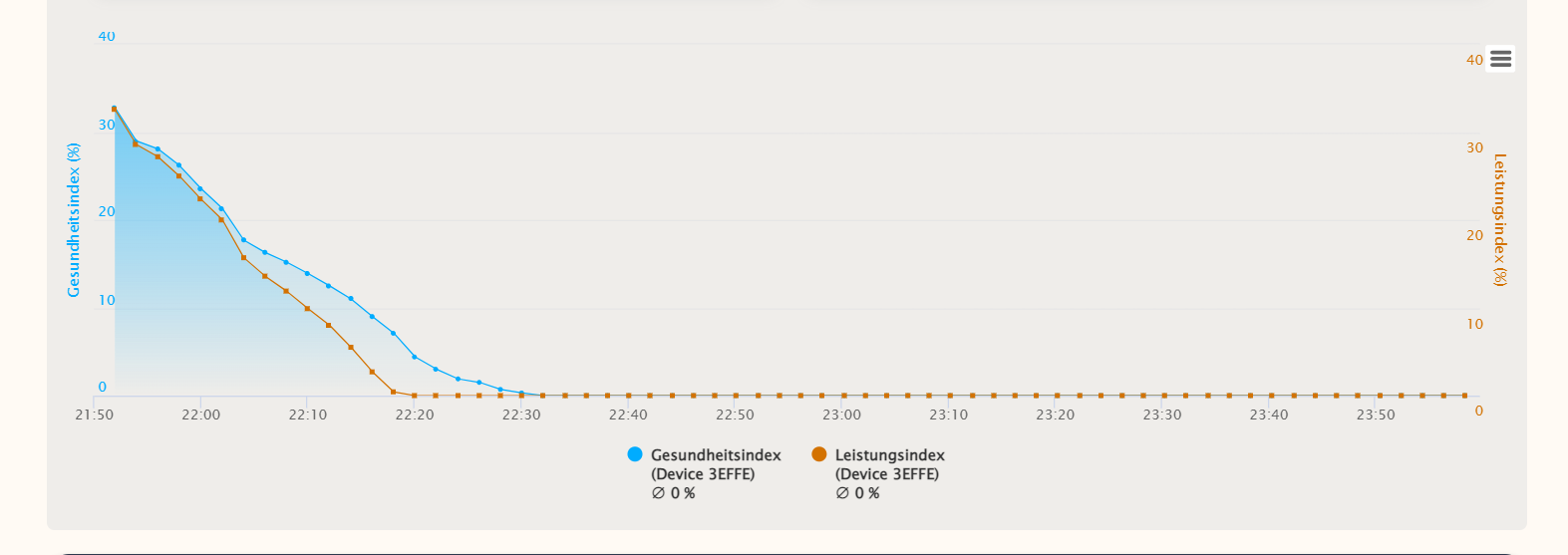
After ventilating, there's plenty of oxygen in the test room — both the health index and the performance index are at 32 percent. This value drops rapidly to 0 and doesn't recover for the rest of the test period.
Conclusion
Smoking an e-cigarette indoors demonstrably affects air quality. Many readings responded to the vapor and rose sharply, like VOC or carbon dioxide. The health and performance index is also significantly affected, since relevant readings exceeded limit values during the experiment. We therefore recommend avoiding vaping indoors, or at least opening windows while doing so, or thoroughly ventilating afterward, to reduce the elevated pollutant values. Still, vaping has a comparatively less dangerous effect on room air than smoking tobacco. For example, there's no risk of carbon monoxide poisoning, as is the case with actual combustion. Of course, we recommend living completely smoke-free, to avoid harming yourself and the environment.