
Can a Vacuum Cleaner Improve Air Quality? Testing the THOMAS Aqua+ Multi Clean X10 Parquet
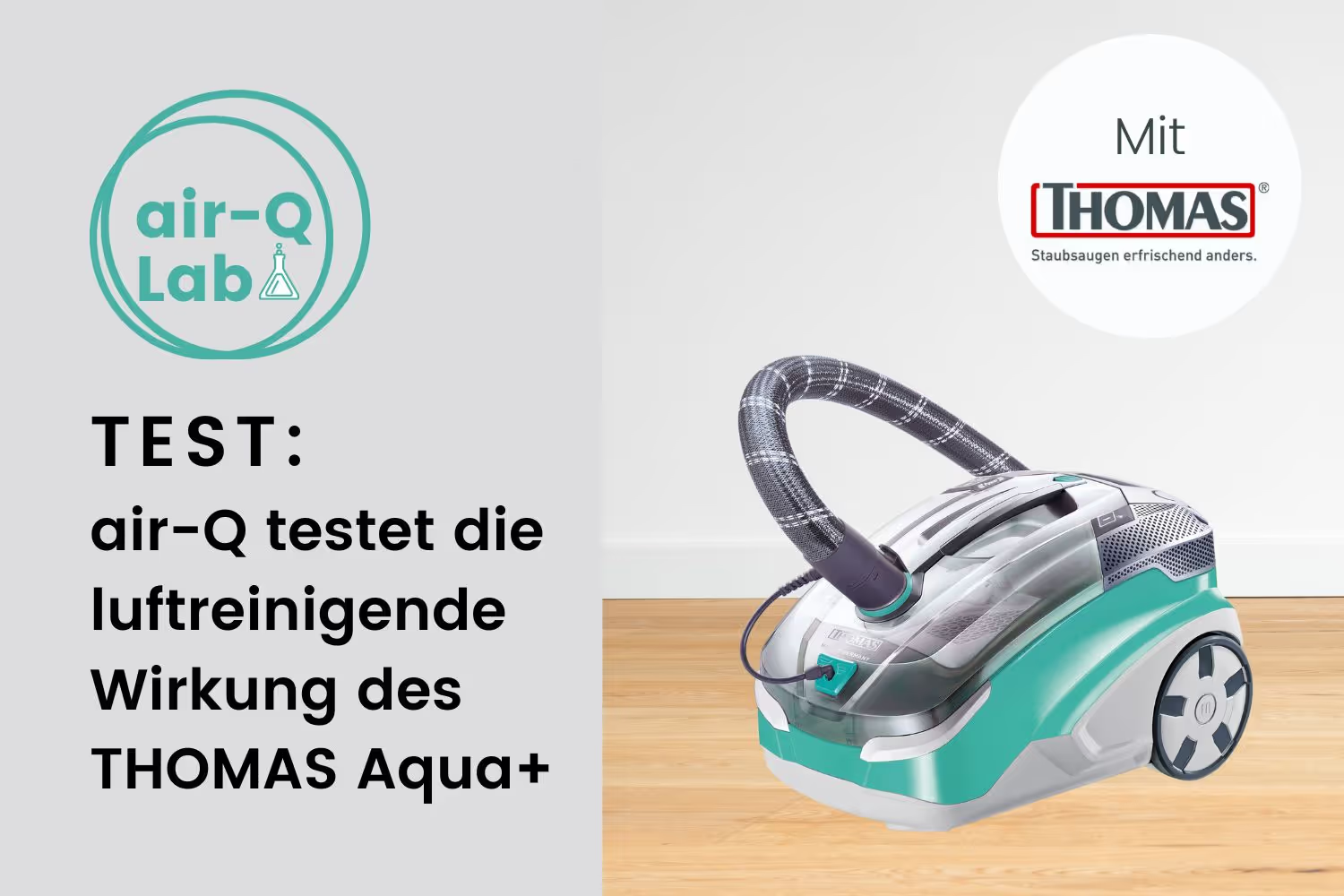
Vacuum cleaners are actually meant for vacuuming dust. Some devices come with high-quality filters and are even said to improve air quality. We checked whether that's true, and how well the THOMAS Aqua+ Multi Clean X10 Parquet vacuum can do that, based on humidity, VOC, and particulate matter readings.
What types of vacuum cleaners are there?
Bagged vacuum cleaners: how they work, pros & cons
Bagged vacuum cleaners are the most affordable models by comparison. They collect dirt in a bag that can then be disposed of with household waste. Since the dust is disposed of in an almost sealed bag when emptying, no dust clouds are released — especially relevant for people with dust allergies. However, more waste accumulates than with bagless variants.
Bagless cyclone vacuum cleaners: how they work, pros & cons
Bagless cyclone vacuum cleaners collect dirt in a dust container instead of a bag. Once full, you empty it into household waste. This can be a dusty affair, though. Since cyclone vacuums don't need bags, these models win the comparison with bagged variants from both an economic and ecological perspective.
Vacuum cleaners with a water filter: how they work, pros & cons
Vacuum cleaners with a water filter promise high filtration performance. The vacuumed air is routed through a water bath and thus filtered. Dust is bound in the water. This is especially beneficial for allergy sufferers or pet owners, since pollen, dust mites, pet hair, and other particles are said to be better removed from the air by the water filter. Emptying the filter happens without a dust cloud, since dirt and dust are dissolved in the water.
air-Q Lab: testing Robert Thomas's Aqua+
Vacuum cleaners are actually designed to remove dust from floors and furniture. According to the manufacturer, some devices can do even more. Can the ROBERT THOMAS Aqua+ Multi Clean X10 Parquet vacuum cleaner — a vacuum with a water filter — affect or even improve air quality? During the hands-on test, we monitored air quality with an air-Q pro with 14 sensors, recording humidity, VOCs and chemicals, particulate matter, and nitrogen dioxide. In our analysis, we present the three most relevant readings.
The test took place in a 15 m² room. With the Aqua+ Multi Clean X10 Parquet, we ran several test rounds with and without artificial pollution. We generated heavy artificial air pollution using an incense cone, to test the purification effect. The vacuum ran for a total of 30 minutes. Suction performance wasn't tested; the device essentially ran "empty."
Our test room wasn't under lab conditions. The test aimed to explore whether an improvement in air quality is measurable during a normal vacuuming process. Starting values in our test room can be slightly influenced by factors such as temperature differences over the course of the day, plants and their moisture release, and the slightly varying pollution level depending on how the incense cone burned.
Measuring humidity: can the THOMAS Aqua+ vacuum improve room humidity?
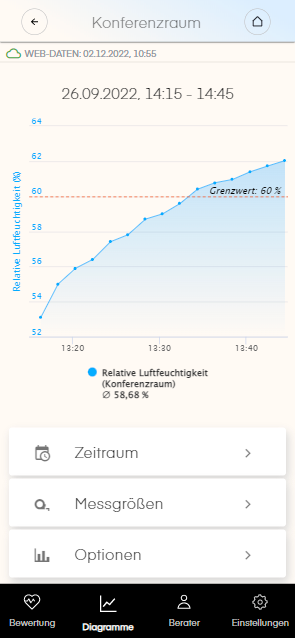
Within a 30-minute runtime, the THOMAS Aqua+ was able to raise humidity by about 10 percent. There was no other moisture source in the room. This was confirmed by a comparison measurement, in which humidity stayed constant without the vacuum running.
Measuring VOCs: can the THOMAS Aqua+ vacuum neutralize VOCs in the air?
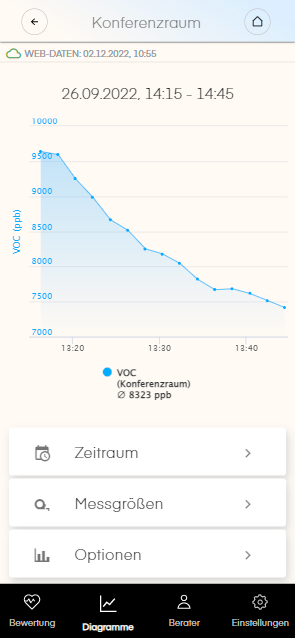
During the test run, the very high VOC reading generated by the artificial pollution source could be quickly reduced while the Robert Thomas vacuum was running. VOC pollution dropped from more than 9500 ppb (parts per billion) to about 7,500 ppb after 30 minutes. The VOCs present in significant amounts in the air can be dissolved fairly effectively in the vacuum's water. Toward the end of the period, the water's absorption capacity decreases. This could be because saturation occurs, reaching the maximum amount of water-soluble VOCs.
Particulate matter measurement: can the THOMAS Aqua+ vacuum filter particulate matter from the air?
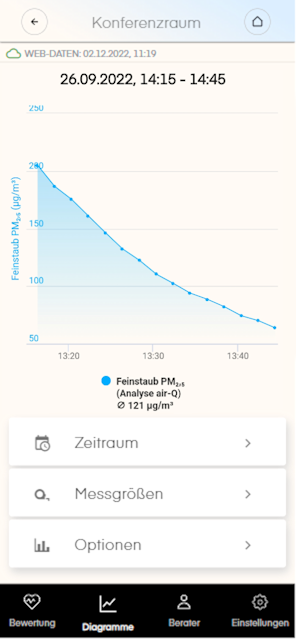
Burning the incense cone produced a very high particulate matter reading of about 200 µg/m³. This pollution was even visible, since a haze of smoke could be seen with the naked eye. Air in the small room was thus heavily polluted with dust and particulate matter.
While the ROBERT THOMAS Aqua+ Multi Clean X10 Parquet was running, particulate matter readings of just under 200 μg/m³ could already be halved after about half the test period. Particulate matter pollution dropped steadily during the test phase, down to below 70 μg/m³. That's a reduction in particulate matter pollution of about 67 percent from a very high starting level.
Conclusion
The ROBERT THOMAS Aqua+ Multi Clean X10 Parquet is, first and foremost, a vacuum cleaner. Vacuum cleaners generally aren't suited for continuous use as air purifiers. In the test, it showed a positive effect on the three most notable readings: humidity, VOCs, and particulate matter. The water-filter vacuum was able to noticeably raise room air's moisture content. In doing so, the vacuum acts like a very effective humidifier. That's because a lot of air is pumped through the water and evaporates in the process.
The VOC particles present in the air during the test scenario could be reduced, and the high pollution broken down by the vacuum. The water filter works effectively against water-soluble VOCs, retaining them in the water. Highly concentrated particulate matter could also be filtered from the air with the Aqua+. Our air-Q Lab's test result: using vacuum cleaners with a water filter, like the Aqua+, can, besides a clean floor, also produce a noticeable freshening and cleaning of the air.
(Cover image: air-Q)