
Temperature and Humidity Data Loggers: Why Precise Measurement Is Essential Today
Precise temperature measurement is more than just statistics. Whether for quality assurance in logistics or a healthy indoor climate in the office, a modern temperature and humidity data logger is essential. Find out in our guide what matters when choosing a temperature logger, and how real-time data makes the difference.
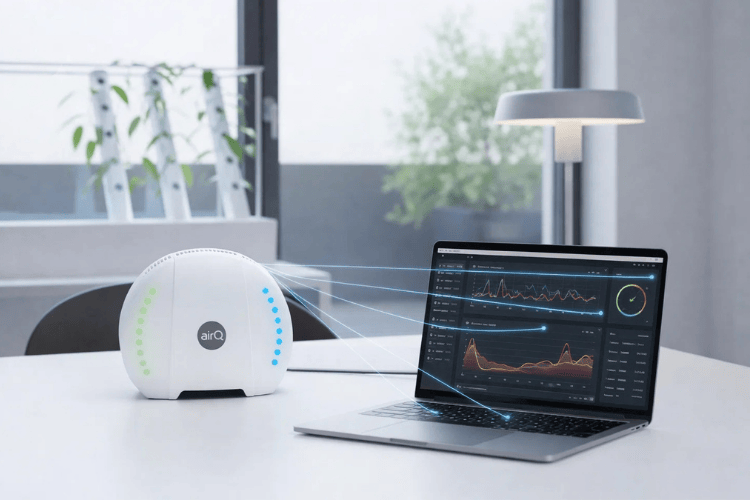
In modern industry, in trades and crafts, and even in the private home, environmental data is becoming massively more important. Whether it's about maintaining cold chains, preventing mold growth in rental properties, or monitoring processes in laboratories – a reliable temperature data logger is often the decisive tool for quality assurance.
But what does a modern temperature logger need to deliver today, and why is a simple thermometer no longer enough?
What is a temperature data logger?
A temperature data logger is an electronic measuring device that independently records and stores temperature values over an extended period. Unlike a conventional thermometer, which only shows the current state, a logger enables gapless documentation of trends over time.
Combined devices in particular have become the standard: a data logger for temperature and humidity offers a decisive advantage, since these two factors are physically closely linked – for example at the dew point.
-(300-x-250-px)-(1500-x-1300-px).jpg)
Applications: where the temperature logger makes the difference
The application areas for temperature data loggers are diverse and are often mandated by law or by standards such as HACCP or ISO.
Food safety and pharmaceuticals
In the logistics of food or medication, the cold chain must never be interrupted. A temperature data logger in the delivery van or storage refrigerator serves here as legally sound proof of proper storage.
Building management and structural drying
After water damage, or in older buildings, monitoring the indoor climate is essential. A temperature logger helps you understand the interplay between heating behavior and humidity development, so you can protect the building structure and prevent mold.
Smart office and wellbeing
Did you know that performance at work depends heavily on thermal comfort? Modern multi-sensors, like the air-Q, go a step further: they don't just act as a precise temperature and humidity data logger, they also correlate this data with other factors such as CO2 or volatile organic compounds (VOC).
The technical differences: which temperature data logger do you need?
Anyone looking to buy a temperature logger faces a wide selection. Devices can be roughly divided into three categories:
- USB data loggers: simple devices that are read out manually on a PC after the measurement period.
- Bluetooth loggers: allow readout via app near the device.
- Wi-Fi/IoT data loggers: these devices send data in real time to a cloud or a local network.
Why real-time data is the future
A classic USB logger only shows you the problem once it's too late – namely, when you read it out. A connected system, by contrast, warns you immediately via push notification when threshold values are exceeded. This is where innovative solutions like the air-Q come in. It offers not only the storage function of a classic logger, but also makes the data accessible anytime, from anywhere, via a web dashboard or an app.
Important features when buying a temperature logger
If you're looking for the ideal temperature data logger, you should pay attention to the following criteria:
- Accuracy & calibration: for professional applications, a small deviation (e.g. ±0.3 °C) and a calibration certificate are important.
- Measurement interval: how often is a data point recorded? Flexible intervals (from seconds to hours) are ideal.
- Storage capacity: how many thousands of readings can the device store locally if the connection drops?
- Additional sensors: A pure temperature logger often falls short. Also capturing humidity is standard, but for a comprehensive analysis of air quality, sensors for pollutants are often the smarter investment.
Using the data logger strategically: more than just numbers
A temperature and humidity data logger is only as good as the conclusions you draw from its data.
Take the example of "office climate": a simple logger might show that it gets too warm in the afternoon. A more sophisticated measuring system like the air-Q, however, shows you at the same time that CO2 levels are rising along with the temperature. The solution then isn't simply to turn up the air conditioning, but to optimize the ventilation strategy.
This "under-the-surface" intelligence is what distinguishes a simple temperature data logger from a holistic monitoring solution. While the logger only documents, an analysis tool helps you find causes and save energy.
Which data logger is right for you?
Choosing the right temperature data logger depends heavily on your individual use case. For simple transport documentation, an inexpensive USB stick may be enough. But if you want to monitor rooms, protect the health of residents or employees, or understand complex relationships within indoor air, a high-end measuring device is the better choice.
The air-Q combines the classic reliability of a temperature data logger with the intelligence of a modern IoT device. It offers not only precise measurement of temperature and humidity, but also delivers a complete picture of your environment through its wide range of additional sensors, such as particulate matter, nitrogen oxides, or oxygen.
Want to learn more about how you can not only measure your indoor climate, but sustainably optimize it too? Take a look at the various sensor configurations and find the solution that's the perfect fit for your needs.