
Solar Yield: How Air Pollution and Particulate Matter Reduce Power Generation From Solar Panels
Many of the dangers posed by air pollutants like particulate matter are undisputed and well known. But besides these health reasons for doing more toward good air quality, there are also economic reasons: solar yield can be significantly reduced by air pollution and particulate matter — and in two ways at once.
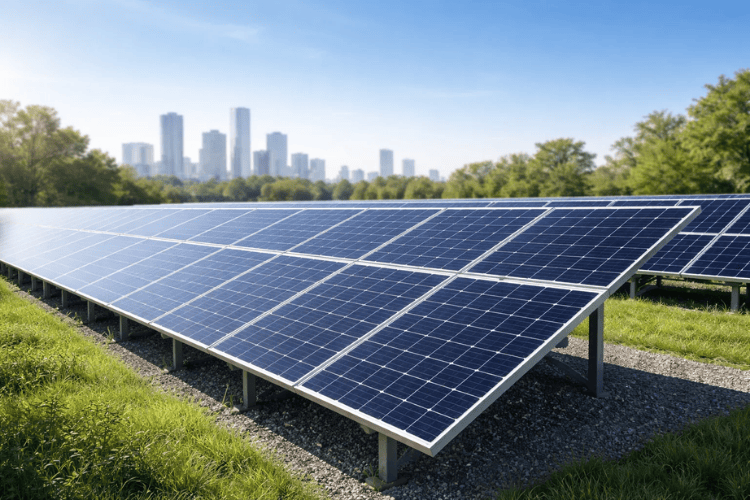
Solar yield — meaning the product of specific solar radiation per square meter and a solar panel's peak output — decreases on one hand because air particles at high altitude absorb radiation, as a new study now shows. On the other hand, because particulate matter particles settle on the photovoltaic panels themselves and dirty them. Frequent cleaning of solar panels, however, carries the risk of tiny surface damage. So how do air pollution and particulate matter reduce power generation from solar panels?
Less specific solar radiation due to polluted air
Chinese scientists from the Institute of Atmospheric Physics at the Chinese Academy of Sciences have now confirmed in their study that polluted air scatters or absorbs sunlight. As a result, less sunlight reaches the Earth's surface — and there's less specific solar radiation.
It's particularly concerning that the effects become more harmful the smaller the particulate matter particles are. While the intensity of solar radiation fluctuates over time, besides cloud cover, released aerosol particles, ash, or dust can also refract or scatter sunlight.
The researchers found that as air pollution increases, the ratio of scattered to global radiation also rises, meaning less sunlight ultimately penetrates to the Earth's surface. It also holds that: the higher the particle concentration, the more the direct penetration of solar radiation to the Earth's surface is reduced. At the same time, more air pollution also increases the potential for scattering.
Under various weather and light conditions, researchers studied how different degrees of air pollution affect solar radiation. Solar radiation striking the Earth's surface — the SSR (surface solar radiation) — is the actual energy source for photovoltaic systems.
Solar yield is especially lower for urban photovoltaic systems
This means the findings of this study point to potential difficulties facing solar power generation, by no means only in China, and make the transition to renewable energy no less challenging.
As early as 2017, scientists from the American Chemical Society studied the effects of particulate matter in the atmosphere on specific solar radiation per square kilometer. In China and India, the researchers found 17 to 20% less energy production from photovoltaics. Extrapolated, this means: particulate matter is currently responsible for reducing solar yield by up to 1 gigawatt in India. In China, it's even up to 10 gigawatts of solar power not generated due to polluted air. Solar yield is correspondingly lower.
Particulate matter from human activity especially dramatic
Even though most of the deposited particles come from dust and dirt, the particulate matter that results from human activities like burning fossil fuels is disproportionately more problematic. These particles are often very small. They're also difficult to clean, since they're often sticky. But the more often solar panels are cleaned, the greater the risk of damaging these highly sensitive surfaces.
The researchers are by no means alone in their findings: in the journal Energy & Environmental Science in 2018, scientists from the Massachusetts Institute of Technology (MIT) confirmed that the effects are indeed enormous. In some cases — the MIT scientists also studied the situation in India and China — it can mean the difference between a successful solar power installation and one that ultimately doesn't reach the expected production level, and possibly incurs losses.
Among those involved in the study was MIT professor Tonio Buonassisi from the Department of Mechanical Engineering. Over two years, the scientists collected measurements of solar radiation and pollution — and confirmed a significant reduction in specific solar radiation reaching solar panels. It turned out that in Delhi (India), there wasn't a single day without polluted air.
Economic damage in the billions?
Result: the researchers ultimately determined an annual, average solar cell performance dampening of about 12 percent. That very 12 percent often exceeds profit margins, making photovoltaic systems less lucrative.
Extrapolated, the economic damage is immense: in Delhi alone, revenue losses in power generation could amount to up to $20 million annually, in Kolkata around $16 million, and in Beijing and Shanghai about $10 million each annually, the team estimates. Planned installations in Los Angeles could lose between $6 and $9 million. Overall, they predict that potential losses "could easily amount to hundreds of millions, if not billions of dollars annually."
Another finding, according to the MIT scientists, leads to lower solar yield: global warming. In a further study, Ian Peters and Tonio Buonassisi found that, on average, solar yield decreases by 0.45 percent per degree of temperature warming. This figure certainly varies depending on the type of solar panel used, but it's already a risk to factor in.
With these findings in mind, it becomes even clearer that limiting pollutant emissions is also essential for the sake of the energy transition.
(Image: Mariana Proenca/ unsplash)