
Secret Vaping in School Bathrooms or Public Buildings: How E-Cigarettes Affect Air Quality
Vaping is becoming increasingly popular, especially among teenagers. This brings challenges regarding the health of minors and indoor air quality in places like schools and public buildings. But how does the vapor affect air composition, and how can these changes be measured?
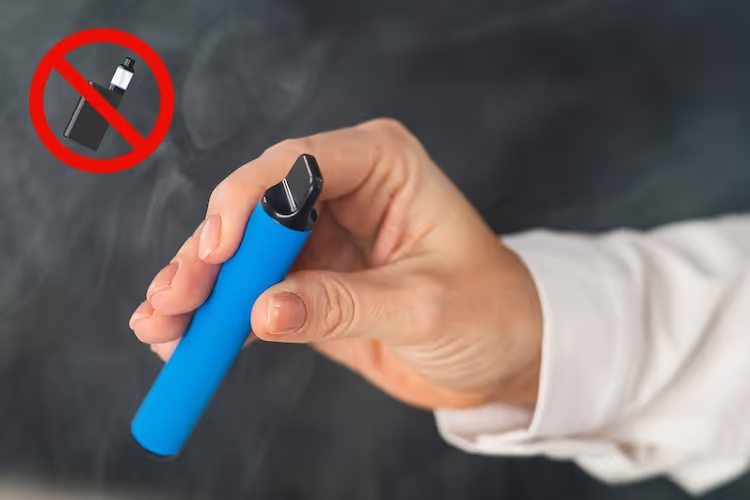
Possible effects on air quality from e-cigarettes
Secret vaping in school bathrooms or hidden corners of libraries and offices isn't uncommon. One problem with vaping is the pleasant-smelling vapor from vape liquids. This scented vapor can initially smell pleasant and is therefore often not immediately perceived as disruptive. In some cases, it's even interpreted as a kind of fragrant cosmetic product. This perception can lead to secret vaping indoors being taken less seriously, even though the vapor's chemical components can significantly impair air quality. Despite the misleadingly pleasant smell, e-cigarettes do release pollutants. We wanted to know how much e-cigarettes affect air composition. So we ran a self-test.
The air-Q hands-on example "simulated school situation"
In our current test, we used the air monitor air-Q to monitor indoor air quality while an e-cigarette was smoked. To simulate a school situation, the experiment was conducted in a small 24.5 m² office room. Thanks to the room's size, we could roughly recreate the spatial conditions of a school bathroom.
Before the experiment, we ventilated the room for about 20 minutes. Particulate matter entered the room from the nearby main road, and the reading rose from below 1 µm/m³ to over 2 µm/m³. The room was then closed for almost an hour and not entered. The particulate matter reading returned to its starting value shortly before the test began. During the test, two people vaped, each taking three puffs from their e-cigarettes. This short smoking interval was meant to imitate teenagers' behavior during secret vaping and thus realistically reflect the situation.
air-Q Lab: particulate matter development while vaping
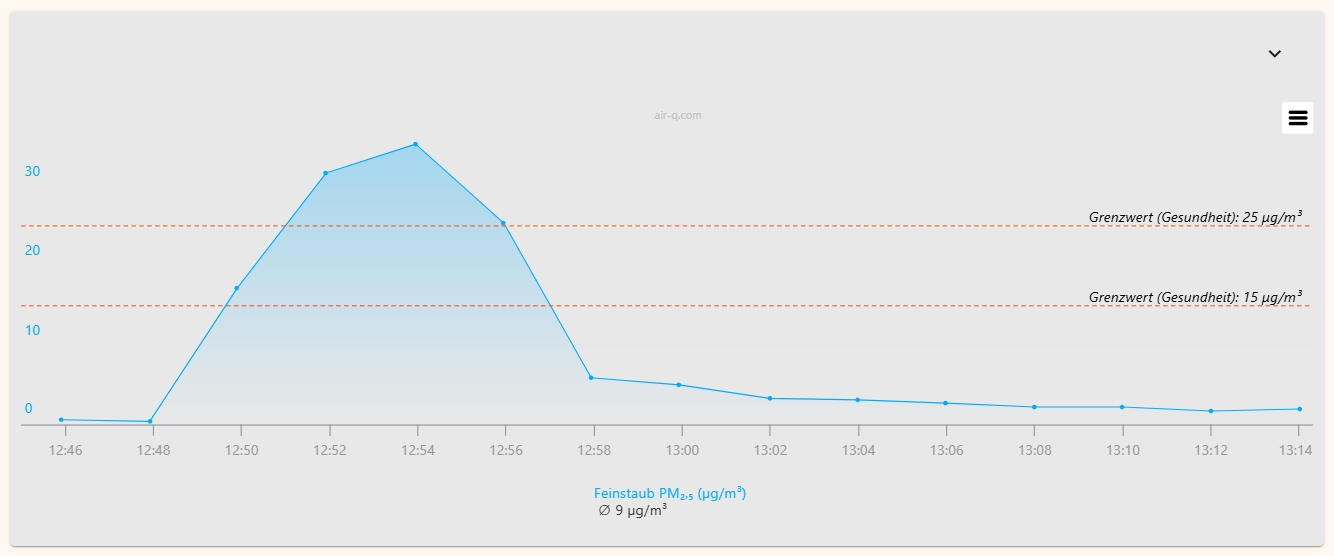
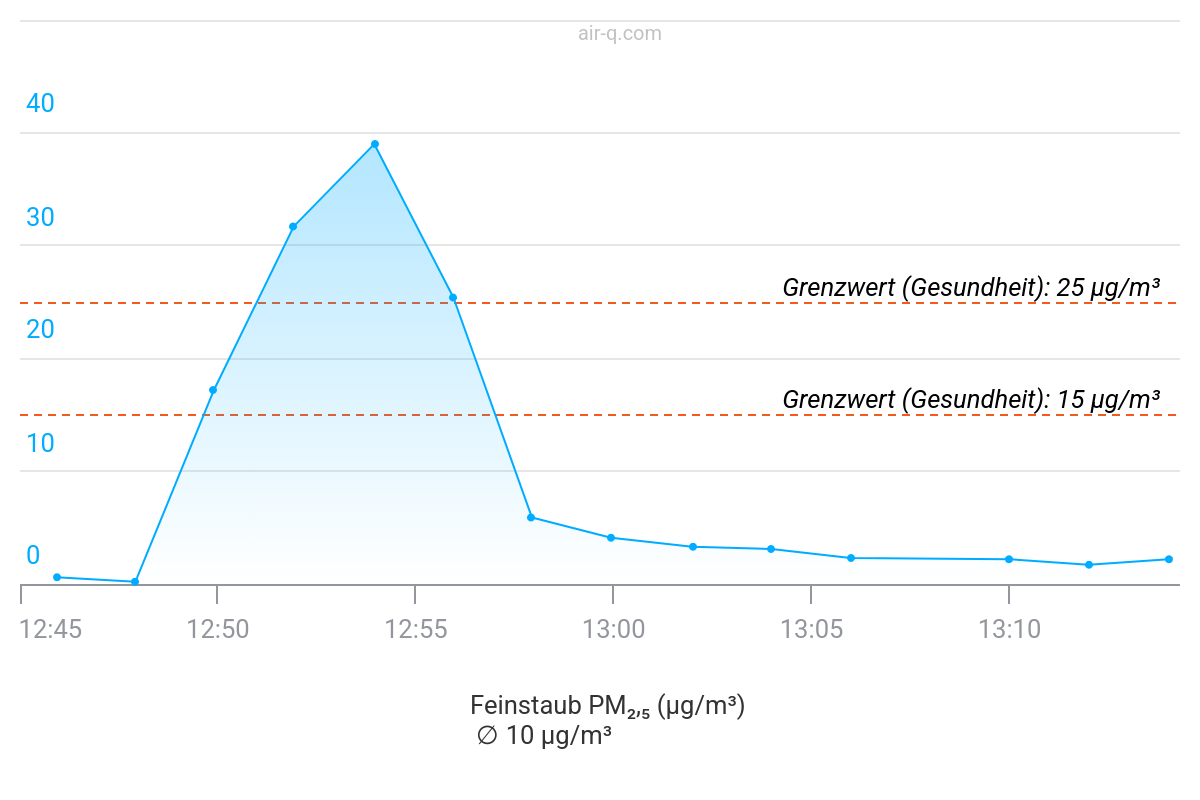
Vaping began shortly after 11 a.m. At that point, particulate matter concentration was close to 0 µm/m³. The harmfulness of particulate matter is linked to particle size: the deeper particles penetrate into the lungs and bloodstream, the greater the danger to people. That's why, in this experiment, we chose to focus especially on PM2.5 particulate matter, since these particles have a diameter under 2.5 micrometers.
Already after a few seconds, vaping's immediate effect was visible, rising sharply. Toward the end of the test at 12:52 p.m., a peak of nearly 40 µm/m³ was reached. Shortly after, values quickly began to drop again. After that, particulate matter pollution settled back at around 2 µm/m³. This shows that the elevated PM2.5 particle concentration from vaping was temporary, and air quality normalized after a certain time without further vapor release.
air-Q Lab: the effects of vaping on VOC concentration
Volatile organic compounds (VOCs) are organic, carbon-containing compounds that enter the air from various sources and can be harmful to health. Before the test began, VOC concentration in the room was about 5000 ppb. At the start of vaping around 12:48 p.m., a clear but less rapid rise in VOC concentration was visible compared to the other readings. The rise was rather steady and even. After a continuous increase, the VOC reading reached its peak of about 9000 ppb around 12:56 p.m.
Toward the end of the test, the air-Q air monitor measured a VOC level of about 7000 ppb.
.png)
Recommended indoor VOC thresholds vary, but many guidelines, including the German Federal Environment Agency's, set the safe threshold at around 1200 to 4000 ppb.
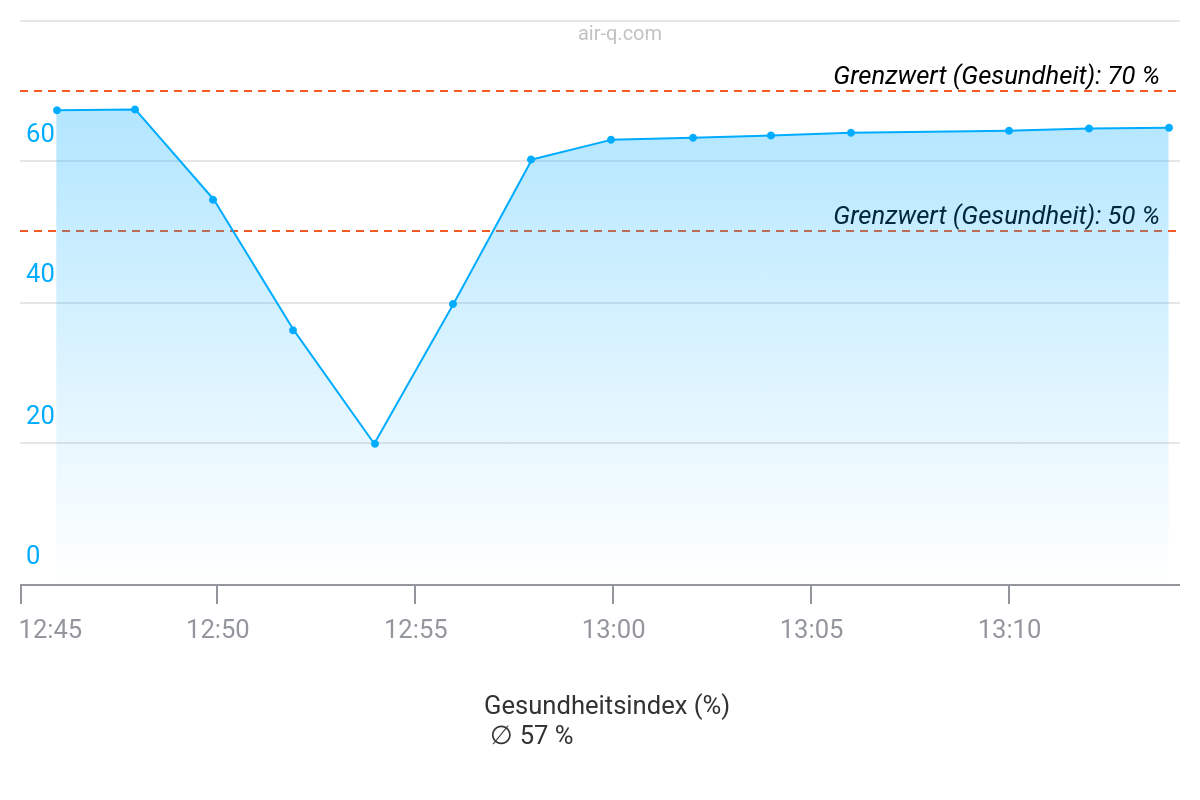
The chart shows, in parallel with the rise in the other readings, a rapid drop in the health index. The health index is calculated based on official thresholds, regulatory recommendations (e.g. from the German Federal Environment Agency or the WHO), and scientific studies, from the "worst" reading among all measurement values at a given point in time.
Conclusion
The test results show that vaping indoors leads to a significant rise in all readings examined. These changes can not only affect the health of people who regularly spend time in these rooms but can also disrupt the function of sensitive technical equipment. Our analysis makes clear that the vapor significantly increases both particulate matter and VOC pollution. Regular vaping in enclosed spaces could thus lead to a lasting increase in pollutant concentration, which could be harmful to health long-term. Various health effects are possible, including airway irritation, headaches, dizziness, reduced concentration, as well as declining performance and long-term health damage with sustained exposure.
It's therefore advisable to regulate vaping in enclosed spaces and take measures to monitor and improve air quality, to protect the health of people in the room. Overall, it's clear that monitoring indoor air quality is an important step in addressing the challenges posed by vaping. With precise measurements, the immediate effects on air quality can be detected and secret smoking uncovered.
Air monitors like the air-Q offer a way to detect pollutant concentrations and thereby take targeted measures to protect health and safety indoors. This lets schools and public institutions not only improve air quality but also take preventive steps to stop secret vaping.