
Can Plant Pot Covers Purify the Air? We Put the AIRY Pots to the Test in the air-Q Lab!
Air pollutants at home are bad for your well-being and health. But how do you get clean air in your rooms? AIRY's plant pot covers promise an innovative biofilter and a patented natural room air purification system. We checked how effective these pots really are in our air-Q Lab with the air-Q air monitor.
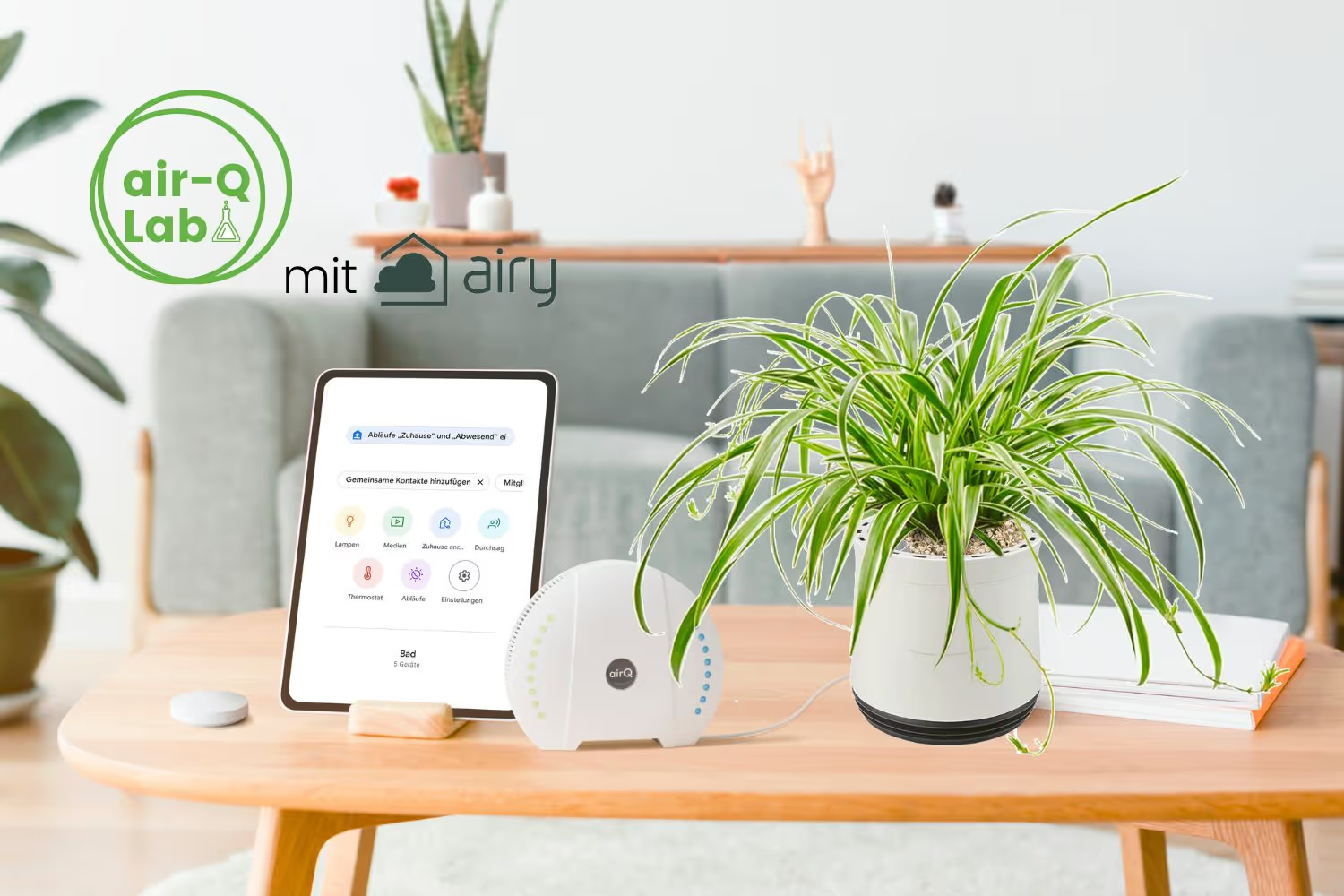
Particulate matter readings dropped 30% faster with the AIRY Pot S and 76% faster with the AIRY Pot M than with a normal plant pot cover. How do AIRY pots work? Using specially designed slits, or louvers, at the bottom of AIRY pots, air supply to the plant's root system is improved compared to a normal pot. Through these slits, the plant draws in room air. The pots' two-chamber system creates a chimney effect — suction forms. This enables a continuous airflow through the Smart Substrate and down to the roots. The air passes by the roots, which purify it. We wanted to know how effectively AIRY's plant pot covers actually purify the air of pollutants.
For our test, we placed a spider plant together with the air-Q in our airtight, roughly 1 m³ gas measurement chamber. Across three different test runs, a green plant sat in different pots: 1. a normal pot cover, 2. the AIRY Pot S, and 3. the AIRY Pot M. Each test ran for 24 hours, from 10 a.m. to 10 a.m. the following day. We examined the air-purifying effect on the following air components: volatile organic compounds (VOCs), particulate matter (PM₁ – PM₂.₅ – PM₁₀), and relative humidity.
How do the air-purifying AIRY pots affect VOCs?
The hands-on tests' starting values differed slightly, at 1,700 (normal pot cover), about 1,900 (AIRY Pot S), and 2,300 ppb (AIRY Pot M). Across all test runs, VOC readings initially dropped rapidly.
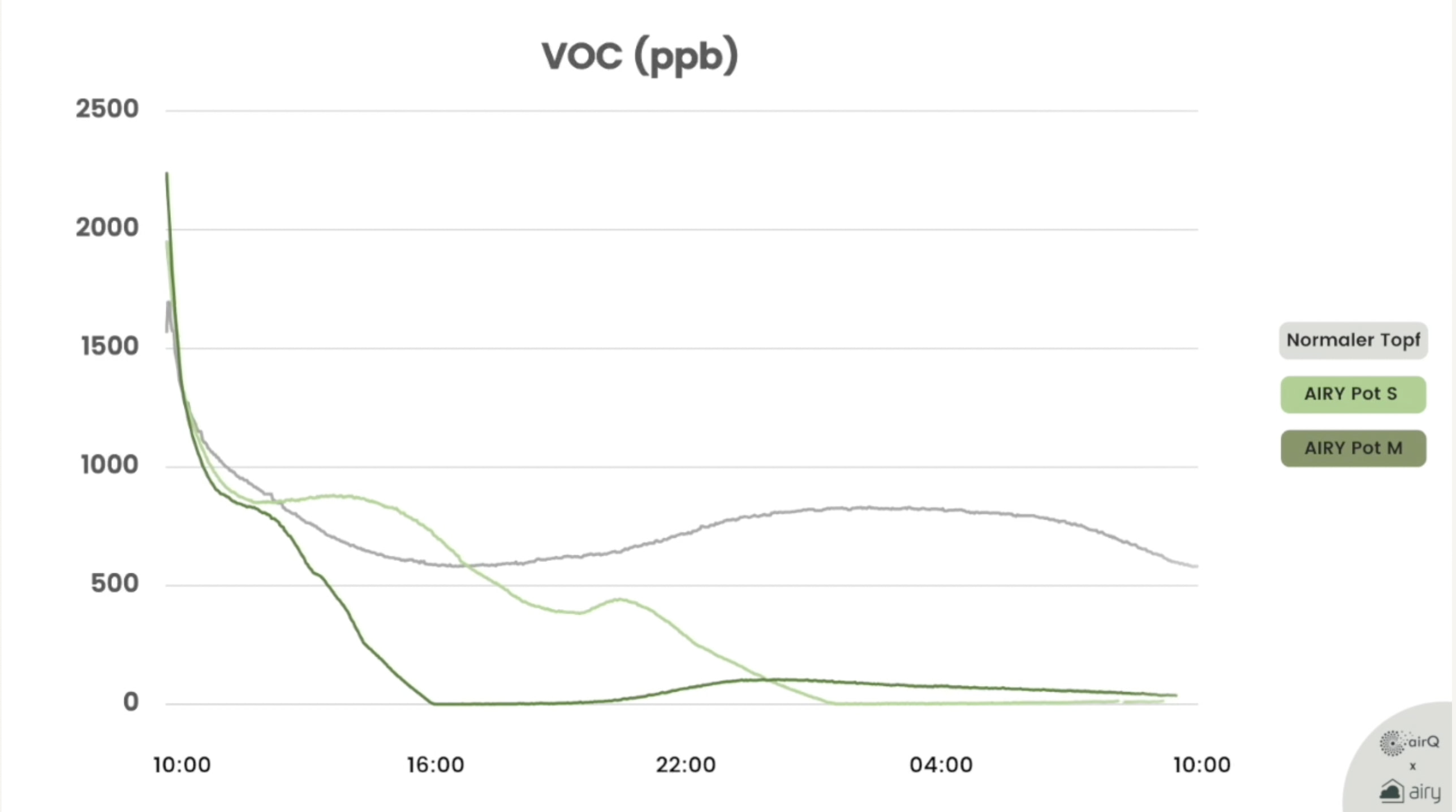
Chart of carbon monoxide reading development with the air-Q air analyzer
air-Q test result: VOC readings with a normal pot cover
With the normal pot cover, a reduction from 1,700 ppb to 1,200 ppb was visible within the first hour and a half. After two hours and 20 minutes, the box's VOC reading had halved. After that, the pace of the decline stagnated, but the VOC reading kept dropping. Around 4 p.m., VOC pollution hit its lowest point at 600 ppb: values had more than halved. After 6 p.m., though, they rose again, showing a peak of about 800 ppb around 3 a.m.
air-Q test result: VOC readings with the AIRY Pot S
With the AIRY Pot S too, VOC readings dropped sharply within the first two hours, reaching a low of 800 ppb. To halve the VOC reading, the spider plant in the AIRY Pot S took just 47 minutes instead of almost 2.5 hours. Between noon and 4 p.m., the air-Q recorded an increase in VOC readings. VOC pollution then dropped sharply again, falling to 400 ppb. After a small rise to just under 500 ppb around 9 p.m., the reading dropped steadily, even reaching zero around 1 a.m., and stayed there until the end of the test.
air-Q test result: VOC readings with the AIRY Pot M
In the third test run, the spider plant started with the AIRY Pot M and the highest VOC readings (2,300 ppb) in the test box. To halve the VOC reading, the AIRY Pot M needed just 26 minutes. Within the first two hours, the VOC reading didn't just halve — it dropped by 65.22%. After a brief stagnation between noon and 1 p.m., the VOC reading fell again, reaching zero around 4 p.m. Around 9 p.m., values rose slightly to about 100 ppb, before dropping back toward zero starting at 3 a.m.
Can the air-purifying AIRY pots reduce particulate matter?
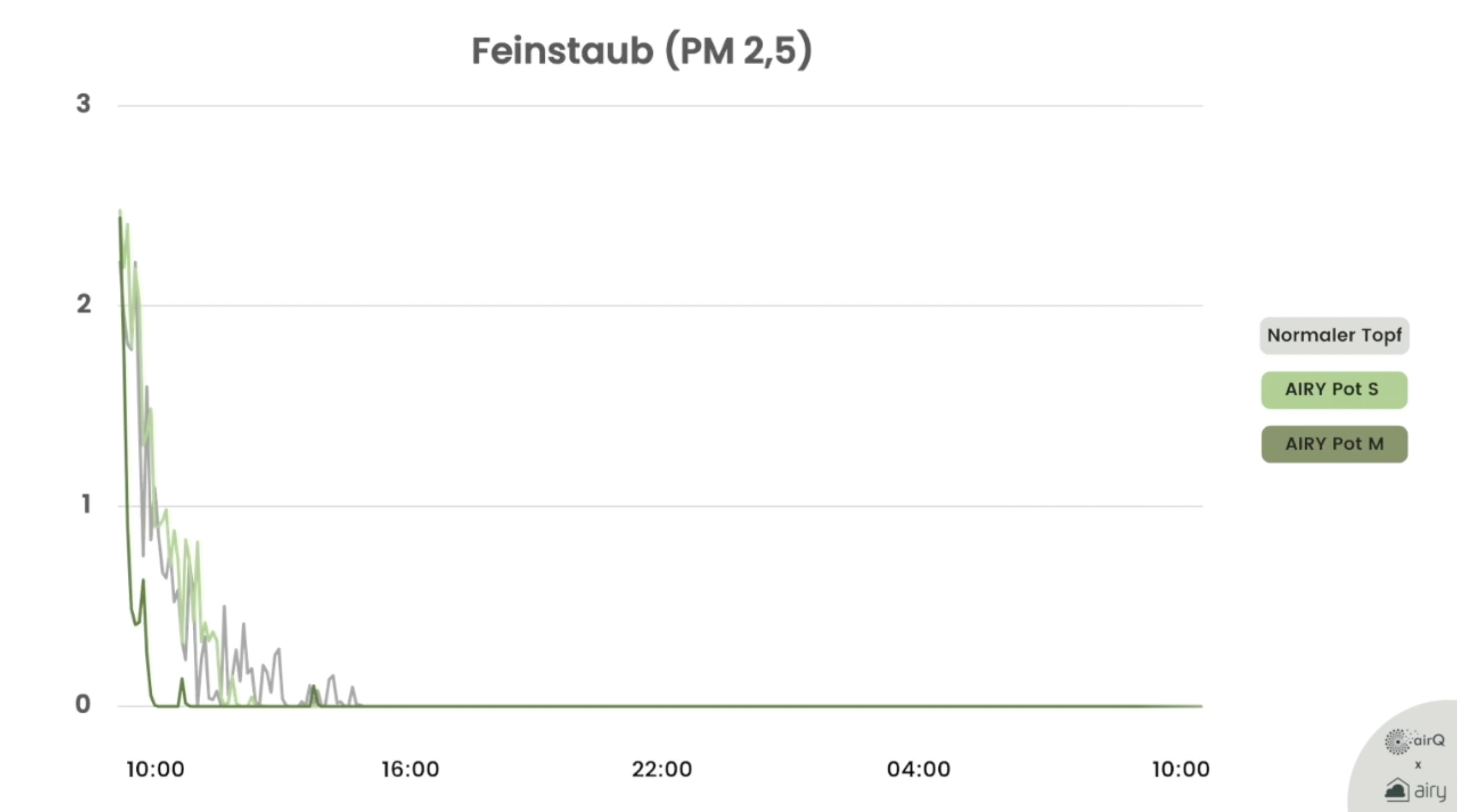
Across all test runs, the particulate matter pollution starting value was about 2.5 μg/m³. With all pot covers, zero was reached within the test period. While readings with the normal pot cover showed many spikes, and thus a constant alternation between rising and falling particulate matter readings, PM readings with the AIRY Pot M dropped very steadily. In the test with the AIRY Pot S, the air-Q still recorded a few spikes.
From the measurement analysis, we can conclude that particulate matter content drops 30 percent faster with the AIRY Pot S, and even 76 percent faster with the AIRY Pot M, than with a normal pot cover.
Do AIRY's air-purifying plant pot covers affect humidity?
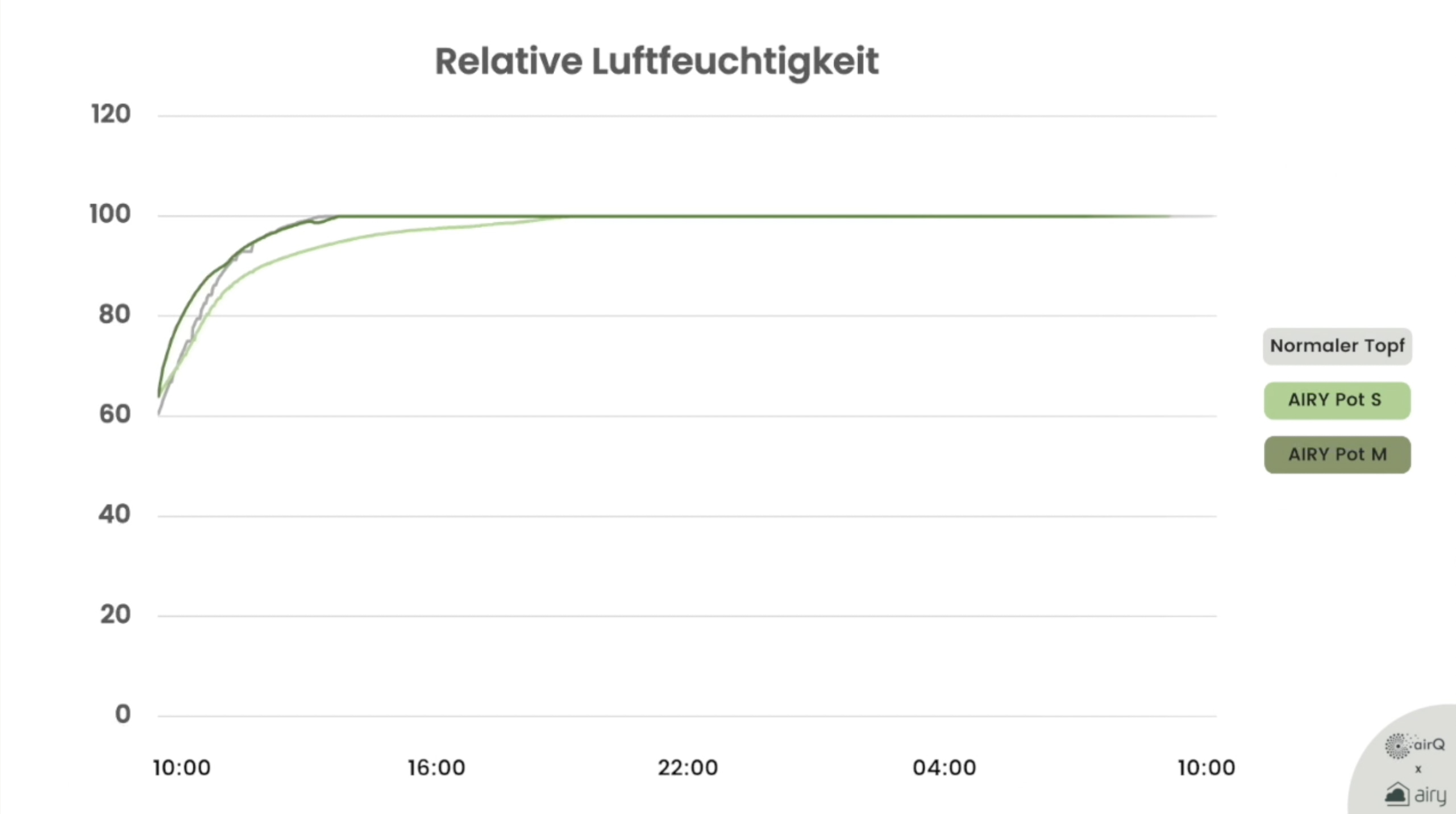
All tests started with relative humidity just above 60% in the box. With all pots, moisture levels rose within the first three hours, reaching a maximum of 100, which didn't change again until the end of the test. So all the plants and pots tested were able to noticeably raise humidity, thus contributing to healthier air. During the test, it was noticeable that the AIRY Pot M released the most water into the environment. We want to get to the bottom of this phenomenon in a detailed lab test.
Conclusion
Our hands-on tests show that plants with an AIRY Pot purify the air of pollutants significantly more than plants with a normal pot cover. The pots also raise humidity. In our lab experiment, AIRY thus demonstrably improved room air quality within the roughly 1 m³ gas measurement chamber.