
Increased Particulate Matter from Vacuum Cleaners? – Cordless Vacuum Cleaners Put to the air-Q Test
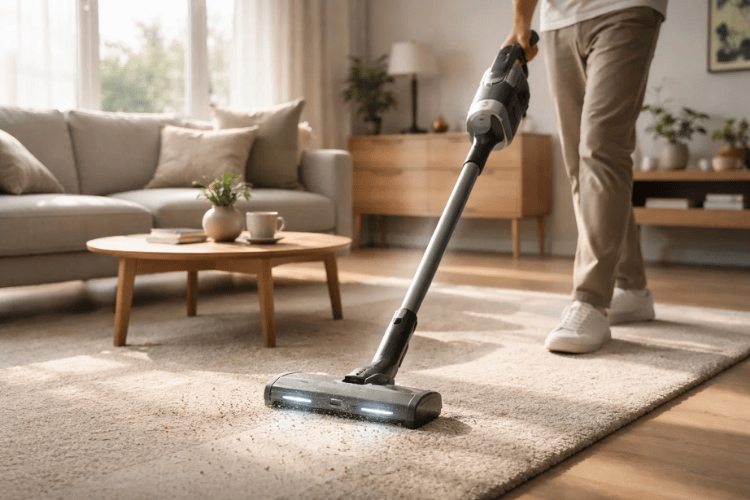
Particulate matter in the home poses a risk to health. Good floor hygiene is the only real defense against these tiny particles. Are cordless vacuum cleaners the ideal solution, or do they just stir up more dirt? We put the Xiaomi cordless vacuum to the test and checked particulate matter levels while vacuuming.
What is particulate matter, and which dust components does a vacuum cleaner pick up?
Our household dust consists of crumbs, fibers, skin flakes and hair. Mixed in are the tiniest dust particles, so-called particulate matter (PM₁ – PM₂.₅ – PM₁₀), which settle into carpet fibers, on surfaces or on textiles. PM stands for particulate matter. The number, meanwhile, indicates the size of the particles in micrometers.
Particulate matter also contains bacteria and dust mite droppings. But harmful chemicals such as plasticizers, off-gassing from synthetic materials and dyes, and flame retardants also accumulate in the particulate matter found in homes. Many of these substances are suspected of being carcinogenic, disrupting hormone balance and the immune system, promoting allergies, and increasing the risk of asthma.
What health effects can increased particulate matter exposure cause?
Particulate matter threatens health: the smaller the particles, the more far-reaching the health effects of particulate matter exposure. While ordinary dust is already filtered by fine hairs and mucous membranes in the nose or bronchi, particulate matter penetrates all the way into the delicate branches of the lungs and the alveoli. Here, the fine particles can cause inflammation or even tumors, as they often carry pollutants such as toxic heavy metals with them.
Further health effects of increased particulate matter exposure include:
- Coughing fits, asthma and other respiratory diseases
- Heart and circulatory diseases
- Itchy eyes or nose
You can find more information about particulate matter in the home in our dedicated article.
Does a vacuum cleaner cause even higher particulate matter exposure?
Using a "normal" vacuum cleaner can quickly spread particulate matter. That's because the air drawn in while vacuuming is also blown back out again – along with particulate matter particles. The cause is missing or dirty filters. So while cleaning, you can end up flinging more dirt and invisible particulate matter, such as fungal spores, mite droppings, pollen or bacteria and other pollutants, throughout the home. Vacuuming itself, as well as changing the vacuum bag or emptying the dirt container, also stirs up dust.
air-Q test: Xiaomi Mi Vacuum Cleaner G10 cordless vacuum
We wanted to find out how air quality changes while vacuuming. To do this, we carried out a practical test with our air-Q air quality monitor and the Xiaomi Mi Vacuum Cleaner G10 cordless vacuum. The stick vacuum has a HEPA filter. Shortly before the practical test, a piece of furniture was assembled in our test room, so the room had elevated particulate matter levels. Unpacking, hammering and drilling left a thin layer of wood dust on the floor. According to the air-Q air quality monitor, particulate matter levels were around 6 μg/m³.
Shortly before the test, the room was ventilated and particulate matter levels dropped below 3 μg/m³. We then started vacuuming. Within a very short time, a lot of dust was stirred up and particulate matter levels doubled. The peak particulate matter reading reached almost 15 μg/m³ after just a few minutes of vacuuming. After about 10 minutes the increase leveled off, then dropped to a level permanently lower than at the start of the particulate matter measurement. The average particulate matter exposure during the test was 3 μg/m³. The built-in HEPA filter of the Xiaomi cordless vacuum clearly shows a significant effect. No additional dust escapes into the room, and suction power is very good. So when buying a vacuum cleaner, make sure it has a filter.
.png)
Measuring particulate matter with the air-Q particulate matter sensor
Our test clearly shows that vacuuming initially stirs up particulate matter, increasing particulate matter exposure. After vacuuming, however, significantly lower levels can be measured.
The air-Q particulate matter sensor detects the small particles by means of optical scattering. Inside the particulate matter sensor, an infrared LED and a detector are separated by a wall. When a particulate matter particle passes through the LED's light, the detector registers a flash. If the particulate matter particles are larger, the flashes are brighter. If they are smaller particles, the flashes are dimmer. The air-Q then "counts" these flashes and can tell you the particulate matter exposure in your indoor spaces with especially high measurement accuracy.
You can get the air-Q air quality monitor in various models.
Tips for proper vacuuming & removing particulate matter
Regular ventilation, the right humidity level, vacuuming with a suitable filter, and regularly mopping floors all help lower particulate matter exposure indoors.
Further tips on how to reduce particulate matter while vacuuming:
- Use especially hygienic vacuum cleaners with a modern HEPA filter that can filter out particulate matter. Or use a vacuum cleaner with a water filter that cleans the exhaust air of particulate matter and more.
- Only glide the vacuum cleaner gently over the floor to avoid unnecessarily stirring up dust.
- Replace the vacuum bag or dust container in good time.
- Check the vacuum bag for tears and damage.
- Always clean the water tank thoroughly to prevent contamination and bacterial buildup.
- Regularly replace filter systems, such as motor protection and micro exhaust filters.
- Avoid skin contact with the bag, filter and other parts of the cordless vacuum – ideally wear gloves when emptying it.
- Vacuum first, then mop. This removes particulate matter more effectively, and it can't immediately resettle on the surface.