Noise Peak Level (Lp_max): Definition, Causes & Effects
Have you ever instinctively covered your ears? Certainly. Sirens, fireworks or traffic noise quickly trigger this protective reflex for the ears. But even indoors, comparatively minor noise exposure can damage your hearing and reduce your wellbeing. We take a detailed look at the noise peak level.

Noise Peak Level: Causes & Origins
Physically speaking, all sounds consist of sound waves. As soon as an object vibrates, tones are produced. The loudness of sound is described in the unit decibel (dB), where 1 decibel represents the quietest tone audible to the human ear.
Across Europe, the greatest noise burden comes from traffic: around 40% of people in European countries are exposed to road noise of more than 55 dB (decibels). Germany's Federal Immission Control Act (Bundes-Immissionsschutzgesetz), on the other hand, sets limit values of 50 dB (daytime) and 35 dB (nighttime) in purely residential areas.
Indoors, air conditioning systems, ventilation systems as well as machines and devices add to the noise burden. When several people are together in one room, this often leads to elevated noise levels. In addition, sound waves from outside penetrate into rooms. However, how strongly noise is perceived as such is subjective and depends on a variety of factors. For instance, the distance to the noise source influences how it is perceived. The perception of noise also depends on how we feel, whether we can see the sound source, and at what time we are exposed to the noise. People often tolerate sounds during the day far more than in the evening or at night. Individual noise sensitivity or a person's age naturally also play a decisive role here.
Limit values as well as recommended normal values regarding noise exposure can be found listed under our Noise peak reading.
Noise vs. Noise Peak Level: Who Is the Sensor Suitable For?
With the air-Q, in addition to air quality, noise can also be measured. The noise meter can track and evaluate two different readings: the noise reading and the noise peak level. Unlike the noise (Lp) reading, which constantly tracks "normal" noise levels, the noise peak level records acute noise events.
With this sensor, you learn about short-term noise exposure: for example, a brief, loud bang at night or moments when the noise curve rises situationally. This documents events that abruptly interrupt your rest periods and thus cause stress. Monitoring the noise peak level is helpful for people who sleep restlessly and want to determine the cause. The analysis shows when limit values are exceeded. Using this information, conclusions can be drawn about the noise source responsible for restless sleep.
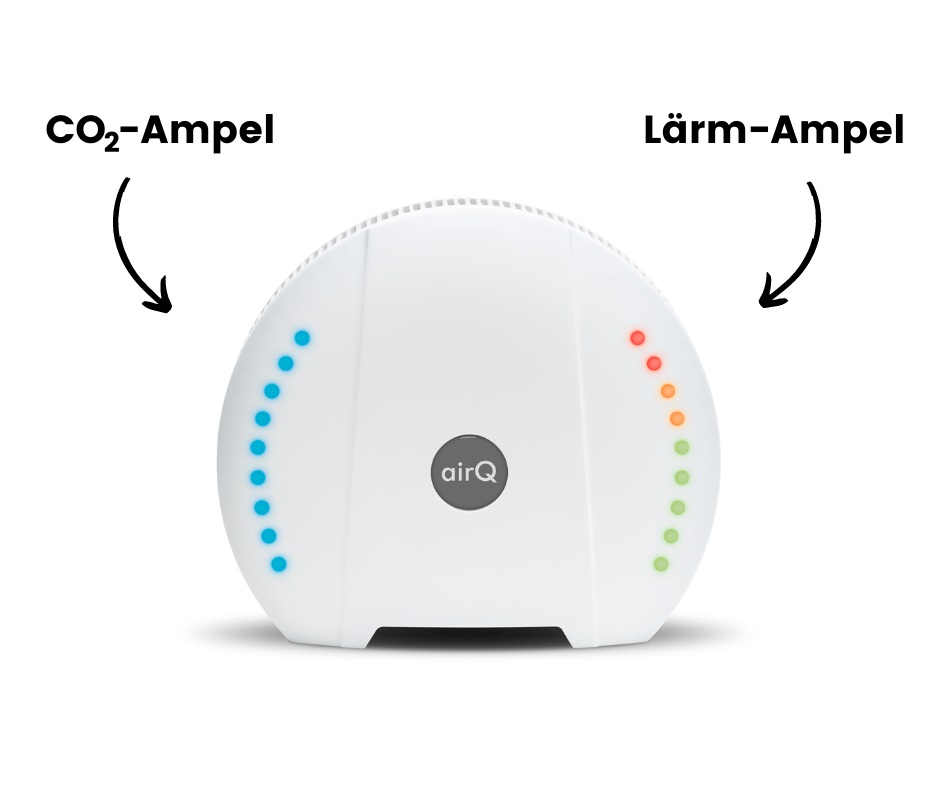
The sensor is also suitable for schools, offices, kindergartens or everyday private life. It objectively records the volume level in a room and shows when recommended limit values are exceeded using easy-to-understand LED bars. This traffic-light function intuitively alerts even small children when a room is getting too loud. This is useful in kindergartens, classrooms, but also in open-plan offices or your own living room.
Noise Peak Level: Health Consequences
Health consequences of noise can be divided into two categories: physical reactions and psychological effects.
Physical reactions caused by noise:
- Increased heart rate & associated cardiovascular problems
- Constriction of blood vessels & decrease in skin temperature
- Hearing impairment up to tinnitus
- Muscle tension
- Headaches & circulatory problems
- Stomach and intestinal illnesses
- Thyroid disorders
- Elevated blood lipid levels & hormonal disturbances
Psychological effects of noise:
- Decline in performance & increased error frequency
- Reduced resilience
- Learning difficulties, especially in children
- Nervousness & irritability
- Sleep disturbances
air-Q reading tip: We've put together further information on the topic of noise and possible analyses in a separate article. You can find it here.
How Can I Avoid Health Damage from Noise?
- Monitor noise exposure & evaluate peak values (ideally with the air-Q's integrated noise sensor & noise traffic light)
- Use plants, furniture, floor coverings & curtains for better sound reduction
- Insulate windows using composite foam
- If possible: the bedroom should not face the street
- Give your hearing rest breaks (don't always leave the TV or music running)