
New Year's Particulate Matter: air-Q Measures Sharply Elevated Levels in Leipzig
Particulate matter concentration on New Year's Eve and New Year's Day has been significantly elevated in Leipzig in recent years, even exceeding limit values. The measurement results show, besides the effects of fireworks on New Year's particulate matter, the influence of wood stoves. We explain the health effects and how you can protect yourself.

Corant GmbH's office in Leipzig is located in the west of the city, in the Plagwitz neighborhood, on the second floor of the office complex called BIC. In front of the windows is a partially green roof, with other building sections to the left and right. On New Year's Eve 2019/20, we installed one of our air-Q monitors outside on the roof and let it take measurements, protected from rain.
The air-Q air analyzer used measures 14 air pollutants, including PM1, PM2.5, and PM10 — meaning particulate matter in three different sizes.
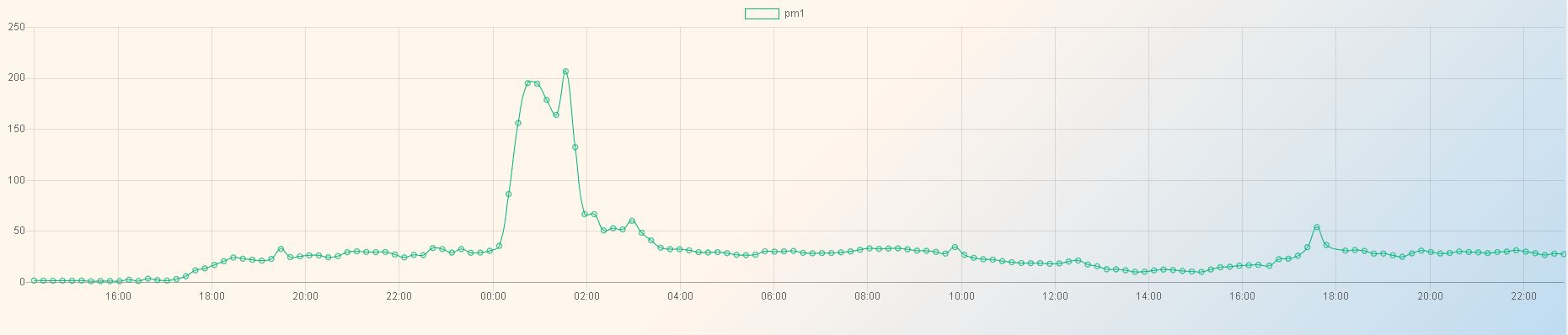
The results are clear: even away from the fireworks hotspots, New Year's particulate matter PM1 values rose to a concerning 200 μg/m³. Looking at the larger particulate matter particles, the values are, as expected, higher, since the larger figures each include the smaller particles. On New Year's Eve night, particulate matter values for the PM2.5 category were 311 μg/m³, while the PM10 value rose to 343 μg/m³. For comparison: the daily limit value for outdoor air for PM10 is 50 μg/m³, and the annual average is 40 μg/m³.
New Year's particulate matter in Leipzig's city center
In Leipzig's city center (compare kachelmannwetter), exposure was even more directly noticeable. Here, the PM10 value rose to 650 μg/m³ between midnight and 2 a.m. As in our measurement as well, it took a good 14 hours for particulate matter exposure to gradually decrease again and drop below the annual average, to just under 20 μg/m³ at 3:07 p.m.
Our particulate matter measurement (more on the particulate matter reading here) shows another interesting aspect: on the relatively warm New Year's Eve day, particulate matter exposure at our office location was between 6 and 10 μg/m³ during the daytime. As the sun set and the first firecrackers and rockets were set off and fireplaces lit, the PM10 value rose to as much as 60 μg/m³. The value thus already slightly exceeded the daily limit value between 9 p.m. and midnight.
New Year's Day was noticeably colder (about 3 degrees Celsius) than the previous evening (6 degrees Celsius). Now particulate matter exposure from heating fireplaces shows up especially clearly: with a peak of 112 μg/m³ around 5:30 p.m. and consistently high values of about 66 μg/m³.
Health effects from particulate matter
Particulate matter (PM₁ – PM₁₀) consists of solid and liquid suspended matter with a very small diameter. Depending on particle size and composition, particulate matter can have a lasting effect on the airways and cardiovascular system. Here, the particles irritate the airways and can cause inflammation. Depending on composition and the pollutants bound in the particulate matter, allergic reactions can be triggered. For example, coal dust destroys the alveoli. The smaller particles in particular enter the bloodstream via the alveoli and thus the cardiovascular system, negatively affecting it. Some substances, like sulfur-containing particulate matter, increase the risk of heart attack. Other substances, such as asbestos, on the other hand, are carcinogenic.
Besides these effects, irritation of the mucous membranes of the eyes, nose, and throat is possible from particulate matter. Damage to the central nervous system from the small particles is also assumed.
How to protect yourself from excessive particulate matter values on New Year's Eve
As long as the CO2 value in your rooms stays below 1,400 ppm, you should keep your windows closed on New Year's Eve. Just do one proper round of quick ventilation shortly before midnight, then close your windows again.
Conclusion: sharply elevated particulate matter values in Leipzig
The measurements of New Year's particulate matter and wood-stove particulate matter make clear: New Year's particulate matter was especially harmful precisely because it worsened air quality over many hours. Since it neither rained nor was there excessive wind, the particles weren't dispersed, but instead remained in the air for a long time. The effects of heating with wood are similarly strong. However, not just on two days a year, but over weeks and months.
Do you also want to measure New Year's particulate matter or your own room air? Learn more here about the air-Q air quality monitor.