
New Product: air-Q Now With New Sensors
We're constantly refining our air analyzer, so you keep benefiting from new features and improvements to the air-Q. Our new sensors, which you can order individually and integrate into your existing air-Q, now provide even greater well-being and optimal safety. Discover our new products now.
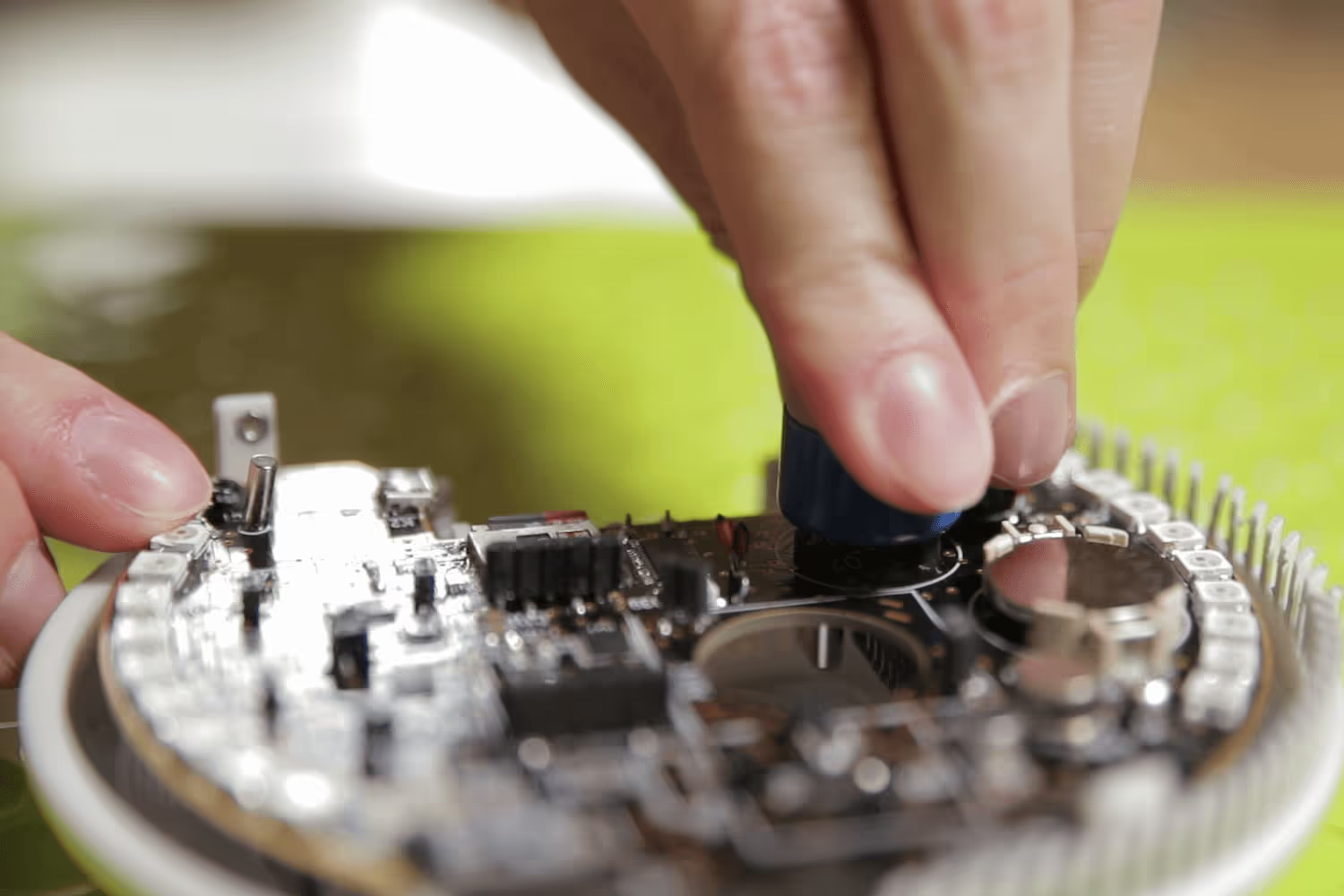
Individual air measurement — tailored to your needs
The air-Q air quality sensor already measures a large portion of the volatile organic compounds in the air, and thus hundreds of components that pollute your room air. With the new sensors, the air quality monitor now also monitors formaldehyde, methane, hydrogen, nitrogen, and ammonia. If limit values are reached here, you get warnings via LED traffic-light technology on the device itself as well as in the air-Q app. The app's health guidance tells you what you can do: e.g. when it's time to ventilate or how you should respond to individual readings. By monitoring a wide range of air components, the mobile safety assistant offers you significantly more features than a plain CO₂ monitor.
Depending on the sensors you choose, you configure your air-Q to match your needs. If you have a gas heater, for example, it's recommended to check the methane level in the air, so you're warned in the event of a gas leak. For fireplace owners, on the other hand, sensors that measure carbon monoxide levels are advisable. We offer you the right technology for your needs, since the air-Q can be equipped with various sensors. Put together the ones you want and customize your air measurement.
Below, we introduce two of our new sensors in a bit more detail: the formaldehyde sensor and the methane sensor.
New sensor for formaldehyde (CH₂O): the carcinogenic gas

Originally used as a preservative, formaldehyde is still very common indoors today. Contained in adhesives and plastics, many wood products have been heavily treated with CH₂O: for example particle board or plywood. The colorless, pungent-smelling substance pollutes air quality and can affect memory and concentration and cause sleep disturbances. Since CH₂O is gaseous at room temperature, it off-gasses from many wood-based materials and furniture. Improper use can also cause allergies, skin, respiratory, or eye irritation. At a concentration of 30 mg/m³, there's a risk to life. According to the European Union's assessment, formaldehyde may even cause cancer or increase cancer incidence.
The new air-Q sensor is equipped with a sensitive electrochemical sensor that reliably reacts to formaldehyde. To do this, the air analyzer draws in the ambient air and directs it to the sensor contact. This lets you monitor your air quality directly on-site — without any time-consuming and expensive laboratory analysis.
New sensor for methane (CH₄): the highly flammable gas
Methane is a colorless and odorless gas and a main component of heating gas. The problem: it's highly flammable and, precisely because of this high flammability, poses a significant risk in the event of a gas leak. At a methane concentration in the air of 5 to 15 percent, an explosive mixture forms. If this meets ignition sources like open flames, sparks, hot surfaces, electricity, or electrostatic charge, you risk an elevated explosion hazard.
Besides this danger, methane also causes physical discomfort and significantly reduces performance and well-being. At higher concentrations, it triggers breathing difficulties, increases breathing and heart rate, and can cause low blood pressure with dizziness or even lightheadedness. Since methane impairs oxygen uptake, symptoms like central nervous system disturbances are added, showing up as drowsiness, numbness in the arms and legs, as well as mental confusion and memory loss.
Intuitive air measurement & analysis
With just a glance at the air-Q, the air-Q app, or the web app, you see how air quality in the room currently stands: through the intuitively understandable, colored LEDs, you immediately recognize whether the air is good, moderate, or even poor. This shows you when it's time to ventilate. To do this, the air-Q constantly measures room air and transmits the collected data to the app. Here you'll find detailed analyses for every gas, every pollutant, or every particle: specially evaluated and displayed over time. Based on the trends, you can draw appropriate conclusions and always keep an eye on your health and performance!
Want to equip your air-Q with one of our new sensors? You'll find our sensors in our shop.
With our new products, we respond to specific customer requests and wishes. Do you also have a use case that requires precise monitoring? Then feel free to reach out to us, and we'll assess the possibilities for developing an appropriate sensor.