
How Do Multiple People Affect Indoor Air Quality?
The COVID-19 pandemic made us more aware of air quality. To protect against infectious aerosols, it's important to measure indoor air and ventilate regularly. This is especially important when multiple people gather in a confined space. Our experiment during a party with 10 friends shows how important these measures are.

It's not just in schools and workplaces that it's necessary to keep an eye on air quality and take countermeasures when limit values are reached. We should also monitor air components in our private lives, in our homes, or while meeting friends indoors. And not just during a pandemic. Now restrictions are easing and we can slowly return to our old lives. But even in normal everyday life, we need to make sure to ventilate regularly and check air quality. Our experiment shows why this is necessary even without an aerosol burden.
Carbon dioxide: the reading for "stale indoor air"
Besides viruses, other air components also affect indoor air quality and thus our health and performance. Special attention should be paid to the carbon dioxide level (CO₂), which is spread, among other things, through exhaled breath. When we inhale, we absorb oxygen from the air. When we exhale, on the other hand, we release carbon dioxide into the air. While inhaled air contains 21 vol.% oxygen and 0.035 vol.% carbon dioxide, the values of exhaled air change to a 16 vol.% oxygen share and a significantly increased carbon dioxide share of already 4 vol.%. Carbon dioxide is an odorless and tasteless gas. Although it can't be detected visually or by smell, its negative properties are noticeable for humans and animals. A high CO₂ concentration shows up as discomfort, poor concentration, and reduced performance. It's only toxic starting at a concentration of 2.5 vol.%, but performance, concentration, and well-being already decline starting at a concentration of 0.1 vol.%. This corresponds to a value of 1,000 ppm — i.e. a mass fraction of one milligram per kilogram.
Especially in enclosed rooms where many people are present, CO₂ already rises sharply after just a few minutes and reaches values of 5,000 to 6,000 ppm.
The air-Q test: how does indoor air change when several people are in a room?
We wanted to know how strongly CO₂ levels in a room change when multiple people gather. To find out, we placed the air-Q air quality monitor at a private party of 10 people on January 8, 2022, in a Leipzig kitchen and documented the change in readings. Our test took place in a room of about 12 sqm with an air volume of approx. 33.6 m³. Before the party, the room was well ventilated and showed a CO₂ value of about 600 ppm. The air quality monitor indicates when limit values are reached using LED lights. If CO₂ exposure reached limit values, the air-Q indicated this via a red LED display. In these cases, the windows were opened and the room was intensively ventilated for about 5 minutes.
By around 8:30 pm, all guests had arrived. The CO₂ value quickly rose above 2,200 ppm. After a brief ventilation interval, during which the level could be reduced to 1,600 ppm, the value rose again, reaching a maximum of about 2,300 ppm. Further ventilation intervals around 10 pm, 1 am, and 2 am minimized the CO₂ exposure. However, the starting value was significantly exceeded each time. So by ventilating around 1:30 am, a CO₂ value of only 1,200 ppm could be reached.
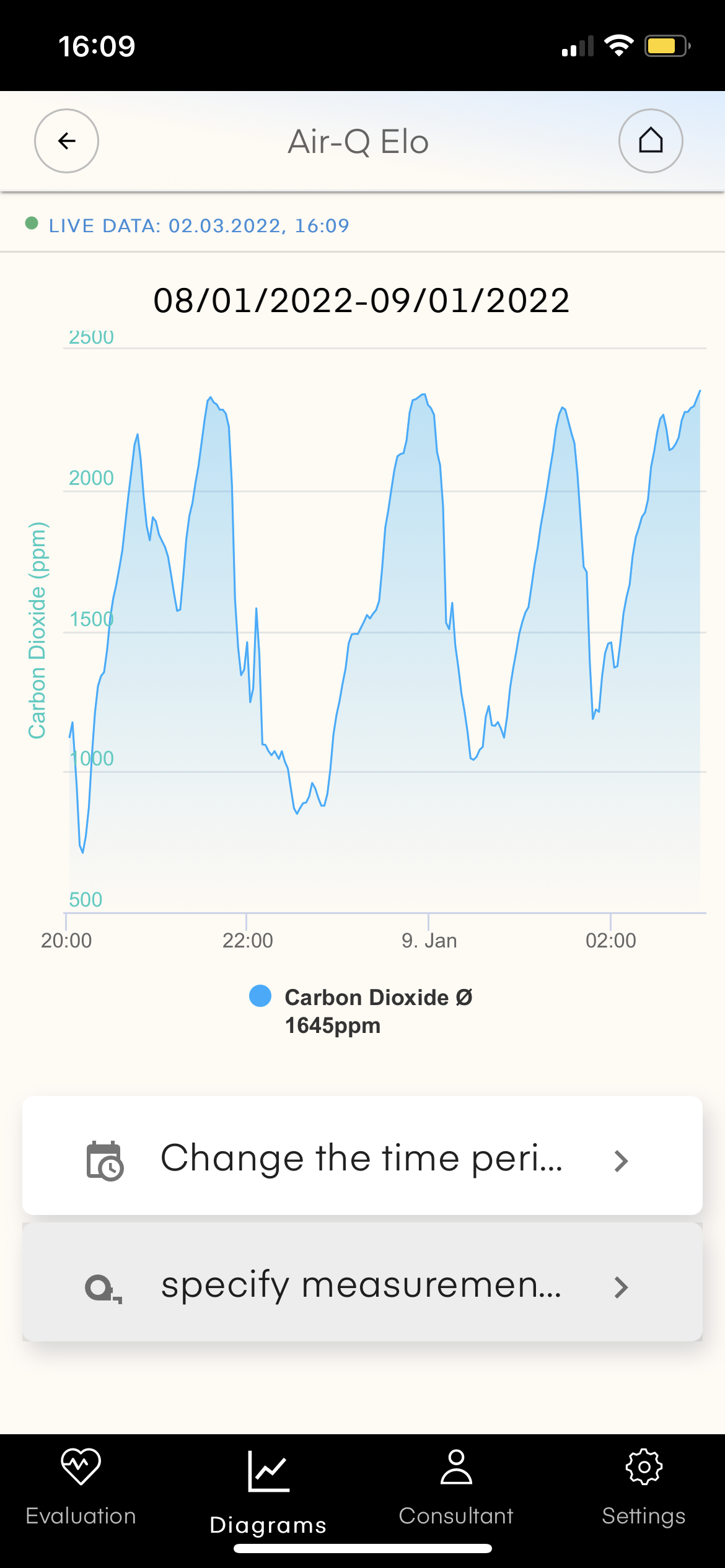
During the party, some people weren't in the kitchen, our test environment, the entire time. The balcony was also used for smoking. This is especially visible in the spike around 2 am. Cigarette smoke affects the CO₂ level, even if no one smokes directly in the room, but the smoke "only" enters the room via breathing and clinging to clothing.
The average CO₂ exposure during the observed period was 1,645 ppm — significantly above the recommended limit value of 1,000 ppm. Repeatedly, carbon dioxide in the room rose within a 30-minute time interval and reached peak values around 2,300 ppm.
Our test results show that even short ventilation intervals of about 5 min. noticeably reduce CO2 concentration. Over the course of the evening, however, the CO2 level rose faster and faster and, despite ventilation breaks, couldn't be brought back down to the starting value. To constantly lower the CO2 value, either the ventilation frequency or the ventilation duration would need to be significantly increased.
Alcohol & gatherings of people affect the VOC value in a room
It's not just oxygen that "disappears" from a room when many people gather — hazardous substances also suddenly rise in the air composition. For example, volatile organic compounds (VOC), whose elevated concentration enormously limits well-being. An elevated VOC concentration in indoor air causes fatigue and shows up, combined with odorants, in the typical perception of "stale air".
High VOC values, however, aren't just unpleasant for the nose — they also have health consequences. VOC exposure shows up through the following symptoms: altered smell and taste perception, irritation of the eyes or mucous membranes, poor concentration, exhaustion, dry skin, as well as a tendency toward eczema and headaches. Alcohol vapors affect the VOC value indoors. This is also shown by our test. Over the course of our party, more and more open bottles stood on the kitchen table.
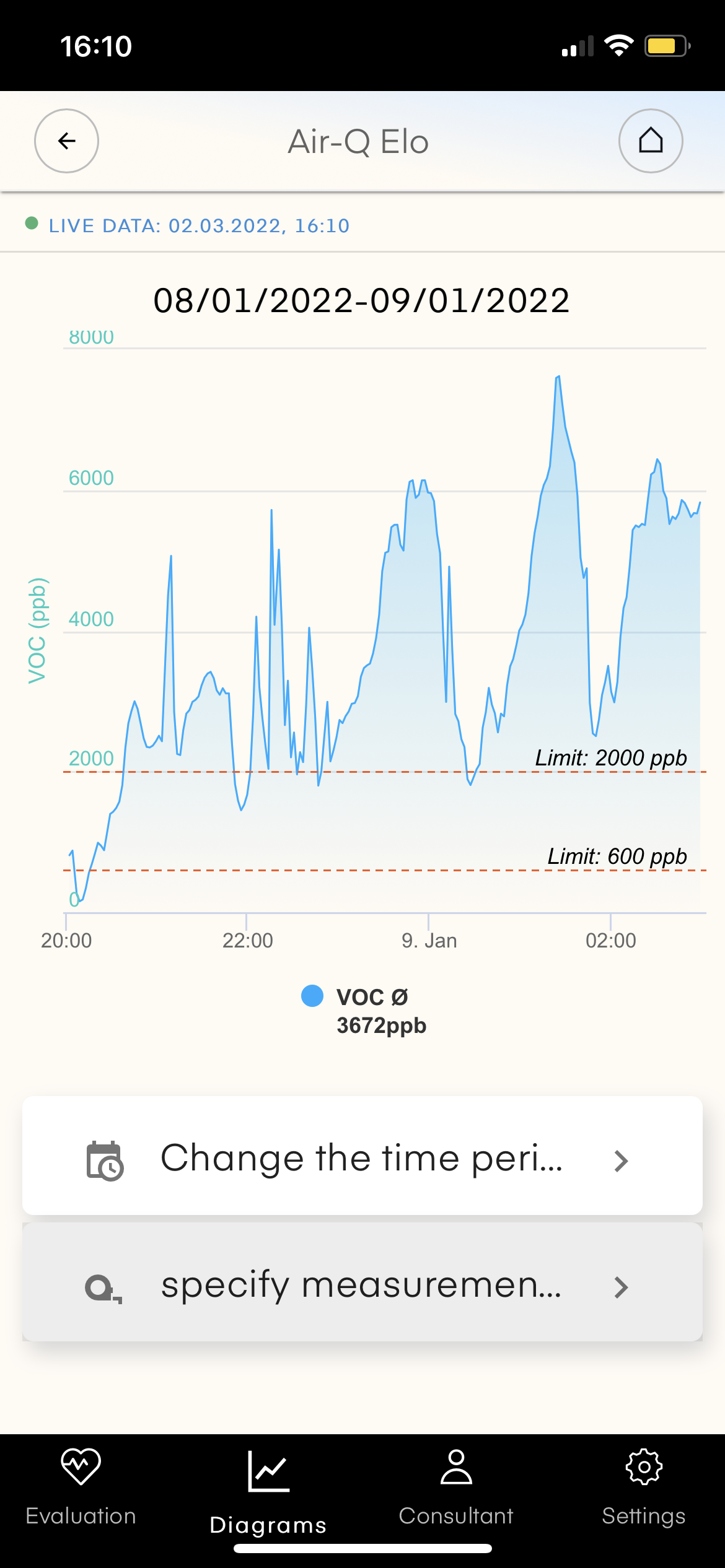
Our test shows a constant rise in VOC exposure, interrupted by the short ventilation intervals. But here too, it becomes clear that the low starting value of about 100 ppb shortly after 8 pm could no longer be reached again. The 2,200 VOC value after ventilating shortly before 2 am even exceeded the limit of 2,000 ppb. Peak values of 5,000 to almost 8,000 ppb were measured in five time intervals between the ventilation breaks.
How high is the noise level at a small party?
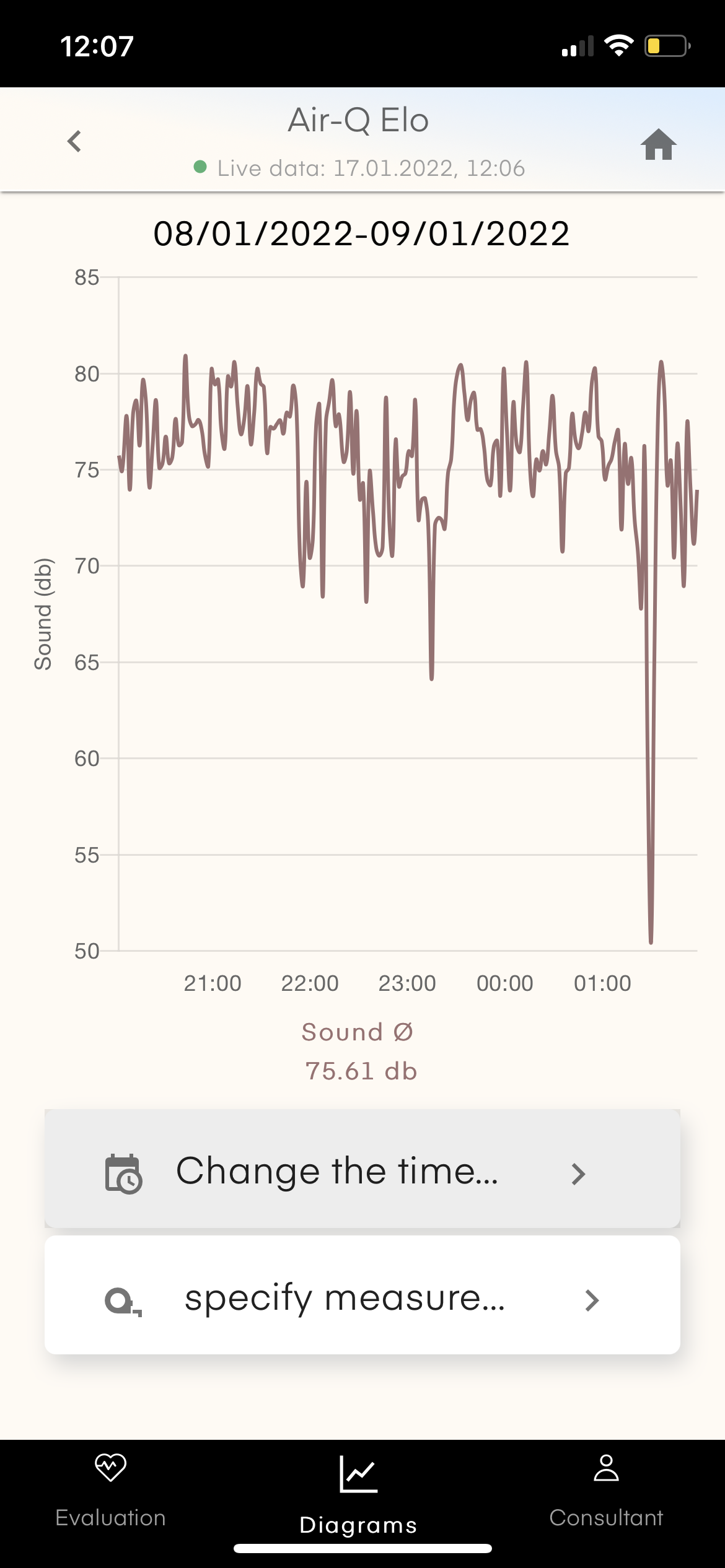
Besides the CO2 and VOC values, the air-Q also analyzed noise (Lp). The evaluation shows that noise exposure averaged 75.29 dB. An elevated noise level also impairs well-being and performance. When whispering, the noise level is about 40 decibels. Anyone living on a main road or working in a loud open-plan office is quickly exposed to a sound level of 80 dB. Generally, sounds of up to 65 decibels are considered "normal" loud. Permanent exposure to a level of 80 to 85 dB, on the other hand, can cause permanent hearing damage.
As a remnant from our ancestors, noise puts our entire organism on high alert: we're ready to flee at any moment. This tension means stress for the body. Starting at a noise level of 60 decibels or higher, the level of the stress hormones cortisol and adrenaline in the body rises. Heart rate and blood pressure also increase. Noise thus alters the hormone balance. But it also affects metabolism and brain wave activity. Anyone permanently exposed to noise risks permanent hearing damage and can be more prone to depression. We've summarized more information about noise and its physical and psychological effects in a separate article.
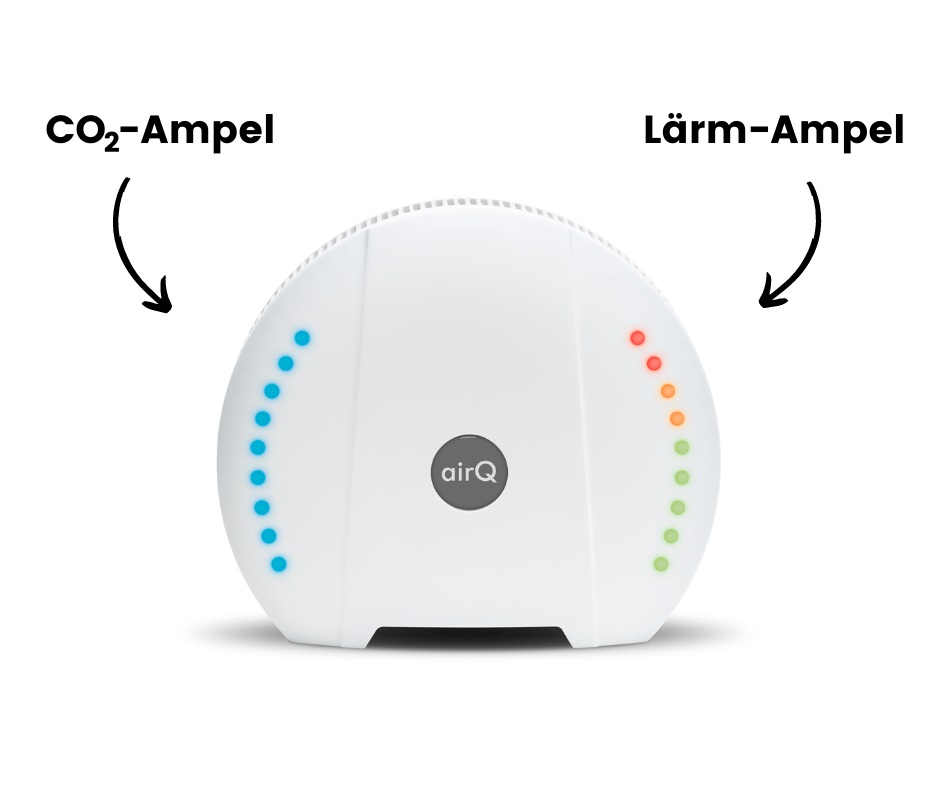
With the air-Q, you keep an eye on air quality in real time: at a party, in everyday life, or in the office. Thanks to the smart air quality monitor, sources of air pollutants can be uncovered, and thanks to the warning alerts you can take countermeasures accordingly.
(Cover image: Canva edit/ LightFieldStudios from Getty Images)