
Mold & Smart Homes: How Modern Technology Can Monitor Air Quality
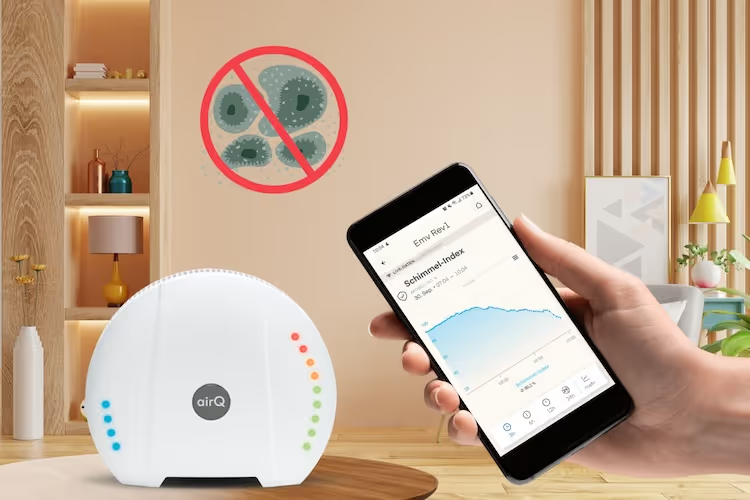
Mold in a home is a widespread problem that isn't just unpleasant, but also carries health risks. In this blog post, we want to show you how modern smart home technology like air-Q can help monitor air quality in your rooms and detect mold growth early.
In this post, you'll find the following content:
- How does mold develop in a home?
- Mold prevention through smart home technology
- The air-Q: smart technology against mold growth
- Conclusion: modern technology as the key to preventing mold in a home
- air-Q mold quiz: test your knowledge about mold now
How does mold develop in a home?
Dangerous mold in a home mainly develops through a combination of high humidity and inadequate ventilation. Additional factors are insufficient insulation, thermal bridges, and improper heating and ventilation habits. Especially due to more compact modern construction methods and energy-saving measures, mold growth is favored in many houses and apartments, since less air circulation takes place. To prevent mold growth, relative humidity should ideally be between 40% and 60%. The optimal room temperature is between 16°C in the bedroom and 23°C in living spaces. CO₂ levels should be kept as low as possible.
Unfortunately, many people only notice the signs of mold when it's already too late. Thanks to modern smart home devices, however, you can continuously monitor these important values. This gives you early warning of critical changes — long before mold can even form.
Mold prevention through smart home technology
Mold growth in a home can be prevented. However, the usual preventive measures like regular ventilation and adjusting room temperature offer no absolute guarantee that critical values for humidity, CO₂ level, and volatile organic compounds (VOCs) stay below their thresholds. Modern air quality sensors like air-Q function as highly developed monitoring systems for room air. The devices continuously measure various air parameters, including particulate matter, humidity, CO₂ level, and VOCs.
The smart systems collect and analyze this data in real time. They detect critical values and patterns that indicate mold risks or poor air quality. When limit values are exceeded, they automatically send warnings, e.g. via app. This lets users respond early, before problems arise.
The air-Q mold index: precise mold prediction for your home
The air-Q mold index is an innovative feature that calculates a precise mold risk based on the measured air parameters. It combines values like humidity, temperature, and CO₂ concentrations to assess the risk of mold growth in real time. Users thus get an easy-to-understand assessment of the current mold risk (low, medium, and high) and can take early measures like ventilating or regulating humidity, before mold can even form. But note: the device can't measure mold spores in the air (no device can do that yet).
The air-Q: a smart device against mold growth in a home
- Comprehensive air monitoring: the air-Q has highly precise sensors for measuring particulate matter, humidity, CO₂, and volatile organic compounds (VOCs). These enable comprehensive real-time monitoring of room air quality.
- Real-time data analysis: the collected data is continuously analyzed to detect patterns and critical values that could indicate an elevated mold risk or a deterioration in air quality.
- Intelligent early warning system: upon detecting potentially dangerous conditions, like elevated humidity or CO₂ concentration, the air-Q immediately sends warning notifications to the user, for example via the associated smartphone app.
- Proactive mold prevention: through the early warning provided by the mold index, users can take timely measures, like increased ventilation or adjusting the heating, to prevent mold growth.
- User-friendly visualization: the readings and analyses are presented in easy-to-understand charts and reports, so users can easily monitor and understand the air quality in their home.
Benefits of integrating smart home technologies
Air quality monitors like air-Q connect seamlessly with other smart devices like air purifiers, fans, air conditioning, and thermostatic radiator valves through various smart home standards. These devices can be automatically controlled based on air-Q measurements to create optimal air conditions. Humidifiers turn on as needed, fans provide fresh air, and heating adjusts the temperature.
This intelligent control not only promotes health through consistently good air quality, but also saves costs long-term. Mold growth is prevented, avoiding costly remediation measures for mold removal. Additionally, efficient regulation leads to reduced energy costs. This way, integrating the air-Q combines health protection, comfort, and cost efficiency in one smart living concept.
Modern technology as the key to preventing mold in a home
Smart home technologies for air monitoring offer a wide range of benefits: early mold detection, automatic warning notifications, intelligent indoor climate control, cost savings, and improved home health. An investment in systems like air-Q pays off long-term — you protect your health, prevent mold in your home, and increase living comfort as well as energy efficiency. Make your home smart and healthy now with air-Q!
-(300-x-250-px)-(1500-x-1300-px).jpg)
air-Q mold quiz: test your knowledge about mold now
How much do you know about mold? In our quiz, you have the opportunity to test your knowledge about mold and learn unusual facts. Answer our 5 questions and find out whether you're a mold expert!