
Measuring VOCs with a PID Sensor – What Can the air-Q Do with the PID Special Sensor for Volatile Hydrocarbons?
Volatile Organic Compounds (so-called VOCs) can be measured in the air-Q using various VOC sensors. Depending on the use case, a higher-grade PID sensor can be chosen, which allows precise measurements, even of individual VOCs, in the lab or industrial production.
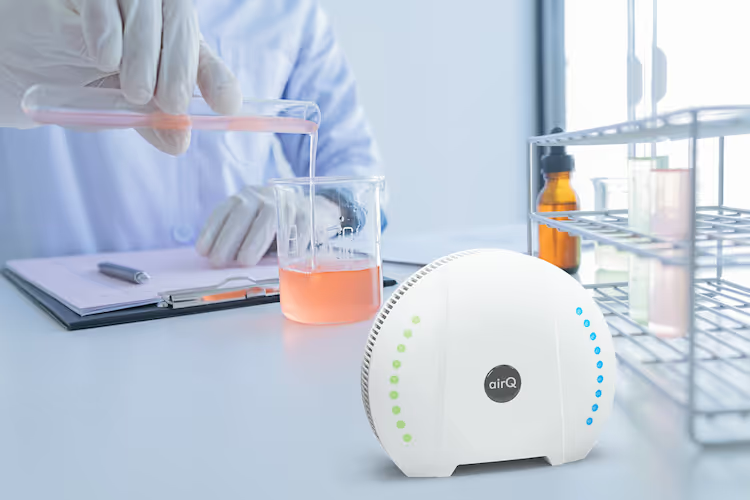
VOCs are measured in the air-Q by default using a resistive sensor. Molecules that "dock" onto the sensor's surface cause a change in the electrical resistance of the sensor. This measurement principle is well-established and very well suited for most requirements. For special applications, it's possible to additionally use a PID sensor in the air-Q, which can be used in a free additional-sensor slot in the device. We introduce the air-Q VOC PID sensor and answer important questions about how it works.
PID sensors, or photoionization detectors, play a decisive role in modern air-monitoring technology. These sensors are especially effective when it comes to detecting volatile organic compounds (VOCs) and other potentially hazardous gases in ambient air. Thanks to their high sensitivity, PID sensors can detect even the smallest concentrations of pollutants, which are invisible to the naked eye but nonetheless pose significant health risks.
Their ability to deliver accurate measurements in real time makes them indispensable in areas like industrial safety, environmental monitoring, and building technology. Companies that rely on PID sensors benefit not only from improved safety for their employees, but also from compliance with legal regulations and the avoidance of costly environmental and health damage. In a world that's increasingly focused on sustainability and safety, PID sensors offer a reliable solution for monitoring air quality and protecting the environment.
What advantages does a PID sensor offer over other gas sensors?
PID sensors are especially sensitive and can detect very low concentrations of VOCs and other pollutants in real time. They offer a fast response time and can measure a wide range of organic compounds, making them versatile and effective for air quality monitoring.
How does a PID sensor measure?
PID sensors (Volatile Organic Compounds – Photoionization Detector) are based on the principle of photoionization. The sensor module consists of an ionizing lamp and a detector. The ionizing lamp generates high-energy UV radiation that ionizes gas molecules with a certain energy by removing electrons from them. The excitation energy can be configured via the choice of ionizing lamp in the PID sensor.
The detector in the sensor measures the number of ions thus generated via electrodes that are struck by the ionized molecules. The electrical current thus generated can be measured and is proportional to the concentration of VOCs in the air. The air-Q converts this current into a reading.
Which VOCs can the air-Q PID sensor detect?
The air-Q PID sensor is able to detect a wide variety of volatile organic compounds (VOCs). Commonly detected VOCs include:
- Benzene - Frequently used in fuels and as a solvent.
- Toluene - Contained in paints, varnishes, and adhesives.
- Xylene - Also found in paints and varnishes.
- Styrene - Used in the manufacture of plastics and rubber.
- Formaldehyde - Used in furniture, building materials, and as a preservative.
- Acetone - A widely used solvent found in household products and industry.
- Ethanol - Contained in cleaning products and disinfectants.
The PID sensor in the air-Q can detect a wide range of VOCs found in various industrial and household environments. The precise detection depends on the sensor's calibration and the specific operating conditions.
%252520Sensor%252520(2).png)
How does measurement with the VOC PID sensor in the air-Q work?
The PID sensor can be purchased as an additional sensor in the air-Q Science or as a separate add-on sensor for retrofitting existing air-Qs. On request, we offer sensors with different ionizing lamps with excitation energies of 10 eV, 10.6 eV, and 11.7 eV.
As with all air-Qs, data input is available to you via the air-Q smartphone app for iOS and Android, our air-Q web app, and data output via MQTT or CSV data export. Via the configuration in the smartphone app or via a configuration file, different response factors for the PID sensor can be recorded, in order to calibrate or use the sensor for measuring particular VOCs.
The air-Q PID sensor has a measurement range of 0 to 6,000,000 ppb at a resolution of 1 ppb. The UV lamp has a lifespan of at least 1 year – experience shows it's often significantly longer. After that, it can be replaced without the entire sensor needing to be renewed.
Who is the air-Q with VOC PID sensor suitable for?
The air-Q with PID sensor is primarily intended for professional use cases. Due to the number of VOCs detected, the very wide measurement range, and the high accuracy, it's perfectly suited for use in research and development. Use for industrial purposes is also conceivable, e.g. to monitor the concentration of certain harmful or explosive gases even in non-air atmospheres. Controlling environmental emissions, workplace safety, detecting leaks in gas pipelines, and monitoring indoor air quality can likewise be areas of application.