
Is a Tea Light Oven Worth It?
Heating is becoming ever more expensive amid the gas crisis. Many people are worried about their upcoming utility bill and are looking for alternatives to save on heating costs. One money-saving trend is the tea light heater. We took a look at how these ovens work, what advantages and disadvantages they have, and whether these small heaters are a healthy alternative.
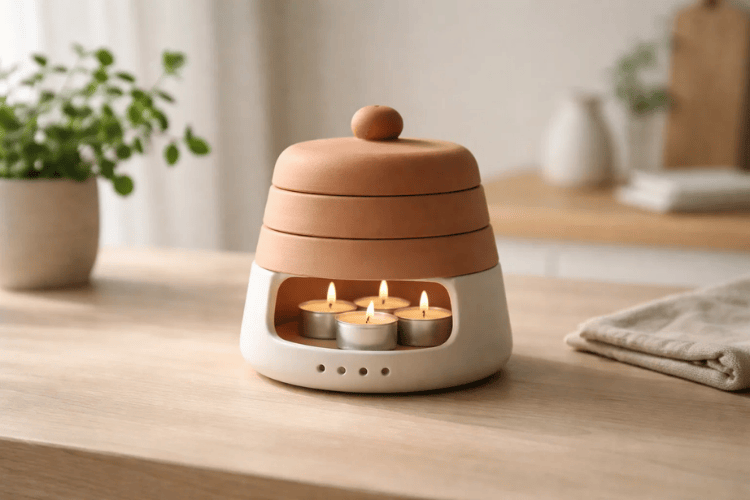
Heating with a tea light and an upside-down flower pot – is that supposed to work? These DIY heaters are mainly promoted on social media, where instructions for building your own flower-pot heater are circulated. The idea behind these clay heaters: the heat from the tea light is supposed to be distributed better throughout the room, instead of simply rising upward. One caveat up front: even proponents admit that tea light ovens don't get as warm as real heating systems. Still, they are said to noticeably warm the room.
How Do You Build a Tea Light Heater?
You need these items for your flower-pot heater:
- 2 flower pots of different sizes
- 1 dish with a hole
- 1 threaded rod
- Nuts for fastening
- Cordless drill with masonry bit
You need a dish with a hole in the center. You can use a flower pot saucer for this. This will be the base. Insert a threaded rod through the hole in the dish. Attach two differently sized flower pots, stacked on top of one another with the opening facing the dish, to this rod. Fasten the pots with a nut. The smaller pot is placed inside the larger one and thus becomes the inner pot. For optimal heat distribution, you can drill holes in the outer pot through which the warmed air can escape more easily. Place several tea lights on the dish. Your tea light heater is now ready.
You can also build your tea light oven with just one pot; this doesn't significantly reduce the heat output.
How Does a Tea Light Oven Work?
Once the tea lights are lit, the heat rises and collects underneath the flower pots. The heat given off by the individual flames now heats the air beneath the pots and the pot itself. The material of the pots stores the heat and releases it evenly in all directions over a longer period of time in the form of thermal radiation. Now you can hold your hands or feet up to the miniature oven and enjoy the cozy warmth.
How Effective Are Tea Light Ovens?
While temperatures of up to 80 degrees can be reached under the inner pot, depending on the number of tea lights, the temperature of the outer pot already drops to 50 degrees. This means the further you move away from your tea light oven, the less heat output you will feel. Accordingly, the heating output of a single tea light oven will not be enough to actually warm a room. A single tea light has a heating output of roughly 40 watts. However, you need about 75 watts per square meter to heat the air in a room to 20 degrees. However, the tea light oven can help increase the perceived temperature (room temperature / radiant temperature), especially in the immediate vicinity of the miniature oven.
Beyond a cozy hand warmer and a stylish way to bring candlelight into your home, such a tea light oven unfortunately doesn't offer much more.
What Advantages or Disadvantages Does a Tea Light Oven Offer?
Advantages at a glance:
- Since the tea light oven is very small, it can be placed anywhere. It fits perfectly on a desk or a chest of drawers.
- The purchase costs are very low and can be quickly obtained at the next hardware store.
- The clay pot prevents the candle heat from rising directly upward. Instead, the heat is collected and slowly released to the surroundings.
- The larger surface area of the tea light oven creates improved and more even heat distribution.
- If the pot is not touched directly, there is significantly less risk of burns than when warming yourself at the tea light flame.
Disadvantages at a glance:
- A tea light oven operates with an open flame, which should never burn unattended to prevent a wax fire.
- A single tea light heater is not enough to effectively warm a room.
- When a tea light burns, air pollutants such as Volatile Organic Compounds (VOCs) and fine dust enter the indoor air, and you need to ventilate more often.
Does a Tea Light Oven Affect Indoor Air Quality?
Burning the tea light releases air pollutants that accumulate in the indoor air. You can check the extent to which these negatively affect air quality with an air quality monitor such as the air-Q. We are currently conducting a practical test with a tea light heater. You'll find the results of our air-Q Lab here in the coming weeks.
.jpeg)