
How Noise Endangers Our Health – an Invisible Danger With Big Effects
Noise is everywhere — on the street, at the office, at home. But unlike visible environmental pollution such as smoke or exhaust, it often goes unnoticed. Yet noise has significant effects on our health, even when we don't consciously perceive it.
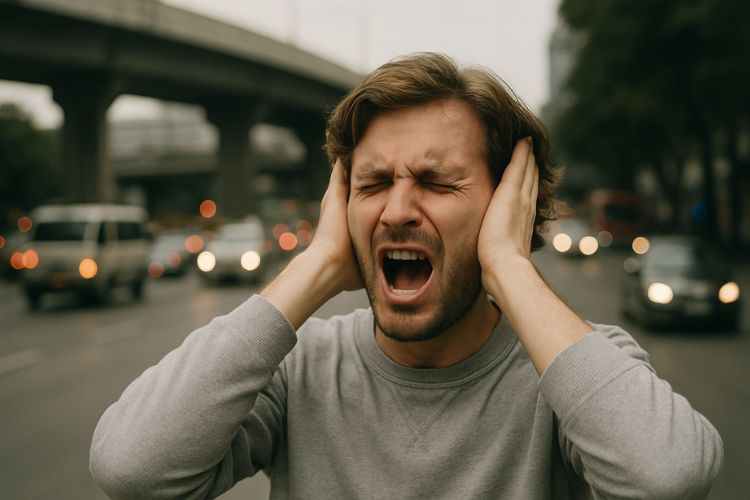
What actually is noise?
Noise is unwanted or disruptive sound. The burden often begins well below the pain threshold: while hearing damage is possible from about 85 decibels (dB), studies show that sustained exposure starting from just 55–65 dB can cause health problems. Especially critical: noise at night. Sleep can already be disrupted starting at 30 dB — for example from distant traffic or neighbors.
At what level does noise make you sick?
Noise can already be burdensome from 65 decibels. With sustained ambient noise — such as from road traffic or machinery — the body responds with stress. This kind of noise stress triggers a chain reaction: blood pressure rises, the heart beats faster, stress hormones like cortisol are released. Anyone exposed to this state daily has an elevated risk of cardiovascular disease, sleep disturbances, and psychological problems.
In short: the effects of noise are measurable — even when we've long since "tuned out" the racket.
Classification in decibels (dB)
| Sound source | Volume in dB | Effect on the body |
| Whispering | 30 dB | Sleep disruption possible |
| Normal conversation | 60 dB | Unproblematic |
| Road traffic (city) | 70-85 dB | Elevated stress level |
| Construction site | 90 dB | Harmful to health if sustained | Rock concert | 100-120 dB | Hearing damage possible after a short time |
(Tip: the air-Q reliably measures noise from 30 dB upward.)
.jpg)
Traffic noise makes you sick — especially in cities
Traffic noise is one of the main causes of chronic noise exposure in Germany. Especially in cities, it's present almost around the clock. The tricky part: some people no longer consciously perceive traffic noise at all.
The problem: our body doesn't get used to it — it stays in an alert state, which makes you sick long-term. Traffic noise is especially disruptive to sleep at night. And poor sleep, in turn, promotes diabetes, depression, and a weakened immune system.
Noise protection along highways — such as barriers, whisper asphalt, or 30 km/h zones — is therefore not a luxury, but a necessary contribution to public health.

Noise at the workplace — an underestimated risk
Noise at the workplace is also often downplayed. Yet many employees — e.g. in production, logistics, or open-plan offices — suffer from a constant soundscape. This not only reduces concentration but also increases the risk of errors, exhaustion, and burnout. Even background noise like printers, conversations, or ringing phones can make you sick over time.
It's better to measure, analyze, and specifically reduce noise sources — for example with sensors like the air-Q, which also captures noise data in real time.
WHO warning: noise as a health risk
The World Health Organization (WHO) calls noise the second-largest environmental health risk in Europe — right after air pollution. In Germany alone, according to the Federal Ministry of Health, about 80% of the population feels bothered by noise — many of them daily.
Effects of noise — more than just annoying
The effects of noise touch nearly every area of our lives:
- Physical:
Elevated risk of cardiovascular disease.
Sustained noise can trigger high blood pressure and significantly increase the risk of heart attacks and strokes. - Psychological:
Noise causes irritability, poor concentration, and greater psychological vulnerability.
Even moderate noise exposure promotes stress reactions and can lead to exhaustion or depression long-term. - Social:
Noise increases aggression potential and strains relationships.
Anyone constantly under noise becomes irritable faster, withdraws, or gets into conflicts more often. - Children:
Noise impairs the development of language, learning, and behavior.
Children who live permanently in a noisy environment more often show concentration problems and emotional issues.
What we can do against noise exposure
Some measures that help:
- Identify noise sources (e.g. with the air-Q)
- Soundproof windows and insulation in your home
- Noise protection measures along roads and highways
- Create quiet workspaces and break areas
- Deliberately protect nighttime quiet hours — no permanent sound exposure
How does the air-Q help?
Noise is invisible — but with the air-Q air analyzer, it becomes measurable. The built-in noise sensor detects sounds in the range of 30 to over 100 dB and documents exposure around the clock. This lets you determine:
- When and how often noise peaks occur
- Whether nighttime noise disrupts sleep
- Which measures actually help (e.g. soundproof windows or a different room layout)
With the air-Q, a vague feeling becomes hard data. And only those who know how much they're affected can take targeted action.
%2520(300%2520x%2520250%2520px)%2520(1500%2520x%25201300%2520px).jpeg)
Conclusion: noise isn't just background hum
Whether at the workplace, along a highway, or in the middle of a city: noise has an effect — always. And it makes you sick if you don't take it seriously. The good news: with the right technology and more awareness, many burdens can be identified and reduced. Anyone who measures the exposure understands the cause. Anyone who reduces it protects their health.
The air-Q doesn't just measure air quality — it also detects noise exposure in everyday life, helping you recognize noise stress early and take targeted countermeasures