
Healthy Workplace Climate – With the air-Q Office Air Analysis
Air pollutants can affect concentration, performance, and well-being, and can even make you sick. That's why it's especially important to check air quality at the workplace. A room air analysis helps you do this. Read here how it works and which measures you should take to improve air quality.

1. Find out with an office air analysis how workplace room air is composed
Office air can accumulate a wide range of pollutants that impair employees' health and performance. With every breath, these can enter the body and cause health impairments as well as a wide range of symptoms. Stale air promotes many symptoms such as headaches, reduced concentration, respiratory or cardiovascular problems, and thus causes fatigue, lack of focus, and consequently errors. It also promotes sick building syndrome, which is estimated to account for 20 to 30 percent of office sick days.
In addition, pathogens quickly build up and spread in stale air. Increased sick days among your colleagues and employees, and the resulting higher costs for the company, are the result. To avoid this, you should continuously check air components, especially carbon dioxide content (CO₂). This value is a reliable parameter for stale air and the risk of pathogen transmission.
With a room air analysis, you detect unfavorable climatic conditions early and identify air pollutants. Using an air monitor, detect relevant air components such as excessively high or low humidity, toxic gases, or pollutants like formaldehyde, volatile organic compounds (VOCs), and particulate matter. An office air analysis with the air-Q air monitor uncovers potentially health-harming substances in the air and gives you a comprehensive picture of air quality at your workplace. By detecting such pollutants early, you avoid health problems in your team and especially protect colleagues with respiratory problems or allergies.
2. How the air-Q office air analysis works
The air-Q helps you detect and eliminate hazard sources in room air. This lets you ensure no harmful substances are present in office air that could impair your employees' health. Besides invisible causes of an unhealthy office climate, a room air analysis also uncovers behavior patterns such as improper ventilation and can reveal energy waste from open windows or heating set too high.
Want to examine air quality in your office? Then the air-Q is the best choice. No other air monitor offers you as many sensitive sensors, data-based analysis, and various alarms. Sign up for an office air analysis with us. To do this, enter your basic details. We'll send you a matching air-Q pro measuring device with suitable sensors for your analysis project. On request, you can also get the device with special equipment, i.e. special sensors. Thanks to its wide array of sensors, the air-Q detects air components, analyzes the indoor climate in real time, and determines environmental influences with scientific precision.
You reach your professional office air analysis in just 3 steps.
Receive & set up your test device
As soon as you receive your air-Q pro incl. 13 sensors, your one-week test phase begins. We send you the air monitor ready to use, so you just need to set it up in the intended location and plug it into power via a cable. Your office air analysis starts immediately.
Office air analysis test phase
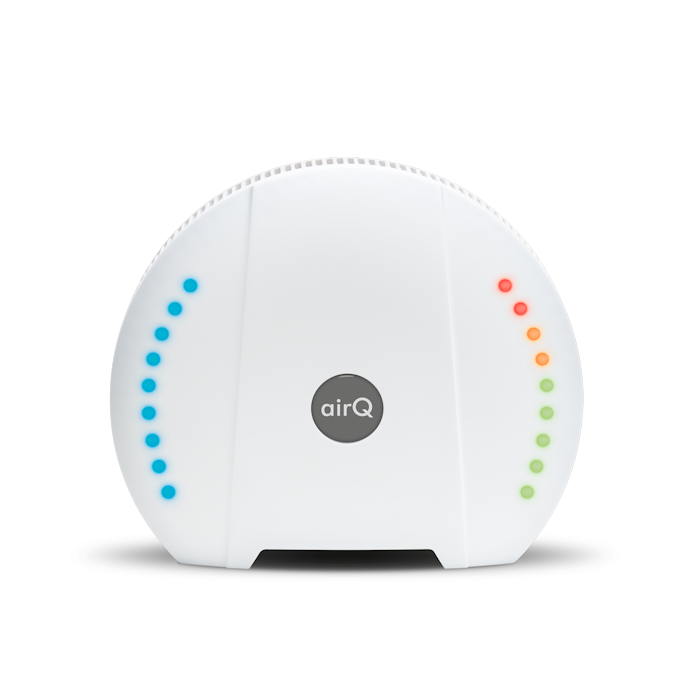
With the air monitor, you get free access to the air-Q's live data via the smartphone app & web app, so you can track all data and its development during the analysis period. Various charts present the air's composition and the development of its components in an easy-to-understand way. Two LED displays on the air-Q also show you the current air quality of two selected air components. Using a colored traffic-light display, you can read off whether the air component's level is within the recommended thresholds or whether you need to act to improve air quality through an air exchange.
The air-Q health index and air-Q performance index assess all readings with regard to their health and performance aspects. These indices show you to what extent and degree air quality might negatively affect physical and mental performance. Based on this data, you keep the effects of air quality on your health and performance constantly in view!
Professional data analysis of the office air analysis
After the test phase ends, you send the air monitor back to us. Our air experts then look at the collected data from all measurement results and individually analyze your data. You then receive a clear summary of your data, including detailed explanations. Each of our analyses gives you information about the measured pollutant exposure as a compact, informative report of about 3 to 5 pages. Our data-based recommendations also uncover hidden productivity killers, and you'll find all important reading charts along with tips for a better office air situation.
3. With the air-Q, you keep a wide range of air pollutants in view
For a meaningful office air analysis, the air-Q pro with 13 different sensors is available to you. This lets you monitor a wide range of pollutants: particulate matter (PM₁ – PM₂.₅ – PM₁₀), carbon dioxide (CO₂), oxygen (O₂), sulfur dioxide (SO₂), volatile organic compounds (VOC), nitrogen dioxide (NO₂), carbon monoxide (CO), ozone (O₃), hydrogen sulfide (H₂S), relative & absolute humidity, temperature (T), dew point (Td), air pressure (p), noise (Lp).
.jpeg)
4. Improving room air at the workplace – individual tips from our air-Q air experts
Our office air analysis uncovers pollutants in the air and helps you avoid problematic behavior patterns in the future. As air experts, we know every "air problem" should be solved individually. Still, we can give you a few general tips for improving air quality at your workplace.
- Ventilate regularly: ventilate several times a day — whenever current air quality calls for it.
- Use air purifiers: air purifiers with HEPA filters remove particles like dust, allergens, and pollutants from office air.
- Add plants: houseplants, especially green plants, can improve air quality by absorbing pollutants and producing oxygen. In our experiment, we tested how plants affect air quality. Find the results in our separate article.
- Detect & eliminate pollutant sources: pollutant sources can be detected and eliminated through regular room air monitoring with an air monitor.
- Control humidity: room air that's too dry or too humid can negatively affect well-being and health, or promote mold growth. Ideally, you should aim for humidity between 30 and 50 percent. Humidifiers or dehumidifiers can help as needed. With the smart air-Q, you can even control these devices in your office on a needs-based basis.
- Regular cleaning: reduce the concentration of allergens and dust particles by regularly vacuuming and dusting the office.
5. Costs & benefits of an office air analysis in focus
Invest in your health and your employees'. Understand the cost of an office air analysis relative to the long-term health benefits you get from the air quality analysis and the accompanying tips for preventive measures. If you detect air pollutants early, you can act accordingly and avoid long-term costs, for example for construction work due to mold.
We recommend a continuous, long-term room air analysis with your own air-Q device, since room air composition changes daily due to various factors. Seasonal fluctuations also occur here, from heating air, elevated temperatures, increased allergens, or waves of illness. By measuring office air not just once but constantly, you can ensure a healthy indoor climate on every workday.
Buying your own measuring device is worthwhile even from your very first office air analysis — if you choose our air-Q light with the basic set of 5 sensors.