
I Use Gas for Heating or Cooking – Why Do I Need a Gas Detector?
Gas is tricky, since it can leak unnoticed, with devastating consequences. Mixed with ambient air, it quickly forms a highly flammable mix that can trigger an explosion from something as simple as flipping a light switch. A suitable gas detector provides safety here. Read now which gases you should keep an eye on.
Unlike smoke detectors, there's no legal requirement in Germany to install gas detectors, meaning alarm devices for flammable or toxic gases. However, since all gas-powered systems and devices are a potential hazard source, these detectors are important. After all, even a high gas concentration usually goes unnoticed, since most gases are colorless and odorless, and you may not be home or may even be asleep. Gas detectors, on the other hand, continuously measure room air and warn when thresholds are reached. This provides extra protection and enables quick action.
Most common sources of dangerous gases:
- Gas heating systems, gas boilers & gas furnaces
- Gas-powered stoves (also in caravans or vacation rentals)
- (Gas-powered) fireplaces & stoves
One risk source often overlooked: gas is frequently used for cooking in caravans or RVs. Since these are very small spaces where gas concentration can quickly become dangerous, you should definitely install a detector here.
These gases are acutely dangerous in your home or caravan:
- Carbon monoxide
- Smoke
- Nitrogen dioxide
- Methane & propane
We've compiled here what characterizes each of these gases, which symptoms indicate a high concentration of the gas in the air, and what health effects to expect.
Carbon monoxide – the respiratory poison
Carbon monoxide (CO) is a potent respiratory poison. However, you can neither see nor taste this gas, since it's colorless, odorless, and tasteless. In unventilated rooms, dangerous concentrations are quickly reached. If CO enters the bloodstream, it can severely disrupt oxygen transport. That's because carbon monoxide binds to hemoglobin in the blood, so much less oxygen can attach here. Carbon monoxide poisoning threatens. From a saturation of 1.28% carbon monoxide in room air, you risk poisoning that can lead to death within one to two minutes. Anyone heating with a wood stove or gas heating, or living in a heavily insulated home, faces a significantly higher risk.
CO concentration Symptoms Low exposure 80 – 120 mg/m³ (several hours) Cold-like symptoms: e.g. runny nose, headaches, shortness of breath, sore eyes Higher exposure 170 – 350 mg/m³ (2 to 3 hours) Fatigue, dizziness, nausea Extreme exposure From 460 mg/m³ Unconsciousness & permanent brain damage, immediately life-threatening/death within three hours at the latest Lethal exposure From about 15,000 mg/m³ immediately life-threatening/death
Reading tip: In our blog post, learn more about how carbon monoxide poisoning occurs, the official CO thresholds, and how to reliably monitor the gas.
Smoke from fire or blazes
While not technically a "gas," smoke is physically particulate matter, in extremely large amounts. Smoke usually occurs together with other combustion gases, acutely irritates the airways, and blocks breathing and oxygen uptake. It's therefore inherently dangerous and also represents an acute fire risk.
Nitrogen dioxide – the pungent-smelling gas
Nitrogen dioxide (NO₂) is a reddish-brown gas with a pungent, chlorine-like smell. NO₂ strongly irritates the airways by narrowing the bronchi. It also promotes asthma and allergies. Asthmatics, allergy sufferers, or patients with bronchial or chronic bronchitis therefore react especially sensitively to high nitrogen dioxide exposure.
Even smaller amounts of NO₂ in the air you breathe can cause dizziness and headaches. Only at larger concentrations, though, is the highly toxic nitrogen dioxide noticed by its characteristic pungent smell. At higher concentrations, you risk shortness of breath and fluid buildup in the lungs (pulmonary edema), which can cause chronic lung damage, irritation of the respiratory tract, chest pain, or even fatal consequences.
Methane & propane – the explosive gases
As a flammable gas, methane (CH₄) is a main component of heating gas. At low concentrations, CH₄ is non-toxic and only mildly anesthetic. If methane density in room air rises, though, it can trigger breathing difficulties.
Normally, methane poisoning leaves no lasting damage, but it does significantly limit performance. However, the so-called lower explosive limit (4.4 vol.%) is reached well before a health impairment occurs. If this threshold is exceeded in living spaces, there's an acute risk to life, since the gas forms an explosive mixture with air. If a defective gas heating system is leaking methane, there's a risk of explosion!
Propane (C3H8) is also a colorless, flammable gas. It's easily identifiable by smell, though, which resembles rotten eggs. An elevated concentration in room air has a narcotic to suffocating effect. Like methane, propane is heat-sensitive and highly flammable. If you use a propane gas cylinder, you should therefore always store it protected from direct and indirect heat exposure. Explosive mixtures form starting at a volume share of just 2.12% in the air.
Signs of methane or propane poisoning:
- weakening of the central nervous system
- elevated breathing & heart rate
- low blood pressure with dizziness & lightheadedness
- at high concentrations, oxygen deprivation can lead to sudden unconsciousness & death.
Learn more about safe heating with gas heating or a gas boiler in our separate article. There, you'll also learn how to behave in the event of a gas leak.
Gas alarm detectors save lives
To minimize the risk of carbon monoxide, nitrogen dioxide, or methane poisoning, you should definitely install a reliable detector in your home. But not all gas is the same. Normally, you get gas detectors specialized in one substance, meaning you need several devices if you want to monitor different gases. Three different types are distinguished here:
- Carbon monoxide detectors, which measure the share of carbon monoxide (CO) in the air.
- Natural gas and town gas detectors, which monitor methane and ethane.
- LPG detectors, which detect propane gas and butane gas in the air.
Compact devices are therefore better, monitoring all of room air using multiple sensors and thus informing you about all potential pollutants. With an air-Q gas alarm detector, you can directly measure each of the substances described above.
Monitor gases in room air with the air-Q
Even our entry-level variant, the air-Q basic, offers very good protection, capable of measuring all relevant gases except methane.
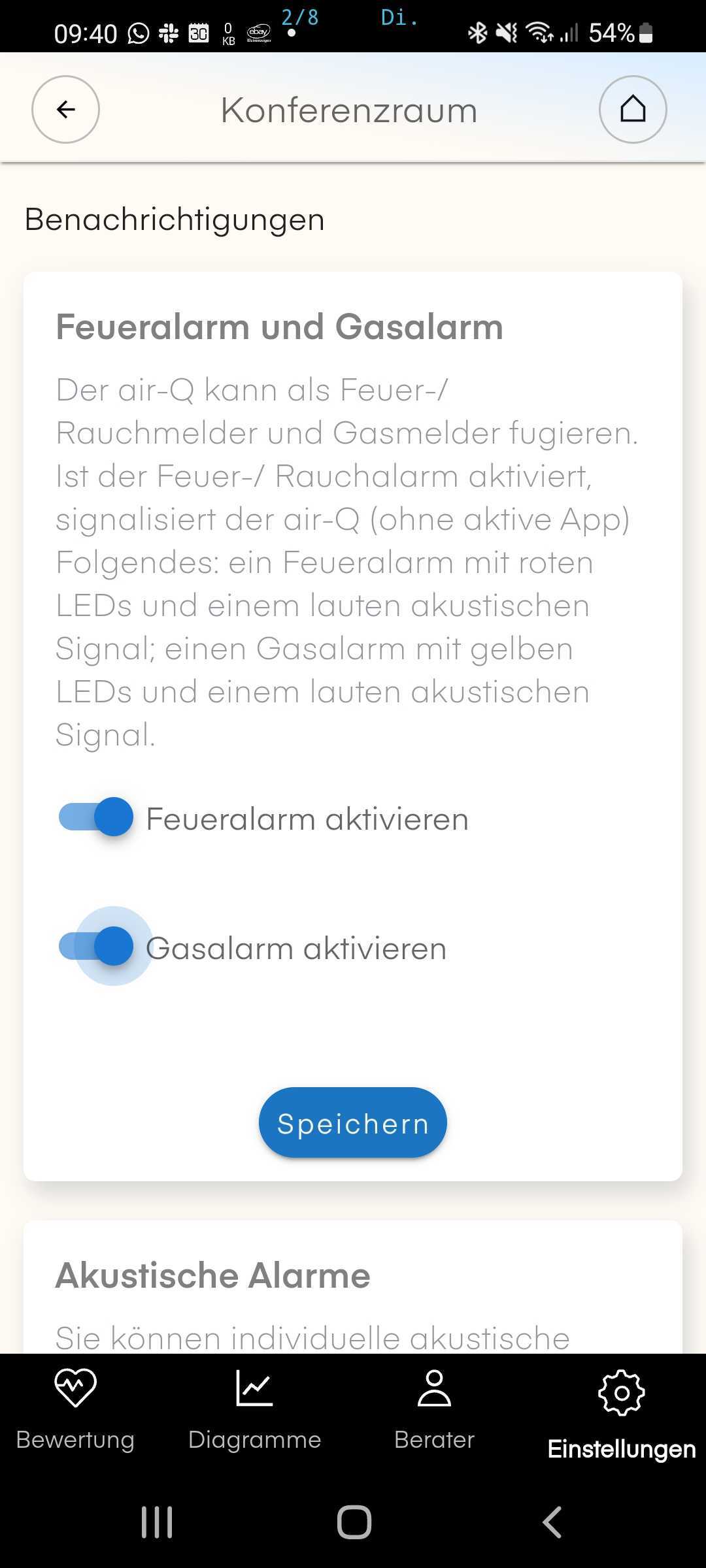
If the gas alarm function in the air-Q is activated via the app, the air-Q automatically sounds an alarm at critical levels of carbon monoxide, smoke (particulate matter), and nitrogen dioxide. A warning tone and light signals sound. You can also set up a push notification for your smartphone, so you're informed even while out and about of a rise in dangerous gases in your home and can act accordingly.
To detect methane, you need at least the air-Q Pro gas detector. This uses a "trick" to reliably detect methane. The built-in oxygen sensor sounds an alarm when the oxygen level drops below 20%. Under normal circumstances, this never happens. The only possible cause of such a marked drop in room air's oxygen share is other gases displacing the oxygen — such as methane or propane.
For our more ambitious customers who want even better protection and finer-grained analysis, an air-Q with a methane sensor is worth considering: like the air-Q Science Methane model. This sensor can specifically measure methane and detects even the smallest gas leaks very early — long before the explosive limit is reached and it becomes dangerous for you and your family.